How AI Is Quietly Solving the Accounting Problem for One-Person Companies
Running a one-person business is empowering. You control your schedule, choose your clients, and build something that's truly yours. But that freedom comes with a less glamorous reality: you are also the finance department.
For many solo founders and small business owners, accounting is not hard because it's complicated—it's hard because it's constant. Income arrives unevenly. Expenses show up in small, forgettable amounts. Tax season always feels closer than expected. Traditional accounting software often assumes you have time, training, and a bookkeeper. Most one-person businesses have none of those.
This is where AI is quietly changing the game—not by turning business owners into accountants, but by reducing friction in everyday financial decisions and making basic financial discipline sustainable.
Two Simple Personas
To keep things grounded, let's look at two common one-person businesses.
Imagine a freelance graphic designer who works project to project. They invoice clients monthly and manage digital expenses like Adobe, stock images, and hardware. Their income is uneven, and their expenses are mostly virtual.
On the other hand, consider a solo moving or cleaning business owner. They often find customers through platforms like Thumbtack and deal with physical costs like gas, equipment maintenance, and insurance. Their income is more physical and expense-heavy.
While these businesses look different, they share the same accounting problem: the need to track money accurately without spending hours doing it.
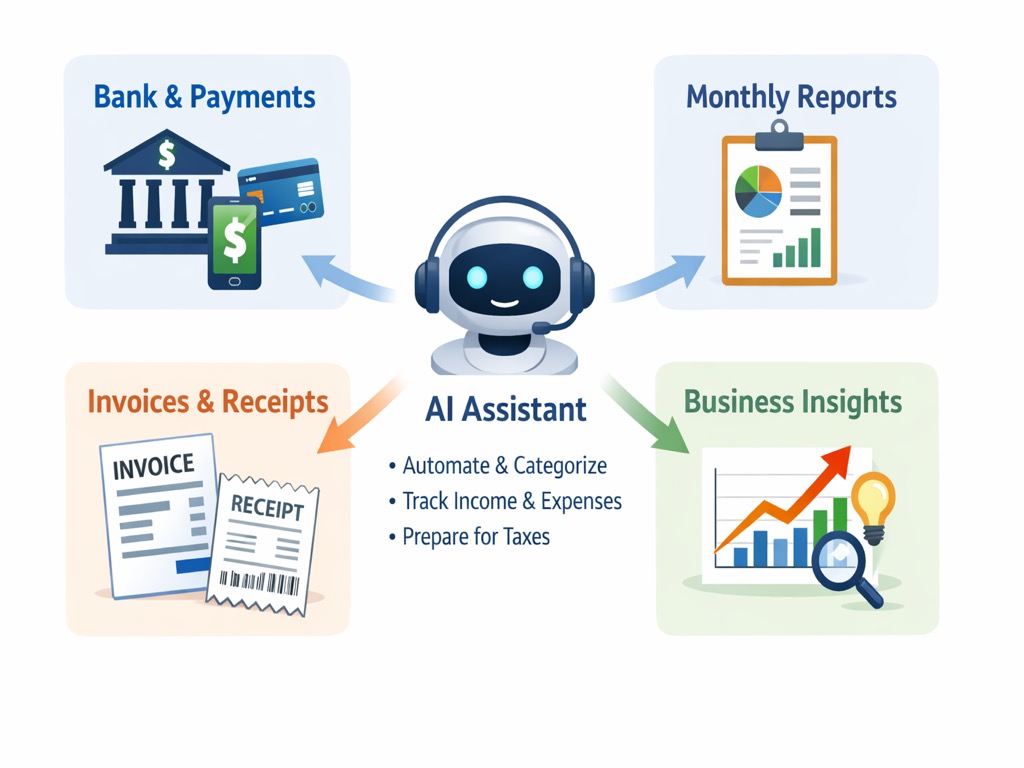
1. Start With Separation: Bank Accounts and Payments
Before any accounting happens, personal and business money must be clearly separated. This is not just good practice—it makes everything else possible. A dedicated business bank account creates a single source of truth.
Even without direct bank integrations, AI tools can now read uploaded statements or exported transaction files. Think of it as a digital clerk: it reviews your bank statement, recognizes recurring vendors, and identifies the overall pattern of your monthly cash flow—without requiring you to type rows into a spreadsheet.
2. Track Money While It's Fresh
Most accounting stress comes from delay. When income and expenses pile up and get reviewed only at tax time, everything feels overwhelming.
AI helps by supporting continuous, lightweight tracking. Rather than forcing you to learn accounting rules, it relies on two key capabilities to bridge the gap.
First, Optical Character Recognition allows AI to read a photo of a receipt and pull out the date and total instantly. Second, language models understand that "Adobe" is a software subscription while "Chevron" is a fuel expense. The AI suggests a category, and you simply confirm it.
The goal is not perfection; it is momentum. It's better to have 90% of your transactions categorized today than 0% categorized while waiting for a "perfect" afternoon that never comes.
3. Invoicing as the Core Accounting Transaction
Invoicing is more than requesting payment—it represents a completed unit of work.
From an accounting perspective, one invoice represents a job completed, an income event, and a reference point for any expenses tied to that specific work.
AI-assisted invoicing helps solo business owners generate professional invoices and connect income to related expenses automatically. This matters especially for businesses using marketplaces like Thumbtack. These platforms are great for finding customers, but they are not accounting systems.
A proper invoice builds trust with your client and creates a reliable financial record for your business.
4. Make Tax Readiness a Byproduct
Tax preparation should not begin in April. When income and expenses are tracked consistently, tax readiness becomes a natural side effect—not a separate project.
The Safety Net
One of the biggest fears for solo founders is "doing it wrong." AI tools are designed to be forgiving. They allow you to re-categorize transactions at any time and keep a clear digital paper trail for your accountant.
You aren't painting on a canvas; you're building with Legos. If a piece is in the wrong spot, you can move it later. By the time tax season arrives, the numbers are already aligned, and the stress is significantly lower.
5. Monthly Reports: Understanding the Business
One of the most overlooked benefits of AI-assisted accounting is the monthly report.
A monthly report is not about compliance; it is about understanding what is actually happening in your business. AI can compare months and surface trends you might otherwise miss—such as a designer noticing subscription costs slowly creeping up or a moving professional seeing fuel expenses rise faster than revenue.
These insights support real decisions, like adjusting rates, rethinking pricing, or changing how work is structured.
Keeping It Sustainable
Accounting for a one-person company does not need to be complex, expensive, or intimidating. It needs to be consistent, understandable, and forgiving of human limits.
For people willing to take ownership of their work and decisions, AI removes unnecessary friction. It does not eliminate responsibility—but it makes clarity easier to maintain.
When accounting works quietly in the background, the one-person company becomes not just possible, but sustainable—and scalable on the owner's own terms.