The $9.40 Phone Call: Why Taking an Order Costs More Than You Think
It costs $9.40 to take a single order by phone in the food distribution industry. That is more than a fast-food worker earns in an hour. And yet, across 25,000 independent distributors responsible for moving two-thirds of everything America eats, the phone call remains the default.
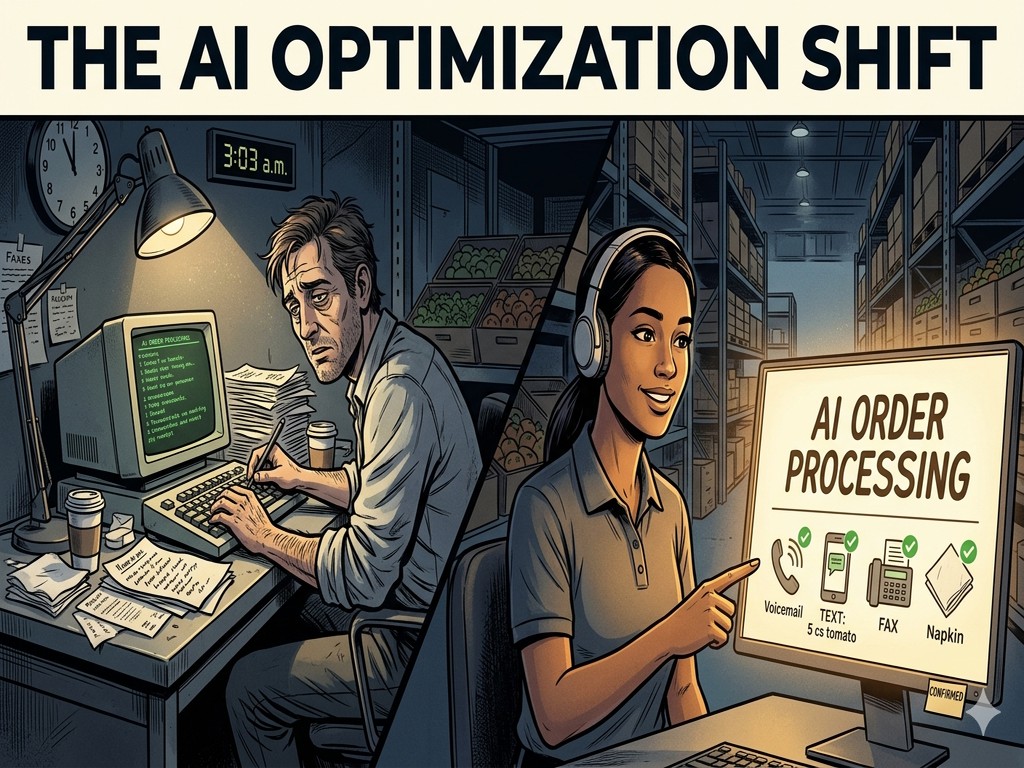
Not because anyone thinks it is a good system. Because nobody had a better one that actually worked with the chaos of how restaurants order — a voicemail at midnight, a text with shorthand only the rep understands, a fax from a machine that should have been retired a decade ago, and occasionally a handwritten note on a napkin.
That is starting to change. The gap between a manually processed order and an AI-assisted one has widened to the point where ignoring it is no longer a matter of preference. It is a matter of math.
3 a.m. and Nobody Is Selling
At a Boston-based seafood distributor pulling in roughly $150 million a year, sales reps were starting their shifts at 3 a.m. Not to negotiate deals or build relationships with restaurant buyers. To type. Nearly 40 percent of their day went to re-keying orders that had arrived overnight through a mess of channels — phone, text, fax, email, and yes, handwritten notes.
Anchr, a startup that raised $5.8 million through a16z's Speedrun cohort in March 2026, built its pitch around giving that 40 percent back. The company's AI ingests orders from whatever format they arrive in and drops them into the distributor's system without a human touching a keyboard.
The striking part is not that the technology exists. It is that a company doing $150 million in revenue was still running on handwritten notes in 2026. And that is not an outlier. According to industry analysts, it is closer to the median.
The Apology Call
The $9.40 cost of a manual order hides a detail most people miss. Confinus, a food distribution consultancy, broke the number down and found that $2.10 of it — nearly a quarter — goes not to taking the order, but to fixing it afterward. The industry's manual error rate sits around 6 percent. For every 100 orders, six trigger a chain reaction: a confirmation call, a credit issued, a redelivery scheduled, a relationship strained.
Choco, a Berlin-founded company now operating across Europe and the U.S., attacks this with a product called Autopilot. It pulls orders from email, voicemail, SMS, WhatsApp, and even scanned PDFs, then normalizes them against the distributor's catalog. The company claims 99.5 percent accuracy before a human ever looks at the result.
In an industry where net margins hover around 3 percent, the difference between a 6 percent error rate and a 0.5 percent one is not an efficiency improvement. It is the difference between staying open and closing.
The 170-Year-Old That Moved First
The biggest early winner in AI-powered food distribution is not a startup. It is US Foods, a broadline giant founded in 1853. The company built an Automated Order Guide using Amazon Bedrock's generative AI and recaptured over 32,000 hours of manual work from its sales force. That is roughly 16 full-time employees' worth of time that had been spent assembling proposals and personalizing pitches — work that is now handled in seconds.
The freed-up reps are not being laid off. They are selling. Which, for a company in a low-margin, high-volume business, is exactly where the leverage is.
Meanwhile, Pepper — a platform now serving more than 500 distributors representing $30 billion in gross merchandise volume — acquired Y Combinator-backed Alima to push AI-powered catalog management into Latin America. The signal is clear: this is not a Silicon Valley experiment. It is a global operational shift.
The 12-Minute Problem
Matterhaul, another player in the space, estimates that manual order entry takes about 12 minutes per order on average. Their AI cuts that by 70 percent. REKKI Connect users reported a 90 percent reduction in order-processing time over a six-month trial.
Those numbers matter less as abstractions and more as competitive pressure. When one distributor can process an order in under two minutes with near-zero errors, and the one across town still takes 12 minutes and gets one in 17 wrong, the restaurant owner notices. Maybe not the first time. But eventually.
The 12-minute order is becoming what the $12 taxi ride was before Uber — a price that feels normal right up until someone shows you the alternative. After that, there is no going back.
Who Feels It First
The distributors most exposed are not the smallest ones. The smallest often survive on personal relationships and hyper-local knowledge that no algorithm can replicate. The most vulnerable are the mid-size operators — big enough to have hundreds of daily orders, small enough that 40 hours a week of manual entry is a real percentage of their labor cost.
For them, the $9.40 phone call is not a line item. It is a slow leak. And the companies plugging it — Anchr, Choco, Pepper, REKKI, Matterhaul — are not selling software. They are selling back the hours that were never supposed to be spent typing in the first place.