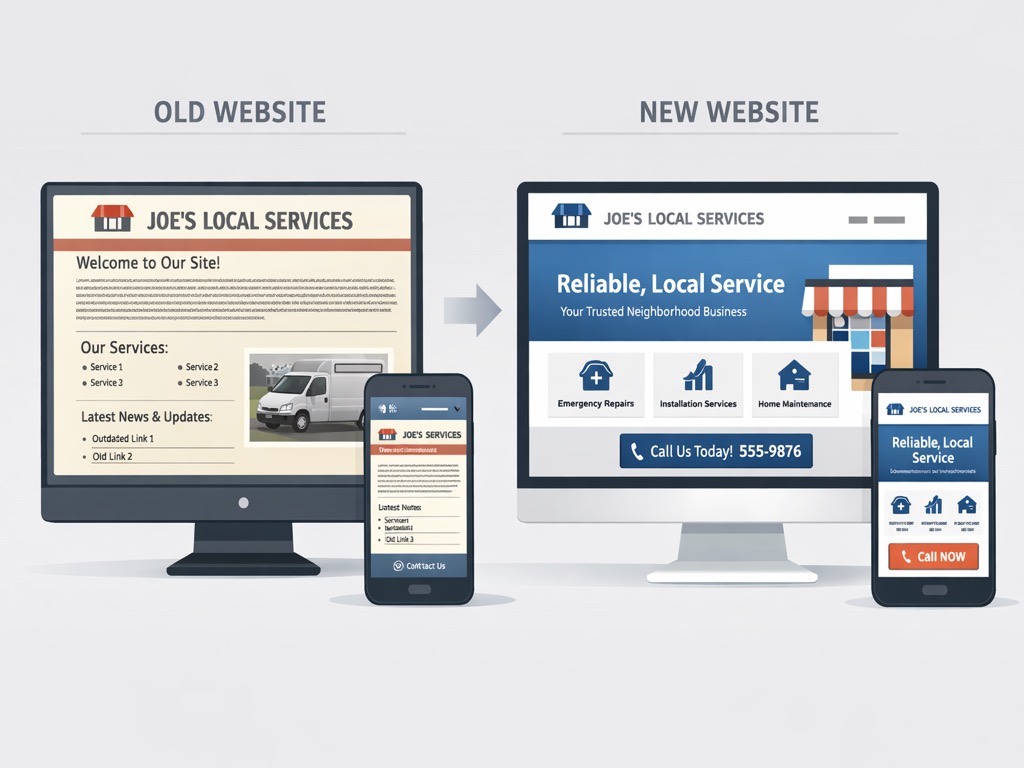
Updating an Old Small Business Website With AI
Many small businesses have a website that has quietly turned into a digital junk drawer. It was built years ago, works poorly on a phone, and feels risky to touch because no one remembers how it was made. Updating a phone number, changing hours, or adding a new service often means calling a developer and hoping they are still available.
The frustrating part is that the business itself may be doing just fine. Customers are calling, jobs are getting done, and trust is being built in the real world. But the website tells a different story—one that feels outdated, neglected, or even abandoned.
For years, fixing this problem meant choosing between two bad options: paying a large agency fee or struggling through do-it-yourself tools that required far more technical effort than advertised. AI-powered website creation has quietly removed that dilemma. Not by replacing humans or adding flashy features, but by making it possible to rebuild a clean, functional website quickly, clearly, and at a much lower cost.
Why an Outdated Website Quietly Costs You Business
An old website creates friction long before a customer ever contacts you. Pages load slowly, text is difficult to read on a phone, and navigation feels awkward or confusing. When basic information is hard to find, many visitors simply leave.
Imagine a local plumbing company called Riverside Plumbing. They have been in business for fifteen years and have a strong reputation among long-time customers. Their website, however, was built in 2014. On a smartphone, the text appears tiny, the menu does not resize properly, and the services page still lists a fax number. There is no click-to-call button, even though most customers are searching from their phones.
To a new resident in town, Riverside Plumbing looks uncertain at best. Even if they are the most reliable plumber in the county, their website suggests they might no longer be active. In cases like this, the hidden cost of an outdated site is often higher than the cost of updating it. Customers don't complain—they simply choose a competitor whose website feels more current.
How AI Removes the "Blank Page" Problem
Traditional website building starts with a blank screen and dozens of decisions. Fonts, colors, layouts, spacing, and structure all have to be chosen before anything feels real. For many business owners, this is where progress stops.
AI-powered website tools start from a different place. Instead of asking technical or design questions, they ask for context. What is the business called? Where is it located? What services does it offer? Who is it for?
For Riverside Plumbing, an AI system can take that information and immediately generate a site structure that makes sense: a clear home page, service sections for emergency repairs and installations, a contact area optimized for mobile use, and simple language that matches how customers actually search. The owner is no longer trying to design a website. They are reviewing and adjusting something concrete.
This shift matters. AI turns the business owner from a designer into an editor. Editing is familiar. It feels manageable. Instead of wondering what should exist, the owner decides what to keep, what to change, and what to remove.
Modern Website Builders Designed for Non-Technical Owners
Several platforms now use AI specifically to help small businesses create or rebuild websites without requiring technical knowledge. These tools are not aimed at startups or large companies. They are built for owners who want a modern website that works and can be maintained independently.
Wix's AI website builder offers more flexibility and polish while still guiding users through the process. It works well for businesses that want built-in features such as appointment scheduling or contact forms without adding complexity.
Durable focuses on speed and simplicity. A business owner can answer a few questions and receive a complete website in minutes. This is especially useful for owners who need something functional right away and do not want to make design decisions.
For businesses already using WordPress, 10Web uses AI to recreate an existing site with better performance and a modern layout. This allows owners to keep their content while improving speed, structure, and mobile usability.
Framer AI is often chosen by businesses where visual presentation matters more, such as boutiques or creative studios. It uses AI-generated layouts that can be adjusted visually without writing code.
What all of these tools share is cost and accessibility. Instead of large one-time redesign fees, they typically use manageable subscriptions that include hosting, security, and updates. For many small businesses, this makes keeping a website current financially realistic.
Rebuilding What You Have Instead of Starting Over
The most practical use of AI in website creation is rebuilding, not reinventing. Most small business owners already know what they offer, where they operate, and how customers contact them. The problem is not missing information—it is outdated presentation.
AI tools allow owners to reuse existing content and ask for improvements. Text from an old website can be rewritten for clarity, shortened for mobile screens, or reorganized so the most important information appears first. Images can be resized and placed into modern layouts without manual formatting.
For Riverside Plumbing, this might mean moving their 24-hour emergency service to the top of the page, adding a clear call button, and simplifying long paragraphs written years ago. The business stays the same, but the website finally reflects how it operates today.
This approach respects the reality of small business ownership. Time is limited, attention is divided, and the website should support the business—not consume it.
What AI Website Tools Are—and Are Not—Good At
AI-powered website builders are very good at handling the fundamentals. They create responsive layouts, organize information logically, and reduce technical friction. They allow owners to make updates without fear of breaking the site.
They are not meant to replace deep branding work, custom software, or complex integrations. Businesses that require advanced systems or highly specialized design may still need professional teams.
For most local and service-based businesses, however, the website is not the product. It is a reference point. In that role, AI tools are often exactly what is needed.
Putting the Business Owner Back in Control
The greatest benefit of AI-assisted website creation is not speed or cost. It is independence.
When owners understand how their website is built and feel comfortable making changes, the site becomes a living part of the business instead of a frozen artifact. Updating hours, adding a new service, or posting a recent project no longer feels intimidating.
Six months after rebuilding their site, Riverside Plumbing is no longer delaying updates. When something changes, they log in, make the edit, and move on with their day. The website supports the business instead of slowing it down.
AI does not replace judgment or experience. It lowers the barrier to participation. It allows small business owners to present their work online with the same confidence they bring to customers in person.
For many businesses, that shift is not just convenient. It is transformative.