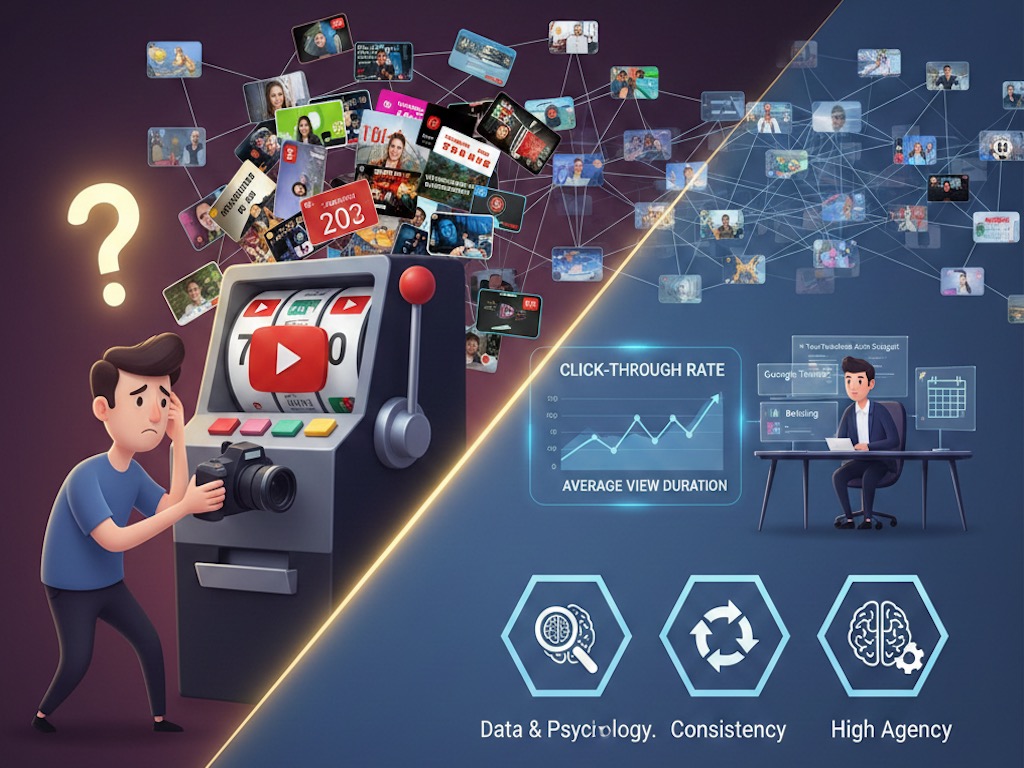
How to Become a Successful YouTuber: A System, Not a Lottery
In 2026, YouTube is no longer a creative lottery. It is a performance engine driven by data, psychology, and consistency. The creators who win are not necessarily the most talented or charismatic. They are the most systematic.
Success on YouTube today is less about going viral and more about building repeatable systems that compound over time. If you approach it casually, it will exhaust you. If you approach it strategically, it can become one of the most powerful personal media assets you will ever build.
This is not a motivational speech. It is a blueprint.
Research: Stop Guessing and Start Listening
Most new creators fail before they upload their tenth video because they create what they want to say instead of what people are already searching for. YouTube is a search engine and a recommendation engine. If you ignore that, you are working against the platform.
Start with macro research. Google Trends remains one of the most underrated tools. Switch the filter from Web Search to YouTube Search and study breakout topics in your niche. When you see a term growing rapidly, especially one marked as "Breakout," you are witnessing early demand. Early demand is opportunity. If something is spiking in your category, you do not wait six months. You create now.
Then move to micro research inside YouTube itself. The auto-suggest feature is pure market intelligence. When you type a phrase and YouTube suggests longer variations, those are not random. They represent real searches from real people. Long-tail phrases often convert better because they reflect specific intent. When competition is high, specificity is your advantage.
Finally, study your competitors strategically. Go to channels in your niche and sort their videos by most popular. Do not copy them. Instead, reverse-engineer the problem they solved. Why did viewers click? What tension did the title create? What result did the thumbnail promise? Your job is not to imitate but to improve, update, or specialize.
Research is not about chasing trends blindly. It is about aligning your creativity with real demand.
Technical SEO: How the Algorithm Understands You
Many creators assume the algorithm "watches" their video first. It does not. Before distribution happens, YouTube analyzes metadata to determine initial testing audiences.
Titles must be concise and clear. Placing the primary keyword near the beginning helps contextual relevance. Thumbnails must communicate contrast and curiosity within half a second. High-contrast colors, strong facial emotion, or a clear visual transformation often outperform cluttered designs. Your goal is not decoration. It is clarity.
Descriptions still matter, especially the first two lines. Those lines influence both YouTube and Google search results. Write naturally, but deliberately. Think like someone trying to find your video.
Chapters are another overlooked advantage. Proper timestamps allow YouTube to surface "Key Moments" in search results. That increases discoverability and perceived authority.
However, metadata only earns you the click. It does not earn you growth.
Content Quality: Retention Is the Real Currency
YouTube does not rank videos. It ranks viewer satisfaction. If people click and leave quickly, distribution slows. If they stay, watch, and continue to another video, distribution expands.
Strong videos follow a psychological structure. The first fifteen seconds must clearly promise a result. Viewers decide almost instantly whether to invest their time. If you start with a long logo animation or vague introduction, you lose momentum before the video even begins.
After the hook, you need pattern interrupts. Visual changes, subtle edits, shifts in pacing, or B-roll maintain attention. Human brains are wired to notice change. Static delivery reduces retention.
Open loops also increase watch time. When you hint that something valuable will be revealed later, viewers subconsciously stay to close that loop. But this must be ethical. The payoff must match the promise. If you exaggerate and underdeliver, you destroy trust.
In 2026, the growth formula can be simplified to this: Click-through rate multiplied by retention multiplied by impressions. High click-through without retention fails. High retention without clicks never scales. Both must work together.
Metrics: Understanding the Health of Your Channel
Creators often obsess over subscriber counts, but subscribers are a lagging indicator. Focus instead on leading indicators.
Click-through rate tells you whether your packaging is working. If it consistently falls below healthy benchmarks, your title and thumbnail need refinement. Small adjustments can dramatically change performance.
Average view duration reveals whether your content structure holds attention. If viewers leave early, your hook is weak or your pacing is slow. Cut unnecessary intros. Start with the outcome. Respect your viewer's time.
Impressions represent YouTube's willingness to test your content with broader audiences. If impressions rise, the platform sees potential. If they stall, something in the click or retention loop needs improvement.
Treat analytics as feedback, not as an emotional scoreboard. Checking it obsessively does not improve performance. Iteration does.
Systems Over Motivation
Motivation fades. Systems endure.
Most creators burn out because they operate on inspiration rather than structure. They film, edit, and publish randomly, which turns content creation into chaos.
Batching reduces mental friction. Research and scripting on one day. Recording multiple videos in one session. Editing on dedicated days. When tasks are grouped, energy is conserved.
Improvement should also be incremental. Instead of trying to create a masterpiece every time, aim to make each video slightly better than the last. Better lighting. Clearer audio. Sharper storytelling. These small improvements compound faster than dramatic reinventions.
Equally important is protecting your mental bandwidth. Analytics can become addictive. If you refresh your dashboard constantly, you are training anxiety, not skill. Set defined times to review performance. Outside those windows, focus on creating.
Your mental health is the engine of your channel. If the engine fails, growth stops.
The Compounding Strategy
Eventually, one video will outperform your average. When that happens, do not celebrate and move on. Study it.
Look at the search terms driving traffic. Identify what viewers were specifically looking for. Then create a follow-up video that expands that exact topic. Use the proven search term strategically in your next title. Build a sequence.
When videos connect thematically and strategically, you create compounding momentum. Instead of isolated uploads, you build content ecosystems. The algorithm recognizes this consistency. So do viewers.
This is how small channels become authority hubs.
YouTube as a Long-Term Asset
If you approach YouTube as a hobby, it will behave like one. If you approach it as a media company, it becomes an asset.
Your audience is distribution. Your content is intellectual property. Your analytics are a feedback loop. Your consistency is your moat.
The creators who succeed in 2026 are not chasing virality. They are building systems that turn effort into leverage. They are thinking in years, not weeks.
YouTube is not easy. But it is fair. The platform rewards clarity, value, and consistency over time.
Luck fades. Systems compound.
If you build the system, the growth follows.