The Human Glue: Why Small Businesses Don't Need More Tools, They Need Better Ones
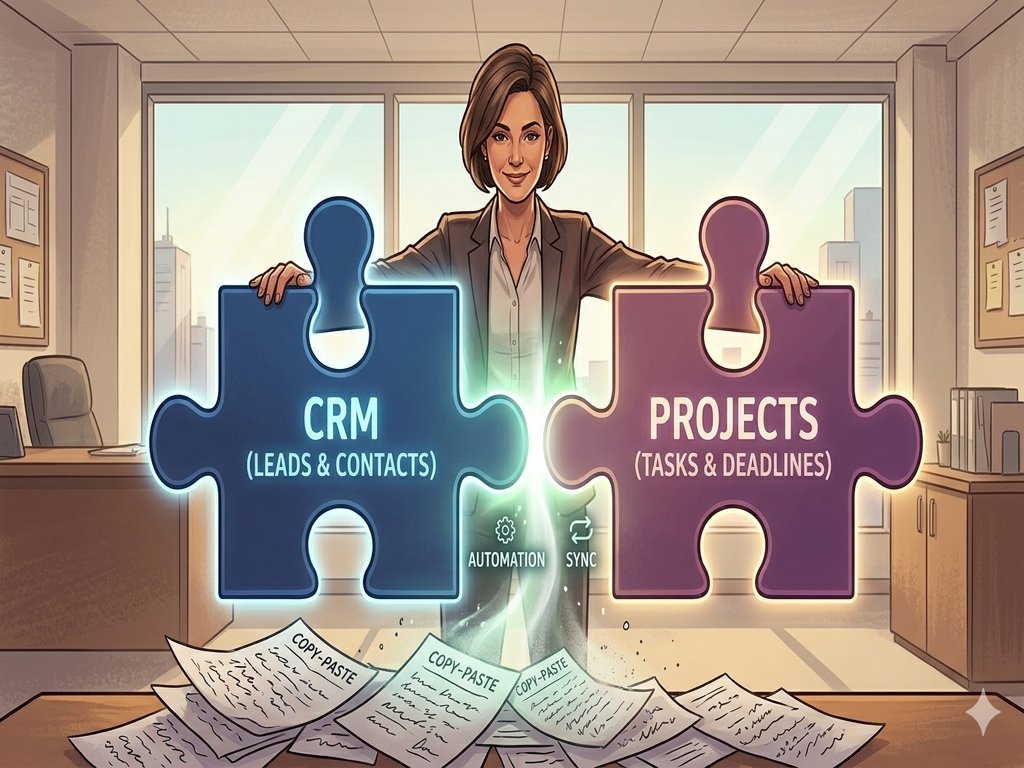
Most small businesses run their customer relationships in one tool and their project work in another. The CRM tracks leads and deals, while the project tracker handles tasks and deadlines. Somewhere in the middle, a person is manually copying information from one system into the other.
It doesn't feel like a crisis because it happens in small doses. It's five minutes to re-enter a client's address, ten minutes to update a project status, and another five to send a follow-up email that should have gone out automatically. But for a solo operator or a small team, those doses add up to six hours a week. That is over 250 hours a year spent on data entry that produces absolutely nothing.
Two Tools and the Structural Problem
The lost time is only half the story. When customer data lives in one place and project data lives in another, things inevitably fall through the cracks. A client's specific request gets lost between systems. A follow-up never goes out because the project tracker doesn't know the deliverable has already shipped. You end up checking two different dashboards, cross-referencing dates, and still missing the small details that keep a customer happy.
This isn't a failure of discipline or a lack of focus. It is a structural problem. The tools weren't built to work together, so they don't. In this scenario, the business owner becomes the "human glue" holding disparate systems together. It is an exhausting way to work, and it's a bottleneck that prevents a business from ever truly scaling.
Moving to a Single Workspace
Modern tools like ClickUp and Routine are starting to fix this by blending CRM and project management into a single, unified workspace. The shift is simple: when a deal closes, the project spins up automatically with tasks, deadlines, and context already attached. There is no re-entry and no copy-pasting. The client record and the project plan are essentially the same thing, just viewed from different angles.
This approach isn't about buying more software. In fact, most small businesses already have too many subscriptions. It is about replacing two half-solutions with one that actually connects the dots. When the system handles the transition from "lead" to "project," the owner is freed up to do the actual work they were hired for.
Putting AI at the Front Door
One of the simplest and most immediate wins in this new setup is connecting an AI chatbot to your unified system. Tools like Manychat or Zendesk AI can handle the first conversation with a potential client at any hour of the day. They can answer common questions, qualify the lead based on your criteria, and even book a call—logging every single detail directly into your workspace.
Imagine a lead messages your website at 10 PM on a Tuesday. By Wednesday morning, you wake up to a qualified prospect with a meeting already on your calendar. This isn't a futuristic hypothetical; it is what these tools do out of the box right now. The only catch is that the chatbot and the CRM must share the same brain. A chatbot that doesn't feed into your system is just a fancy FAQ page that leaves you with more manual work to do later.
Seeing What You Have Been Missing
Once your customer data and project data live in the same house, you start noticing patterns that were previously invisible. You can finally see which types of projects are actually your most profitable, or which clients tend to disappear after the first engagement. You can spot which proposals sit in "pending" for weeks and identify why they never close.
You simply can't answer those questions when your information is scattered across three browser tabs and a stray spreadsheet. AI doesn't give you a crystal ball, but when it has access to the full picture, it can surface what the data has been trying to tell you all along. You stop reacting to whoever is shouting the loudest and start making decisions based on the reality of your business.
The Point of Integration
Small businesses don't need more tools; they need the ones they already have to stop working against each other. When your CRM and your project tracker share the same brain, and AI handles the repetitive work at the edges, you get something that used to require a team of five people: a business that actually knows what is going on.
The goal of "AI for Everyone" is to remove the "human glue" role from the business owner's job description. By automating the noise and connecting the systems, you can finally move your focus away from the dashboard and back toward the growth of the business itself.