You Bought a Gym Membership for Your Business — Why Your AI Tools Are Gathering Dust
There is a moment, usually around March, when you realize you have not been to the gym since January 8th. The membership is still charging. The shoes are still by the door. You meant to go. You really did. But something always came up, and now the only thing getting a workout is your credit card.
That is exactly what is happening with AI tools in small businesses right now. Owners are signing up, swiping the card, and then watching the software sit there like a treadmill with a coat draped over it. The tools work. The problem is that nobody budgeted for the part that actually matters — learning to use them.
The Price Tag You Didn't See
When a small business owner signs up for an AI tool at $200 a month, that number feels manageable. Maybe even cheap. A nice lunch for two. But according to a cost analysis by Rotate.cc, the subscription itself accounts for only 15 to 20 percent of the true cost of adopting AI.
The rest is the part nobody mentions at the sales demo. Data cleanup alone eats 40 to 60 percent of the total budget — because your customer list has three different spellings of "Johnson" and your inventory spreadsheet was last updated by someone who quit in 2024. Then there is integration, training, and security. Add it all up and a 10-person company should realistically expect to spend $10,000 to $30,000 to get a single AI tool properly working inside their business.
That is not a typo. Ten to thirty thousand dollars — for the tool that costs $200 a month.
Most owners never hear that number. They see the monthly fee, compare it to their Spotify subscription, and figure they are getting a deal. Six months later, the tool is still on the home screen and nobody has opened it since the Tuesday after the free trial started.
The Silent Walkout
Here is the part that should worry business owners more than the wasted subscription: their employees already made a decision about the tool. They just did not announce it.
WalkMe's 2026 State of Digital Adoption report surveyed 3,750 executives and workers and found that 77 percent of employees abandoned their company's AI tools in the previous month. Not last year. Last month. They did not file a complaint or send a memo. They just quietly went back to doing things the old way — the spreadsheet with the color-coded tabs, the sticky note on the monitor, whatever worked before the boss came back from a conference excited about ChatGPT.
Forbes contributor Sandy Carter described it as a silent revolt. Leadership buys the tool, sends a company-wide email with three exclamation marks, and then never checks whether anyone actually logs in. Meanwhile, the team routes around it like water around a rock. The new AI scheduling tool sits untouched while everyone keeps texting each other "you free at 2?"
The cost of that friction is not abstract. WalkMe's data shows enterprises now lose 51 workdays per employee per year to technology confusion — up from 36 days in 2025. The tools that were supposed to save time are actively eating it, because nobody spent the time to make them make sense.
Twelve Remote Controls on the Coffee Table
There is a specific kind of frustration that comes from having too many remote controls. You pick one up, press power, and the wrong screen turns on. You try another and the sound bar starts playing a podcast from last Tuesday. Eventually you just walk over and press the button on the TV itself.
That is what AI tool sprawl looks like inside a small business. It starts innocently. You sign up for an AI writing assistant to help with marketing emails. Then someone on the team finds a different one they like better for social media. Then you add a chatbot for customer service, and a scheduling tool, and an AI that summarizes your meetings. Before long there are five or six subscriptions that each do about 60 percent of the same thing, nobody remembers which login goes to which tool, and the monthly total has quietly climbed past $2,000.
Forbes contributor Terdawn DeBoe calls this "AI Agent Sprawl," and it is spreading fast. The U.S. Chamber of Commerce found that 58 percent of small businesses now use some form of AI — more than double the number from 2023. Growth that fast does not come with careful planning. It comes with a lot of free trials that auto-renewed and a second project management app because someone on the team did not like the first one.
Marshall Tech's audit guide for small businesses suggests a simple exercise: pull your credit card statements and accounting data and list every software subscription you are paying for. Most companies discover 20 to 40 percent more active subscriptions than they thought they had. Digital Applied estimates that consolidating the redundant ones alone can cut spend by 25 to 40 percent.
That is not a technology problem. That is a Saturday-morning-with-a-highlighter problem.
The 40 Percent You Are Already Paying For
Here is the number that should change how you think about your next AI purchase: according to Zapier's 2026 automation report, the average small business uses just 40 percent of the features in the AI tools it already pays for.
Think about that. More than half of what you are buying is sitting untouched. Not because it is bad. Not because it does not apply to your business. But because nobody ever clicked past the first screen. The tool can generate invoices, forecast inventory, and draft follow-up emails — but you are only using it to check your calendar.
A Goldman Sachs survey of 1,256 small business operators found that 75 percent use AI in some form. Fortune reports that only 14 percent have meaningfully embedded it across their core operations. That gap — between "I have it" and "I use it" — is where an estimated $3,000 a month in wasted software spend lives, according to an Intuit QuickBooks survey. Over a year, that is $36,000. Enough to hire a part-time employee. Enough to fund a real marketing push. Enough, ironically, to pay someone to actually set up the tools properly.
The Tuesday Afternoon That Pays for Itself
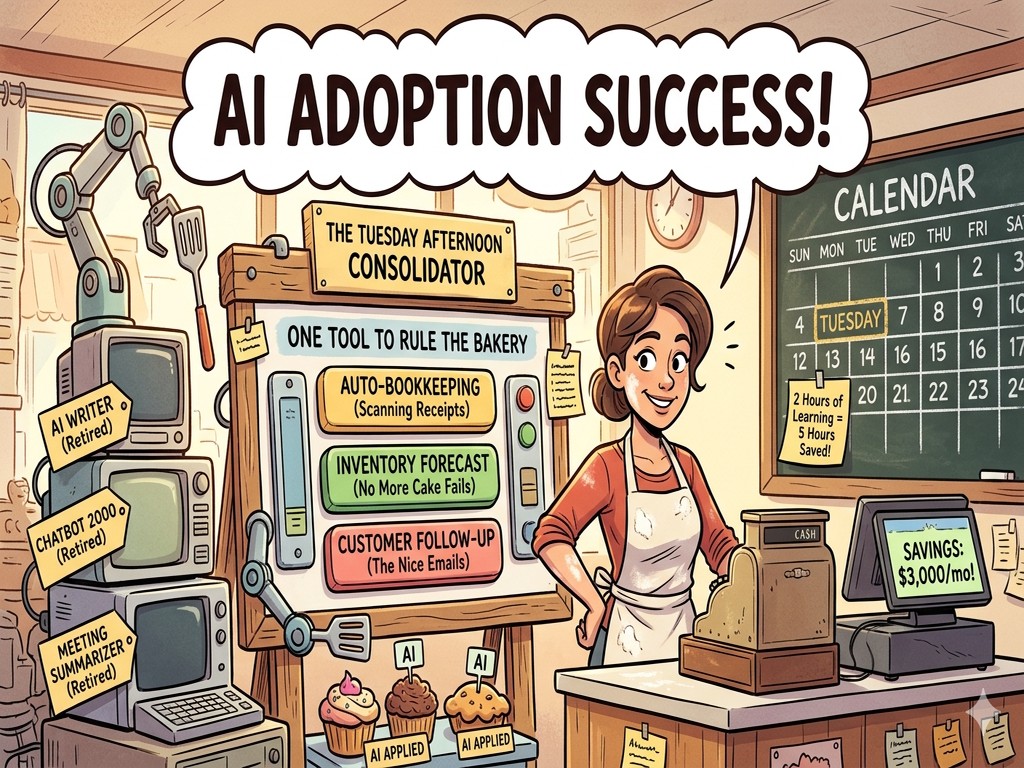
A bakery owner in the Midwest signed up for an AI bookkeeping tool in January. By April, she was still entering receipts by hand every night after closing. The tool could have done it automatically — it had a receipt-scanning feature, an expense categorizer, and a weekly cash flow summary built in. She had never opened any of them. When she finally sat down one Tuesday afternoon and spent two hours clicking through the settings, she found that the tool could save her about five hours a week. Five hours she had been spending at the kitchen table after her kids went to bed.
That is the pattern. The businesses getting real value from AI are not the ones with the biggest budgets or the most subscriptions. They are the ones that treated adoption like a project instead of a purchase. They blocked a specific afternoon, sat with the tool, clicked through the features nobody had looked at, and figured out which two or three things would save the most time that week. They picked one tool and went deep instead of spreading across five and going nowhere. They asked the team what was actually slowing them down before buying something new to speed them up.
The highest-leverage move most small businesses can make right now is not signing up for another AI product. It is opening the one they bought in January — the one still sitting on the home screen like a gym membership in March — and finally giving it the afternoon it deserves.