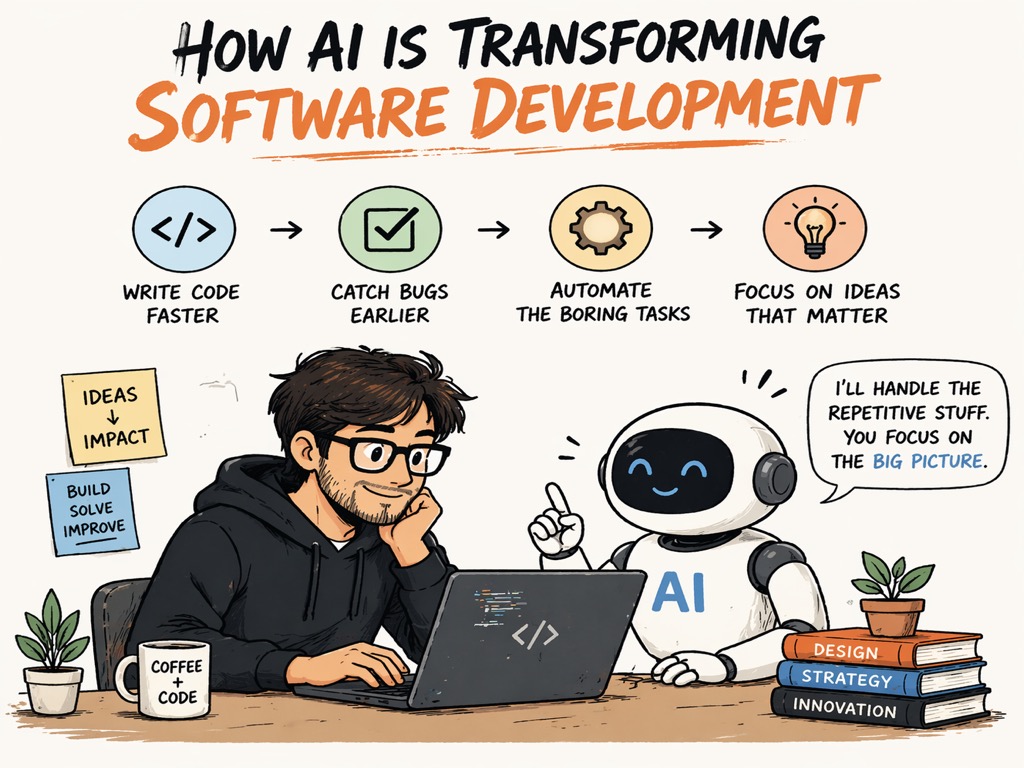
How AI is Transforming Software Development
Software development is all around us, powering the apps on our phones, the websites we visit, and the systems that run banks, hospitals, and utilities. At its core, software development is about turning ideas into programs that solve real problems efficiently and reliably. Achieving this is far from simple. Programs must perform their intended functions, run consistently without errors, be maintainable over time, and work well for real users. Modern software is massive and complex, often containing millions of lines of code. Developers must understand patterns and structures while avoiding mistakes that could create bugs or security vulnerabilities. Many tasks, such as writing repetitive code, creating tests, or documenting features, require tedious effort, and humans cannot remember or track every detail simultaneously, making development slow and prone to errors.
Why AI is Particularly Well-Suited for Software
AI is naturally equipped to handle these challenges because software is structured and precise. Unlike human language, code either works or it doesn't, which allows AI to reason about patterns and logic consistently. Programs often include descriptive names and comments that provide clues about their purpose, while modular structures separate the software into clear, manageable components. Many development patterns are predictable, making it easier for AI to understand the purpose of each part and integrate new features correctly. Beyond generating code, AI can assist engineers in strategic decisions, helping evaluate trade-offs, suggesting optimizations, and guiding the overall design of software systems. Its ability to process vast amounts of information in minutes, which would take humans weeks or months, allows it to detect potential issues, understand system dependencies, and propose improvements quickly.
The Progressive Impact of AI on Software Development
AI's influence on software development unfolds gradually. Initially, it acts as a productivity booster, generating code, automating repetitive tasks, and reducing errors, while humans review and refine its output to ensure quality.
The next stage is self-development and modular testing. AI can generate and test smaller software components independently, verify that each part functions correctly, and ensure best practices are followed. This reduces routine work for humans and accelerates development.
Following that, AI can support production and debugging. By leveraging knowledge of the project and historical information, AI can help identify issues in real-time, suggest fixes, detect side effects, and recommend improvements. Human engineers, freed from repetitive problem-solving, can focus on critical and creative decisions.
Eventually, AI develops a holistic understanding of entire software systems, including architecture, modules, and workflows. This enables rapid prototyping, internal demonstrations, and continuous adaptation based on feedback. By combining project-specific knowledge with its broader understanding of software, AI becomes a continuously learning development assistant. Over time, it can propose optimizations, automate common processes, and guide the evolution of software, allowing human engineers to focus on higher-level problem-solving, design, and innovation.
Why This Matters for Software Jobs
As AI takes on more development tasks, the roles of software engineers are evolving rapidly. Routine coding work, such as writing repetitive code or small features, may increasingly be automated. Mid-level engineers may focus on reviewing AI output, integrating components, and designing system architecture, while senior engineers shift toward orchestration, guiding AI, making strategic decisions, and tackling complex creative challenges. Looking further ahead, the emergence of agentic AI could significantly magnify these changes. Agentic AI refers to systems that can operate semi-independently, taking ownership of specific modules or tasks within a larger project. Imagine hundreds or even thousands of AI agents, each responsible for coding, testing, and integrating a particular component, while an orchestrator AI acts like a project manager, coordinating their work and ensuring the system functions as a whole. In such a scenario, the human role shifts away from hands-on coding toward supervising, guiding, and making high-level strategic decisions. As AI becomes more advanced and capable of handling increasingly complex modules, the traditional roles of software engineers could be fundamentally transformed, affecting both the scale and nature of the work. Development cycles could become faster and more reliable, but the skill sets required for engineers will increasingly emphasize leadership, design, and innovation rather than routine implementation.