When the Wheel Turns Itself: The Real Impact of Self-Driving Vehicles on Jobs
Most people think of self-driving vehicles as futuristic cars gliding along city streets — a cool tech innovation promising convenience and safety. But behind the sleek exterior lies a far more profound story: the restructuring of millions of jobs and entire industries. Autonomous vehicles (AVs) are not just a technological marvel; they are a societal and economic force capable of transforming how we move, how goods are delivered, and how entire industries function.
Driving is one of the largest labor categories in the United States. Millions of people earn their living behind the wheel, forming a workforce that is often invisible in daily life. Autonomous vehicles threaten not just a few jobs but entire ecosystems of employment, and the effects ripple far beyond the driver's seat.
Public Transportation
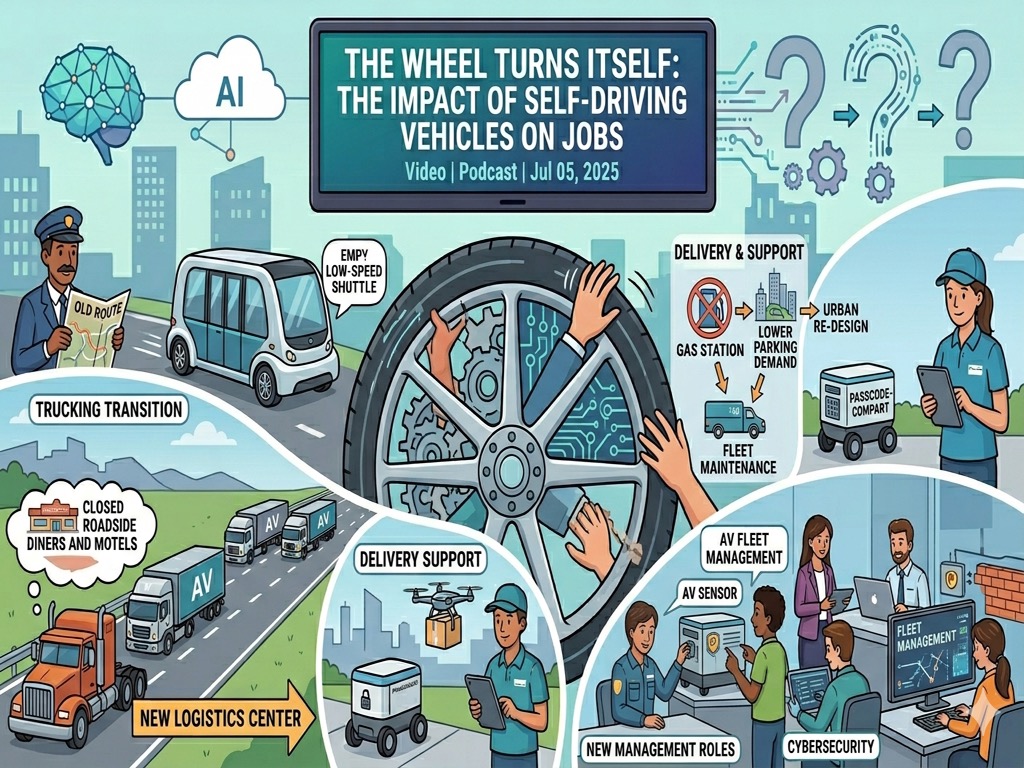
Public transportation, including city buses, shuttles, and airport circulators, is among the first sectors likely to feel the impact. Over 160,000 drivers currently operate in these roles, and many cities are already testing low-speed autonomous shuttles on fixed loops. These early deployments replace shuttle drivers on predictable routes such as airport terminals, corporate campuses, or dedicated bus lanes. This gradual rollout allows municipalities to test safety and reliability while introducing automation, giving a preview of how traditional transit roles may slowly shrink over time. As the technology proves reliable, citywide adoption could reduce the number of operators needed, fundamentally reshaping urban transit employment.
Taxi and Ride-Share
Taxis and ride-share services employ roughly 1.5 to 2 million drivers and are at the forefront of the autonomous transition. Some autonomous taxis are already operating in select urban areas, targeting dense traffic corridors with predictable patterns. Initially, human drivers may still compete with AV fleets in limited zones, but as coverage expands and reliability improves, robotaxis could significantly reduce the need for human drivers. Early adoption in urban centers allows fleets to optimize routes and demonstrate efficiency while gradually changing the economics of gig driving and urban transportation.
Trucking
Trucking, particularly long-haul freight, represents the largest single category of professional drivers, with approximately 1.9 million long-haul truckers in the United States. The first wave of automation will likely focus on highway-only operations, covering long distances between hubs. Human drivers will continue to handle city pickups and deliveries, creating a hybrid model that reduces labor hours while maintaining some human involvement. This phased approach introduces efficiency early, while ripple effects begin to emerge across truck stops, roadside motels, diners, and warehouse scheduling. Over time, as AVs improve, the model could evolve toward full automation, transforming both logistics and the supporting industries that rely on human-driven freight.
Delivery Services
Delivery services, including parcel, postal, and grocery delivery, employ over a million drivers across the country. Early adoption of autonomous delivery vehicles is expected to focus on last-mile routes using small vans or robotic vehicles with secure compartments accessible by passcode. Sidewalk robots and micro-fulfillment vehicles may first operate in suburban neighborhoods or campuses before expanding into dense urban areas. These deployments reduce the workload for human drivers while enabling continuous operation, gradually shifting labor toward oversight, technical support, and fleet management rather than traditional driving roles.
Ripple Effects
Automation does not just remove drivers; it reshapes entire supporting industries. Truck stops and motels lose overnight travelers, roadside diners see diminished traffic, and insurance and vehicle maintenance models shift as fleets become centrally managed and standardized. Urban design may change as parking demand declines and city logistics evolve. These indirect effects demonstrate that the human workforce shrinks not only in direct driving roles but across a wide network of dependent services, illustrating the deep economic consequences of self-driving vehicles.
New Roles in a Driverless World
Even as traditional driving jobs decline, new roles emerge, though they are fewer and highly specialized. Autonomous fleet management, including scheduling, route optimization, and charging coordination, becomes essential. Remote vehicle monitoring ensures safety across multiple AVs, while maintenance technicians handle sensor calibration, software updates, and battery management. Additional roles include HD map maintenance, simulation testing, roadway data labeling, and cybersecurity to protect fleets from digital threats. These positions require advanced technical skills and are concentrated in centralized locations, a stark contrast to the millions of dispersed driving jobs they replace.
A Moment for Reflection
Before we embrace a driverless future, we must consider the societal implications. Self-driving vehicles are more than a convenience; they are a case study in large-scale automation. What happens to the millions of people currently driving for a living? How do we transition displaced workers into new roles? Who benefits financially as corporate fleets replace individual drivers? How do we preserve dignity and livelihood during this shift? And which values — efficiency, safety, fairness — should guide our approach? The future of transportation is not merely a technical question; it is a human one. The roads may soon fill with driverless vehicles, but the real question remains: what kind of society do we want driving alongside them?