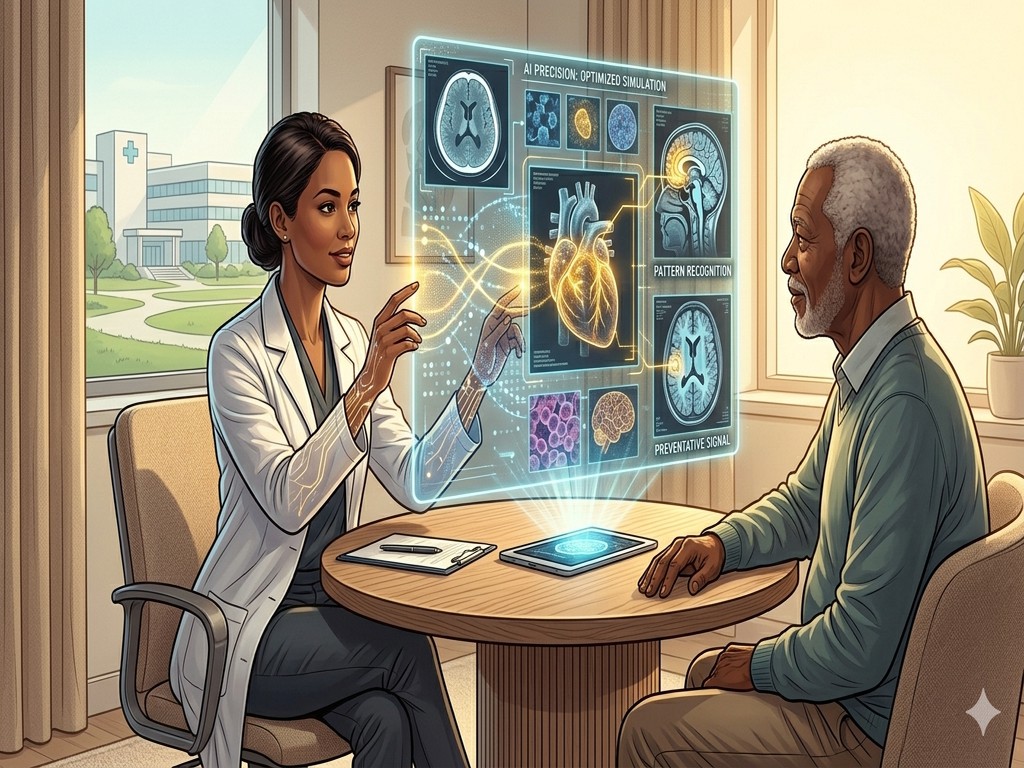
Precision, Not Replacement: Why AI Makes Doctors More Essential, Not Less
Introduction
Whenever artificial intelligence enters the medical conversation, a familiar concern follows: Will doctors disappear? As AI systems become better at analyzing images, spotting patterns, and automating routine tasks, it can feel as though human clinicians are slowly being pushed aside.
But this view misunderstands what medicine truly depends on. Healthcare has never failed because doctors lacked intelligence or effort; it has struggled because training is long, information is overwhelming, and intervention often comes too late. AI is not changing the purpose of doctors—it is changing how medicine manages complexity. By shifting healthcare toward precision, AI strengthens medical practice rather than replacing it.
Shorter, Smarter Training: From Volume to Velocity
Becoming a doctor has traditionally required absorbing enormous amounts of information over many years. While depth matters, not all information contributes equally to clinical judgment. Precision tools allow medical training to focus on what matters most.
Instead of relying solely on the "see one, do one, teach one" model—which depends on the luck of which patients walk through a hospital door—AI-driven High-Fidelity Simulations allow trainees to encounter rare scenarios on demand. For example, an AI simulator can present a student with 100 cases of rare cardiac anomalies in a single afternoon. In a traditional clinical rotation, it might take a decade to encounter that same variety. By reducing cognitive overload and unnecessary repetition, doctors enter practice better prepared, not just more exhausted.
Precision Diagnosis and Treatment
Modern medicine generates more data than any human can fully process alone. Scans, lab results, and real-time measurements create a level of complexity that challenges even the most experienced clinicians.
Rather than replacing judgment, AI acts as a "second set of eyes." It filters the noise to highlight meaningful signals, such as spotting a microscopic lesion on an MRI that a tired human eye might miss. The final responsibility still rests with the physician, but the path to that decision becomes clearer, faster, and less error-prone.
The Economic Power of Preventative Care
Much of healthcare spending goes toward "reactive" medicine—fixing problems after they become severe. Precision-driven automation allows medicine to shift toward prevention, where small, low-cost interventions avoid major complications.
AI systems can monitor trends and flag early risks—such as a wearable device detecting a subtle change in heart rhythm weeks before a potential stroke. What once required intensive human monitoring can now happen continuously in the background. Prevention stops being an expensive ideal and becomes a practical, scalable, and affordable strategy.
Why the Human Element Becomes More Important
As AI takes on routine analysis and automation, the uniquely human aspects of medicine grow more valuable. Trust, empathy, and the ability to navigate uncertainty cannot be automated. Patients do not seek care from systems; they seek care from people.
By reducing administrative burden and cognitive overload, AI gives doctors more time to listen, explain, and connect. In a more precise medical system, human judgment is not replaced—it is protected. It allows the physician to handle the "Black Swan" events and complex ethical dilemmas that code cannot solve.
Looking Ahead
The future of medicine is not a choice between humans and machines. It is a partnership where AI handles scale and complexity, and doctors focus on meaning and care. Shorter training, more accurate decisions, affordable prevention, and stronger human connection are not signs of medical decline—they are signs of progress. AI does not remove doctors from healthcare; it restores the doctor to the patient, allowing medicine to be practiced the way it was always meant to be.