The Invisible Tether of Modern Intelligence
Artificial intelligence has long been marketed as a celestial force—a "Cloud" that exists everywhere and nowhere at once. When we interact with a chatbot, translate a foreign menu, or receive a movie recommendation, we are participating in a silent, high-speed dialogue. Our data travels thousands of miles to a massive, energy-hungry data center, where it is processed by thousands of linked servers before a response is beamed back to our screens. This constant digital handshake has become so seamless that we have come to view the internet as the lifeblood of AI. We assume that if the signal bars disappear, the intelligence vanishes with them.
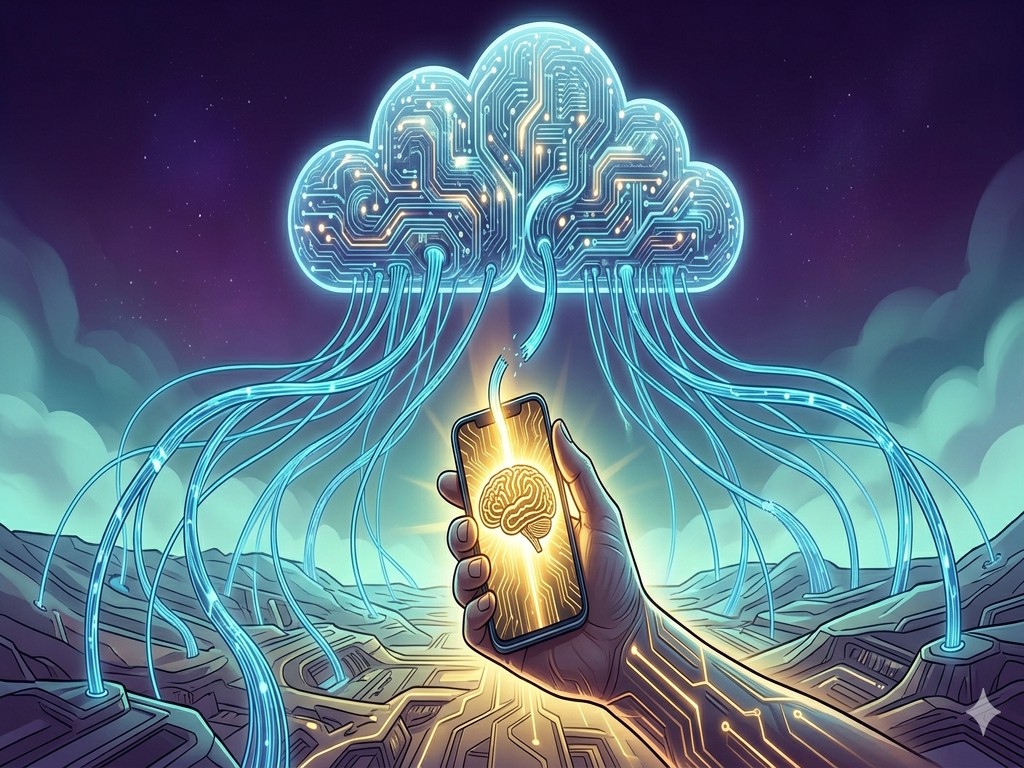
However, a quiet revolution is taking place at the "edge" of the network. A growing movement of engineers and advocates is proving that the tether to the cloud is not a requirement, but a choice. Offline AI—intelligence that lives and breathes entirely on your local device—is emerging as one of the most significant shifts in the history of computing. By moving the "brain" of the machine from a distant server to the palm of your hand, we are unlocking a future where technology is more private, more reliable, and finally, truly universal.
The Digital Divide and the Myth of Universal Access
We often speak about the digital age as if the entire world is perpetually synchronized. In reality, the internet is more like a patchwork quilt than a blanket. For millions of people, high-speed connectivity is a luxury rather than a utility. This digital divide is not just a problem for developing nations; it exists in rural heartlands, low-income urban neighborhoods, and specialized environments like research stations or correctional facilities. When AI requires a constant cloud connection, it inadvertently excludes these populations, turning a revolutionary tool into a gatekept privilege.
Offline AI changes the math of accessibility. Imagine a student in a remote village who has a low-cost laptop pre-loaded with a sophisticated AI tutor. This system doesn't need a satellite link to explain a complex chemistry equation or provide feedback on a history essay. Because the model is stored locally, the device becomes a self-contained encyclopedia of interactive knowledge. By removing the requirement for a data plan, we transform AI from a service you rent into a tool you own. This shift ensures that the benefits of the AI era are distributed based on human curiosity rather than the proximity of a fiber-optic cable.
Sovereignty in the Age of Surveillance
Beyond the logistics of access lies the fundamental question of who owns our digital thoughts. The traditional cloud-based model of AI is built on a trade-off: in exchange for powerful insights, we must transmit our most personal data—our medical symptoms, legal questions, and private reflections—to a third-party server. Even with the strongest encryption, that data is technically out of our hands the moment we hit "send." For many, this has created a lingering sense of unease about the erosion of digital boundaries.
Local AI offers a radical alternative by restoring data sovereignty to the user. When an AI model runs on your own hardware, your information never leaves the device. If you are a doctor summarizing patient notes or a lawyer analyzing a sensitive contract, the "conversation" stays within the room. This isn't just a technical preference; it is a vital safeguard for civil liberties. In an era where data is often treated as the new oil, offline AI acts as a personal vault, allowing us to benefit from the speed of automation without sacrificing the sanctity of our privacy. It turns our devices back into what they were originally meant to be: extensions of our own minds, rather than windows for others to peer through.
Resilience When the Lights Go Out
We have become dangerously dependent on the assumption that the "grid" will always be there. Yet, history shows us that infrastructure is fragile. Natural disasters, cyberattacks, or simple equipment failures can plunge a region into digital silence. In these moments, the tools we rely on most shouldn't be the ones that stop working. If a rescue worker is navigating a collapsed building or a medic is treating a patient in a disaster zone, they shouldn't be met with a "Connection Error" screen when trying to translate a medical manual or analyze a structural map.
Offline AI provides the resilience required for critical environments. By embedding intelligence directly into hardware, we create tools that are "battle-ready" for the real world. This reliability is equally important in mundane but essential settings, such as a ship crossing the Atlantic or an aircraft flying over the poles. When the AI is local, the intelligence is always "on," providing a layer of safety and efficiency that doesn't blink when the signal drops. We are moving toward a world where our most important assistants are as dependable as a physical compass or a printed book—tools that function regardless of the weather or the state of the local cell tower.
The Physics of a Smaller Mind
The sudden feasibility of offline AI is driven by a breakthrough in digital "shrinkage." For years, the trend in AI was "bigger is better," leading to models so massive they could only survive in the air-conditioned halls of a tech giant's server farm. But recently, the industry has mastered the art of compression. Through techniques like quantization—which essentially rounds off the "math" of an AI to make it less memory-intensive—and distillation, where a large "teacher" model trains a smaller, more efficient "student" model, we have learned to pack immense capability into tiny spaces.
This software optimization is being met halfway by a hardware revolution. Modern smartphones and laptops are now being built with dedicated Neural Processing Units (NPUs). These are specialized chips designed specifically to handle the heavy lifting of AI tasks without draining your battery. This means the device in your pocket is no longer just a portal to someone else's computer; it is a powerhouse in its own right. We are witnessing the birth of "Edge AI," where the intelligence is pushed out to the very edges of our society—into our watches, our cars, and our kitchen appliances—making everything around us subtly smarter without making it more intrusive.
A Balanced Path Forward
To be clear, the rise of offline AI does not signal the death of the cloud. The future is almost certainly a hybrid one. Massive data centers will always be necessary for training the next generation of models, performing scientific simulations on a global scale, or managing vast networks of collaborative data. There is a majesty in the cloud's ability to connect us all to a single, shared intelligence.
However, the "Cloud-Only" era was a stepping stone, not the destination. The next chapter of technology will be defined by balance. We will likely use cloud AI for our most expansive, complex queries while relying on local AI for our daily, private, and mission-critical tasks. This hybrid model allows for a "best of both worlds" scenario: the infinite scale of the internet when we want it, and the rugged independence of local hardware when we need it.
Ultimately, the importance of offline AI lies in its humanity. By bringing intelligence back down to earth and housing it within our own devices, we make it more personal, more secure, and more equitable. We ensure that the future of artificial intelligence isn't just a shiny dream lived out by those with the fastest connections, but a practical, empowering reality for everyone, everywhere, regardless of whether they are online or off. The true power of AI isn't found in a distant data center—it's found in the device you're holding right now.