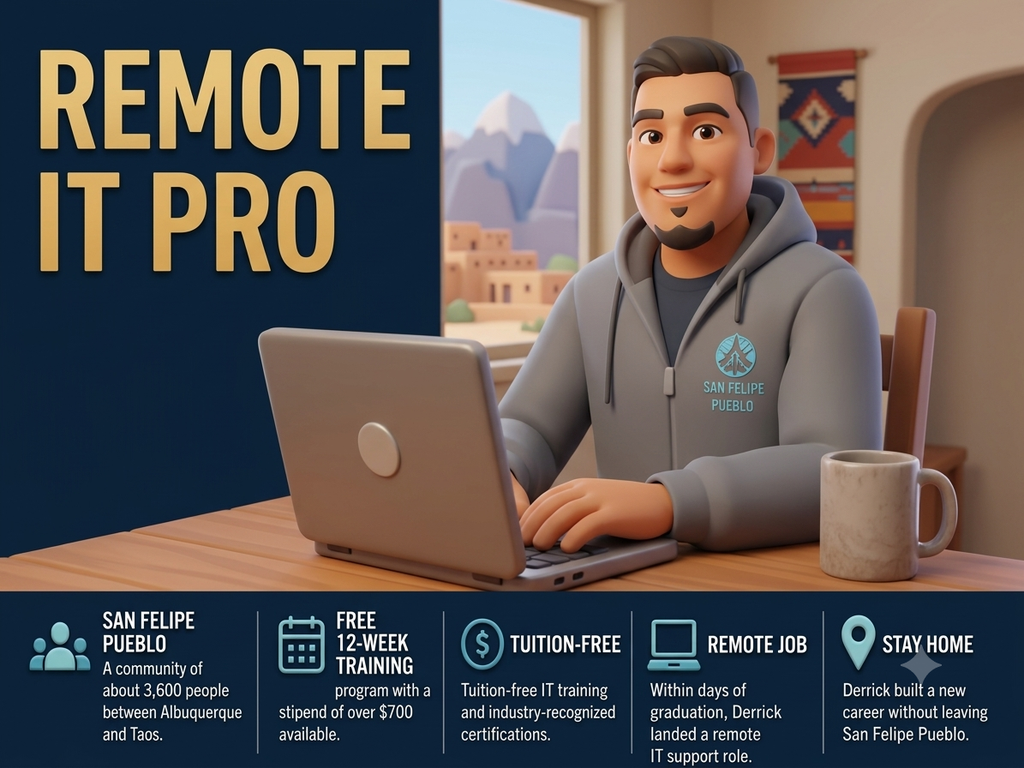
From Laid-Off HVAC Worker to Remote IT Pro — Without Ever Leaving Home
Derrick Esquibel's path into tech didn't start with a passion for computers or a dream of working in the industry. It started with a layoff, a pandemic, and a small community where the next opportunity wasn't obvious.
The Bottom Fell Out
In 2020, COVID-19 shut down businesses across the country, and Derrick's HVAC job was one of the casualties. In San Felipe Pueblo — a community of about 3,600 people between Albuquerque and Taos — losing steady work like that isn't something you bounce back from quickly. There's no tech hub down the street. No coding bootcamp on the corner. For a lot of people in places like his, a layoff can mean a very long road back, or no road back at all.
Derrick had always liked computers, but he'd never thought of them as a career. That wasn't the kind of opportunity that came knocking in a small, rural community.
A Free Program He Almost Didn't Know About
Then Derrick spotted an ad online for a free IT training program. It was a partnership between the Center on Rural Innovation (CORI) and Generation USA, designed specifically for people in rural communities who wanted to break into tech. The program had launched in just four small towns across the country: Ada, Oklahoma; Durango, Colorado; Pine Bluff, Arkansas; and Taos, New Mexico.
Derrick's local hub was the UNM-Taos HIVE, a coworking space at the University of New Mexico–Taos that doubled as a launchpad for people building new skills. He signed up for the July 2021 cohort — one of just nine learners in the program's very first rural class. The commitment was serious: twelve weeks, full-time, nine to five. The training itself cost nothing, and participants could apply for a stipend of over $700 to make the full-time schedule possible.
What He Actually Learned
The first two weeks had nothing to do with computers. The program started with soft skills — communication, teamwork, perseverance, and figuring out what kind of work you actually enjoy. As Derrick put it: "They got us to understand pieces like what our strengths are, what type of work we like to do, and if we were an optimist or a realist before we went into more stuff to be an IT support specialist."
After that foundation, the curriculum shifted to the technical side: hardware, software, operating systems, and network troubleshooting. Software was the hardest part for Derrick — the abstract logic didn't come naturally. But hardware clicked immediately. "With hardware, you can really see the pieces with your eyes," he said. "I like being able to fix stuff and physically upgrade your computer." The hands-on work felt like a natural extension of the mechanical skills he'd built in HVAC — just applied to a different kind of machine.
By early October 2021, Derrick had completed the program and earned a Google IT Support Certificate. He also received a voucher for the CompTIA A+ Certification exam, an industry-standard credential that employers recognize nationwide. In twelve weeks, he'd gone from unemployed to professionally certified in IT support.
A Job Offer in Days — Not Months
Rose Reza, the executive director of the UNM-Taos HIVE, kept a list of local employers looking for workers with tech skills. Derrick didn't wait around for someone to hand him an opportunity — he reached out to companies on that list himself. Within days of finishing the program, he had a job offer.
The company was Televon, a Taos-based IT services firm that happened to be the very first business to rent coworking space at the HIVE. They've since merged with Community Tech Solutions to form Civic Tech, an IT provider serving schools, nonprofits, and local governments across New Mexico.
The best part? Derrick works remotely. From San Felipe Pueblo. He didn't have to pack up and move to Albuquerque or some distant city to start his new career. He built a new life in the same place he'd always lived — proof that a tech career doesn't require leaving your community behind.
Why This Story Matters
Derrick's story is proof of something AI Bridge Foundation believes deeply: talent is everywhere, but opportunity is not.
He didn't need a four-year degree. He didn't need to relocate to a big city. He needed a free program designed for people in places like his, a local hub that connected learners to employers, and the determination to show up every day for twelve weeks.
The gap between people who benefit from the tech economy and people who get left behind isn't about ability. It's about access. When you meet people where they are — literally, in their own communities — they rise to the moment. Derrick Esquibel is living proof.
Sources & Further Reading
- Rural Learners Reflect on Free IT Support Specialist Course — CORI blog article (Dec 9, 2021) profiling Derrick Esquibel
- Generation USA Partners with Center on Rural Innovation — PR Newswire announcement of the partnership (May 27, 2021)
- Televon / Civic Tech — Derrick's employer, now operating as Civic Tech
- UNM-Taos HIVE — The local coworking and digital skills hub where Derrick trained