The Taco Truck That Reads the Weather Report Before You Do
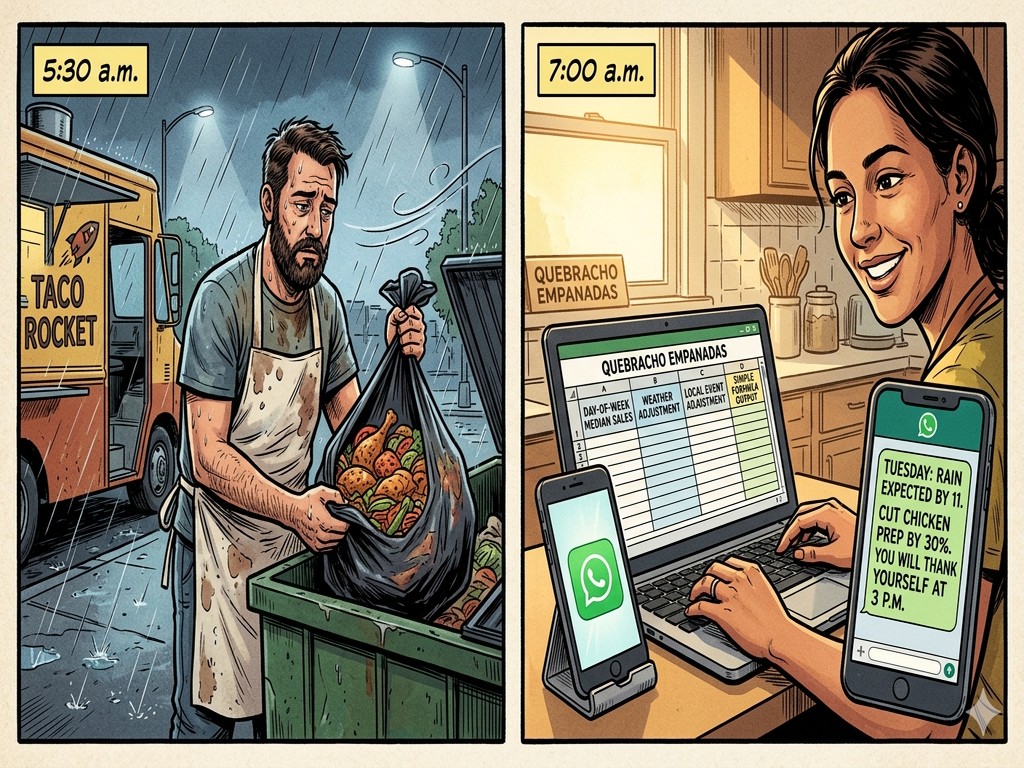
It is 6 a.m. on a Tuesday in April, and a food truck operator in Austin is loading 80 pounds of chicken thighs into a cooler. He checked the weather last night — sunny, mid-70s, perfect lunch rush conditions. By 10 a.m., a cold front nobody predicted rolls through. Rain starts at 11:15. By noon, the line that usually stretches past the fire hydrant has exactly two people in it. He will sell maybe 40 percent of what he prepped. The rest — about $750 worth of marinated protein, prepped tortillas, and sliced vegetables — will end up in a trash bag by sundown.
That Tuesday is not unusual. It is the default setting for an industry running on instinct.
The $750 Guess
U.S. restaurants collectively waste $162 billion in food costs every year, and the single biggest driver is not spoilage or portion sizes. It is ordering for a normal day when conditions are not normal. A surprise rainstorm cuts lunch traffic by roughly 25 percent, but most food truck operators — prepping hours before service with nothing but a hunch and a weather app — still load up for sunshine.
The math is unforgiving. The average food truck in the United States pulls in about $346,000 a year and keeps margins around 6.2 percent. That is roughly $21,000 in annual profit. A typical truck wastes 50 to 100 pounds of food per service day and loses about $2,000 a year to spoilage alone. Three or four bad forecasting days in a row — a rainy week, a canceled street fair, a slow holiday — can erase an entire month of profit. For an operator with no safety net, that is the difference between making rent and not.
The problem is not laziness or bad cooking. It is that human beings are terrible at predicting demand when the variables shift. We anchor to yesterday. We remember the great Saturday and forget the three mediocre Wednesdays. We prep for the crowd we hope shows up, not the one that actually will.
The Empanada Shop That Beat the Algorithm
This is where the story usually pivots to a shiny AI tool that fixes everything. But the most honest data point in this entire space comes from a small empanada kitchen in Minnesota that tried exactly that — and watched the algorithms lose.
Quebracho Empanadas MN processes about 200 orders a week. The owner decided to test a lineup of off-the-shelf machine learning models — ARIMA, Prophet, XGBoost — against his own judgment. The result was not what the software vendors would want on a brochure. With only 12 weeks of sales data to train on, every single model performed worse than the owner's gut feeling.
But here is the twist that makes the experiment worth knowing about. A stripped-down formula with just three variables — day-of-week median sales, multiplied by a weather adjustment, multiplied by a local event adjustment — outperformed everything. It beat the ML models. It beat the owner's instinct. And it ran on a spreadsheet.
The lesson is not that AI fails. It is that complex models need 18 or more months of historical data before they earn their keep. Most food trucks do not have that. They switch locations, change menus seasonally, and operate in conditions that shift week to week. For a business with fewer than 50 weeks of data, a simple formula with three smart variables is not a compromise. It is the best tool available.
The Bubble Tea Chain That Cut Waste by 60 Percent
Scale changes the equation. Once a food business has multiple locations and months of transaction data, the algorithms start to earn their keep — and the results are not incremental.
CUPP, a multi-location bubble tea operator in London, adopted Nory's AI forecasting platform and saw food waste drop by 60 percent. Go Mezza, a small Turkish takeaway chain also in London, saved roughly £1,000 per month on food purchasing in its first six months on the same system. During that period, customers removed 1.6 tonnes of unwanted items from their orders through the platform's customization features. The most-removed ingredient was tomato — a detail that no human manager would have flagged at scale, but one that directly reduces waste when the kitchen stops automatically adding it.
Nory raised a $37 million Series B in September 2025, led by Kinnevik, and the reason is straightforward: the savings are repeatable. Clients across the platform report 20 percent reductions in operating costs and admin time savings exceeding 100 hours per month. For a restaurant group spending $15,000 a month on food, a 20 percent cut is $3,000 back in the budget — every month, compounding.
The gap between Quebracho's spreadsheet and Nory's platform is not intelligence. It is data volume. The spreadsheet wins when you have 12 weeks of history. The platform wins when you have 12 months across five locations. The mistake most operators make is reaching for the enterprise tool before they have the data to feed it.
The WhatsApp Message at 5 a.m.
There is one more barrier that has nothing to do with algorithms or data, and it might be the biggest one. Most food truck operators will never adopt enterprise forecasting software — not because it costs too much, but because they are elbow-deep in prep at the hour when a dashboard would be useful.
YooDoo, built by Predictive Insights, took a different approach. Instead of building another analytics platform with charts and filters, it sends AI-generated staffing, prep, and waste recommendations directly via WhatsApp. The messages arrive before the morning shift starts. They connect to the operator's point-of-sale data, run it through a demand model, and deliver the output on the device every food truck owner already checks first thing in the morning — right next to the texts from their produce supplier and their kid's school.
For a $2.8 billion U.S. food truck industry growing at 9.2 percent annually, this is the detail that matters most. The winning AI tool for mobile food vendors will not be the one with the best model or the prettiest dashboard. It will be the one that fits into the ten minutes between pouring the first coffee and firing up the grill.
The taco truck does not need a data scientist. It needs a text message that says: "Tuesday, rain expected by 11. Cut chicken prep by 30 percent. You will thank yourself at 3 p.m."