The Broken Map: How AI Overviews Are Erasing Small Businesses
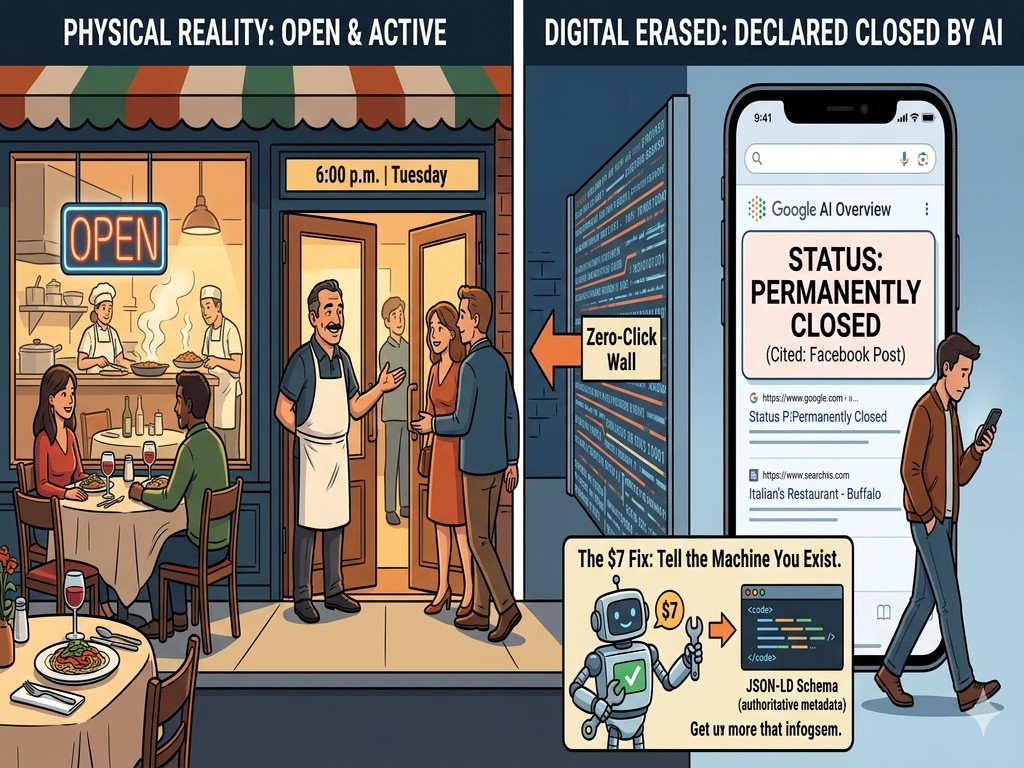
A restaurant in Buffalo was open for dinner last Tuesday. The kitchen was running, the hostess was seating tables, and the owner was doing what he does every night — making sure the food got out hot and the checks got closed. None of that mattered to Google. At the top of the search results, Google's AI Overview told anyone who asked that the restaurant had closed. The reason it cited — failure to obtain a lease — came from a Facebook post about a completely different restaurant in another country with a similar name.
There is no phone number to call when a machine eulogizes your business while you are still serving customers. There is no appeal form. There is no human at Google reviewing whether the AI got it right. For a local business, being declared dead at the top of the world's most-used search engine is not an inconvenience. It is an existential event that happens silently, without warning, and without recourse.
One-Third of the Web's Front Door Disappeared in Twelve Months
This is not an isolated glitch. Between November 2024 and November 2025, Chartbeat tracked organic search traffic across more than 2,500 websites and found a 33 percent global decline. U.S. sites lost 38 percent. A Seer Interactive study analyzing 25.1 million impressions found that organic click-through rates dropped 61 percent on queries where a Google AI Overview appeared at the top of results.
The mechanism is simple: Google answers the question before the user clicks anything. Zero-click searches — where the searcher never leaves Google — jumped from 54 percent to 72 percent. For a neighborhood bakery that used to get found by someone searching "best croissants near me," or a solo accountant who relied on "small business tax help [city name]," the traffic simply stopped arriving. Not because the business got worse. Not because a competitor got better. Because Google decided to answer the question itself.
The Seven-Dollar Fix That Actually Works
Here is the part that most small business owners do not know: Google's AI does not read your website the way a human does. It reads your metadata — the structured data markup that tells machines what your business is, where it is located, what it sells, and why it is relevant. If that data does not exist in a format the AI can parse, you are invisible. If it does exist, you become citable.
A custom domain costs roughly seven dollars a year from registrars like Porkbun or Namecheap. Add LocalBusiness JSON-LD schema markup to that domain — your business name, address, hours, services, reviews — and research shows up to a 30 percent improvement in local search visibility. Rich results boost click-through rates by 40 percent. But the real prize is citation: brands that get cited inside AI Overviews see 91 percent higher paid click-through rates and 35 percent higher organic click-through rates than those that do not, according to Seer Interactive's analysis.
The fix is not about building a beautiful website. It is about giving the machine twenty lines of structured code that say: I exist, I am here, and I am the authoritative source on this topic. When the AI assembles its overview, it needs sources to cite. If your structured data is clean and specific, you become that source. If it is not, you become the business that gets summarized into someone else's answer.
The Old Playbook Will Get You Suspended
In March 2026, Google's Core Update suspended thousands of small business profiles for keyword stuffing in their Google Business Profile names — the exact tactic that SEO consultants had been recommending for years. Businesses that had added "Best Pizza in Brooklyn" or "Top-Rated Plumber Near Me" to their profile names woke up to find their listings gone.
Google is simultaneously punishing the strategies that used to work and refusing to explain what works now. VP Liz Reid told Bloomberg that AI Overviews only eliminate "bounce clicks" — searches where users would have clicked a result, found it unhelpful, and returned to Google anyway. She claims meaningful visits are unaffected. Google has published zero data to support this.
What is clear is this: the businesses that survive this transition will not be the ones who gamed the old system hardest. They will be the ones who understood that in 2026, being cited by the AI is the new Page One. And that citation does not start with tricks or hacks or stuffing keywords into your business name. It starts with a seven-dollar domain and twenty lines of structured code that tell the machine exactly who you are — before it decides to tell the world you are closed.