The New Shield: Reimagining the Dream in the Era of AI
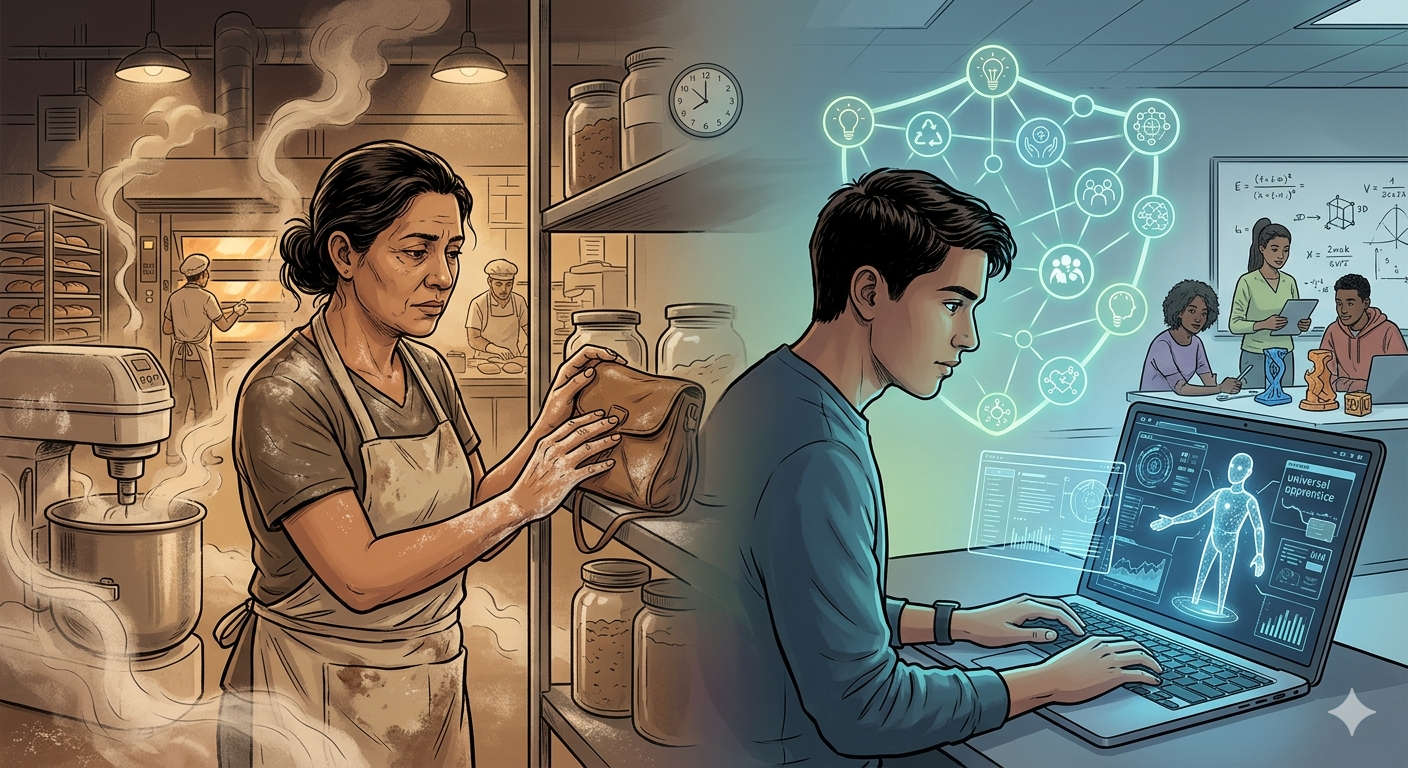
For twenty years, the rhythm of Elena's life was measured in heat and heavy lifting. It lived in the industrial roar of a commercial bakery and the tireless, repetitive motion of kneading dough and hauling flour sacks. Her hands—calloused by the oven's breath and stiff from the dawn shifts—were instruments of survival. Every shift ended the same way: a long bus ride home, a weary sigh as she kicked off her shoes, and a few more bills tucked into a faded leather pouch hidden behind the jars in the pantry.
That pouch held more than currency; it held a promise.
In Elena's world—the world of an immigrant who arrived with little more than a relentless work ethic—college was not just an education. It was a fortress. It was the "Great Equalizer," the only place where years of physical sacrifice could be transformed into permanent safety. If she could just get her son, Mateo, through those university halls, his life would be lighter, cooler, and secure. A keyboard instead of a baker's bench; a climate-controlled office instead of a sweltering kitchen.
For years, that belief never wavered. But now, in 2026, as Mateo moves through his sophomore year, the walls of that fortress no longer feel as solid as they once did.
The Question of Value
The shift began during a late-night study session. What once took Mateo hours—organizing market research, summarizing legal briefs, or drafting complex Python scripts—could now be executed in seconds by AI. At first, it felt like a superpower. Then, slowly, it began to feel like a question: If a machine can do this, what exactly am I being trained to do?
He thought about the roles his mother pointed to with quiet pride—accountants, junior analysts, paralegals. These were the hallmarks of "making it." Yet these are the very roles being reshaped or replaced by systems that don't sleep, tire, or need a lunch break.
For decades, families like Elena's operated on an unspoken contract: give four years and a small fortune to a university, and receive a stable middle-class life in return. Today, the terms of that contract have been rewritten in real-time.
From Memorization to Creation
On campus, the evolution is everywhere. Lectures are no longer the centerpiece; students don't attend merely to absorb facts, but to build, test, and challenge ideas in the "Human Layer." Mateo isn't just writing code anymore; he is learning to direct AI systems to build entire applications that solve community problems. The question is no longer "What do you know?" but "What can you create with what you know?"
One afternoon, Mateo called his mother to explain. "It's not about having the answers anymore, Mamá," he said. "It's about learning how to ask the right questions—how to decide what actually matters."
Elena didn't have the vocabulary for "large language models" or "prompt engineering," but she understood change. She had crossed borders; she knew what it meant when the old maps no longer worked. "So… this is still the way forward?" she asked quietly.
Mateo looked around the lab at students debating ethics and testing through failure. "Yeah," he said. "It's just a different path than we imagined."
The Human Layer
For the communities served by our nonprofit, this "different" can feel like the ground shifting beneath already uncertain footing. The old path was difficult, but it was a straight line. Now, that lack of definition feels like a new kind of barrier.
But there is a more hopeful side to this shift. For the first time, the tools of high-level knowledge are no longer locked behind the gates of elite institutions. AI has become a universal apprentice—available at any hour, capable of accelerating learning in ways once reserved for the privileged. The gap in access to information is shrinking, but a new gap is widening: The Human Layer.
Knowing how to apply ethical judgment, lead a team, and turn raw information into meaningful solutions requires something deeply human. It requires mentorship, community, and the courage to iterate.
This is where our role evolves. We are no longer just gatekeepers of access; we are builders of the environment where students like Mateo learn to wield these tools with purpose.
The New Definition of Protection
Elena still works the early shifts. The industrial mixers still roar, and the flour still coats her apron by midday. Sometimes, she still pulls out that leather pouch—flatter now, its contents slowly being invested into Mateo's future.
She didn't just buy Mateo a degree. She bought him the time to adapt and the space to navigate a future that didn't exist when she first stepped off that bus years ago. The sacrifice is the same, but the "shield" has changed. It no longer protects against hard work; it protects against obsolescence.
The New Shield isn't built from credentials alone. It is forged from adaptability, critical thinking, and the confidence to build a new world rather than simply follow the old one. The American Dream isn't gone, but it is asking more of us. It asks students to step into uncertainty, and it asks organizations like ours to stop treating education as a passive journey.
Late at night, Mateo sits at his desk, working through problems that didn't exist a decade ago. In the quiet, he glances at a photo taped beside his laptop: Elena in her flour-dusted apron, her expression tired but resolute.
He understands now what she really gave him. It wasn't just a seat at someone else's table. It was the tools—and the responsibility—to build his own.