A More Thoughtful Way to Use AI for Studying
A woman named Priya was studying for her nursing license exam while working night shifts at a gas station in Bakersfield. She had three months, a used prep book, and a free AI chatbot. Every morning after her shift, she'd open a new chat, ask a question about pharmacology, get an answer, and close the tab. The next morning, she'd do it again—except the AI had no idea who she was. Every session started from zero. She was explaining her situation, her exam date, and her weak spots over and over, losing twenty minutes before she could even start studying.
Then someone showed her how to pin a session—to keep the same conversation going instead of starting fresh every time.
Everything changed.
The Notebook That Remembers
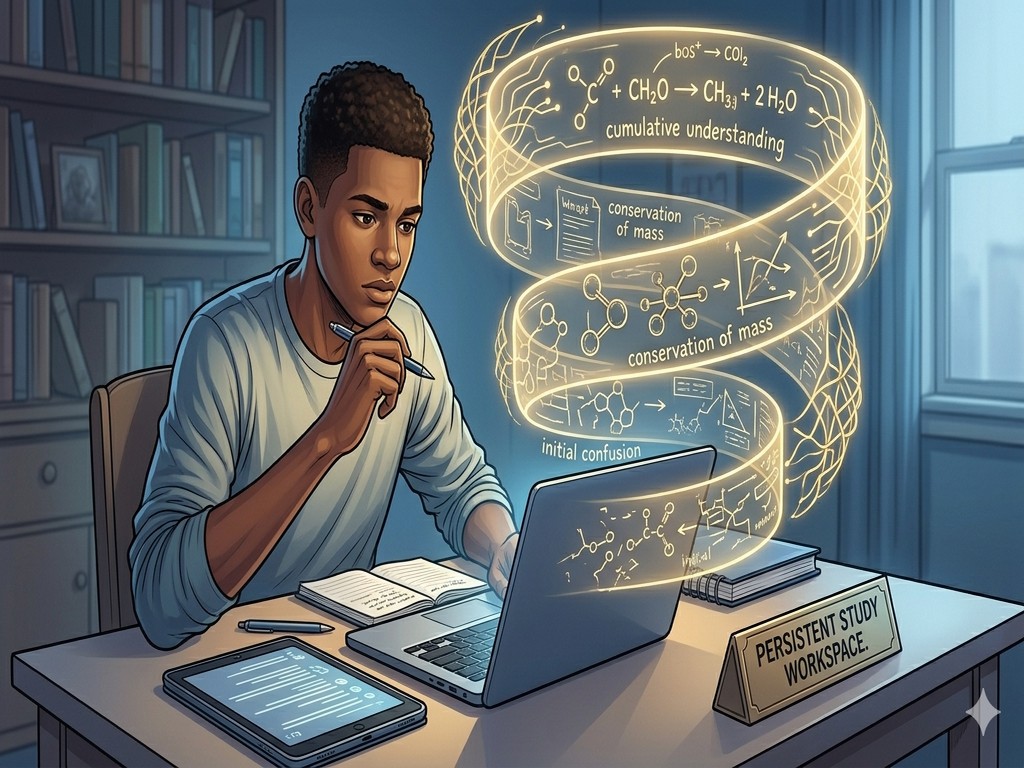
A pinned AI session works less like a search engine and more like a study notebook that talks back. It holds your earlier questions, your half-formed explanations, the moment you confused two concepts, and the follow-up where you finally got it right. When you come back the next day, the conversation picks up where you left off.
For Priya, that meant the AI already knew she was preparing for the NCLEX, that she was strong on patient assessment but kept mixing up drug interactions, and that she learned best when the AI gave her a scenario instead of a definition. She didn't have to re-explain any of that. She just sat down and studied.
Over weeks, the session became a record of her thinking. She could scroll back and see how her explanations of cardiac medications went from scattered to precise. The AI noticed too—it stopped over-explaining the basics and started pushing her on the edge cases she'd need for the exam.
Why Explaining Beats Memorizing
The real power of a persistent session isn't just convenience. It's what happens when you try to teach the AI what you've learned.
Consider a GED student working through chemical reactions. On day one, he asks the AI to explain them. The explanation makes sense while he's reading it. But when the AI asks him to explain it back, he stumbles. He says something about atoms moving around but can't articulate why. The AI doesn't judge—it just points out what's missing and asks him to try again.
Three days later, he comes back to the same session. This time his explanation includes energy transfer and conservation of mass. The AI compares it to his first attempt and tells him exactly what improved. That feedback loop—explain, get feedback, try again days later, see your own growth—is how real understanding forms. Not from reading the right answer once, but from wrestling with it until it sticks.
Staying Focused When Everything Is Available
One risk of using AI for studying is drift. You start with biology and end up in a conversation about the history of microscopes. Interesting, maybe. Useful for your exam? Not at all.
A well-set-up persistent session solves this by defining the AI's role upfront: you're my tutor for GED Science, specifically the life science section. That boundary keeps responses relevant and prevents the AI from wandering into tangents that eat your limited study time. It's the difference between studying with a focused tutor and studying with a friend who keeps changing the subject.
A Study Partner That's Always There
Priya passed her NCLEX on the first attempt. She'll tell you the pinned session didn't make studying easy—it made it possible. She still had to show up every morning after an eight-hour shift and do the work. But she wasn't wasting time re-explaining herself, hunting for where she left off, or wondering if she was studying the right things.
For students balancing jobs, families, and education—which is most of the people AI Bridge Foundation serves—that's not a small thing. It's the difference between a study plan that survives real life and one that falls apart after the first busy week.
The technology isn't the breakthrough. The breakthrough is using it the way learning actually works: persistently, over time, building on what came before instead of starting over every single day.