The $25,000 Lifeline Nobody Applied For
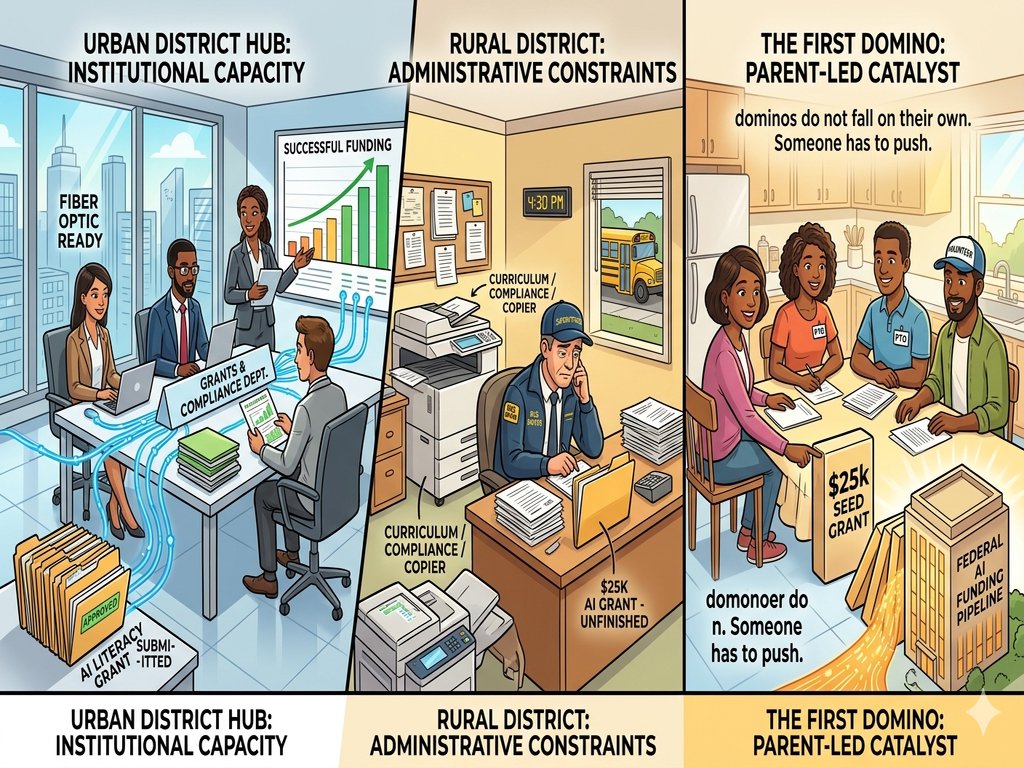
There is a folder on a desk in rural Montana that contains a grant application no one will finish. It is not thick — maybe twelve pages, plus a budget template — but it might as well be a novel written in a language the three-person central office does not speak. The grant is worth $25,000. It would fund AI literacy training for every teacher in the district. The deadline is in six weeks. The folder will not move.
This is not a story about schools that do not want AI. It is a story about schools that cannot raise their hand fast enough to get it.
The Hunger Is Real — the Pipeline Is Not
When the Rural AI Strategy Lab, a joint initiative of FullScale and the Alliance for Excellent Education, opened applications in 2025, more than 100 school and district teams from 34 states applied. They accepted 13. Meanwhile, aiEDU's Catalyst Program reached only 10 states with 21 subgrants, touching 3,045 educators — a meaningful number until you remember there are roughly 9,000 rural districts in the United States. The math is brutal: for every rural school that gets AI readiness support, hundreds are left standing in line with their hand up and no one looking.
The demand is not the problem. The demand is overwhelming. The problem is that the system for distributing money was designed for districts that have grant writers, broadband, and time — three things rural schools almost never have simultaneously.
You Do Not Lose on Merit. You Lose on Paperwork.
The U.S. Department of Education created the Rural Education Achievement Program specifically because it recognized a structural truth: rural districts cannot compete for federal competitive grants. They lack the personnel. A 2025 Government Accountability Office report confirmed what anyone who has worked in a small district already knows — acute teacher shortages in math and science, limited internet connectivity, and administrative teams so small that the superintendent also drives a bus route.
When the National Science Foundation announces $168 million for its TechAccess initiative, or aiEDU posts a $25,000 Community Catalyst opportunity, the application requirements assume a baseline of institutional capacity that simply does not exist in a district where one person handles curriculum, compliance, and the copier. The grants are not exclusionary by design. They are exclusionary by default.
This is not about intelligence or ambition. It is about a three-person office being asked to produce the same deliverables as a district with a dedicated grants department, a data analyst, and a communications team. The playing field is not uneven. It is a different sport entirely.
The Six-Week Gift That 68 Percent of Teachers Never Receive
Here is what makes the funding gap so painful: the tools work. A Gallup and Walton Family Foundation study found that teachers who use AI tools weekly reclaim 5.9 hours per week — the equivalent of six full instructional weeks over a school year. Six weeks. That is not a marginal efficiency gain. That is an entire grading period returned to a teacher who was already stretched past breaking.
But 68 percent of teachers report receiving zero AI-related professional development from their district. Not inadequate training. Zero. In rural areas, the picture is worse: only 46 percent of rural teachers see AI tools as relevant to their classrooms, compared to 66 percent in urban schools. That 20-point perception gap is not about rural teachers being behind the times. It is about never having been shown what the times look like.
A teacher who has never seen an AI tool demonstrated, never had an hour of training, never been given permission to experiment — that teacher is not resistant to change. That teacher has been abandoned by a system that talks about equity while distributing resources through mechanisms that guarantee inequity.
Parents Are the Missing Grant-Writing Army
Here is where the story turns. aiEDU's 2026 Community Catalyst Program — with Letters of Intent due May 21, 2026 — does something unusual: it allows nonprofits, not just school districts, to apply. That means a parent-teacher organization can be the applicant. A local library foundation. A community group with a tax ID and a mission statement.
This matters because parents are the one resource rural communities have that does not require a line item in a budget. They show up to school board meetings. They organize fundraisers. They know which teachers are burning out and which programs are dying quietly. What they have not been asked to do — until now — is write the grant application that their district cannot.
In Michigan, small Rural Readiness grants sparked millions in follow-on local investment before state funding was cut in 2026. The pattern repeated in district after district: a modest seed grant attracted matching funds, built momentum, and created proof points that unlocked larger opportunities. The first $25,000 was never the point. It was the permission slip — evidence that someone, somewhere, believed this community was worth investing in.
The Domino That Needs a Push
The window is specific and it is closing. aiEDU's Letters of Intent are due May 21. The Rural AI Strategy Lab's next cohort will be announced this summer. NSF's TechAccess funding is moving through review cycles right now. Every one of these opportunities will be captured by districts and organizations that have the capacity to apply — unless someone in the communities that need them most decides to pick up the folder on the desk and start filling it out.
That someone does not need to be a grant writer. They need to be a parent who can organize three other parents, find a fiscal sponsor, and write a letter that says: our kids deserve what kids in funded districts already have, and we are willing to do the work to get it.
The $25,000 is not a solution. It is a first domino. But dominos do not fall on their own. Someone has to push.