The Shame Eraser: What Happens When 18,000 Adults Finally Ask the "Stupid" Math Question
There is a question that haunts adult education classrooms, and it is not on any test. It is the one a 34-year-old mother of two wants to ask about fractions but does not, because the person next to her might hear. It is the one a 28-year-old warehouse worker types into Google at 11 p.m. and then deletes, because even a search engine feels like a witness. The question is almost always basic. And the silence around it is almost always the reason people quit.
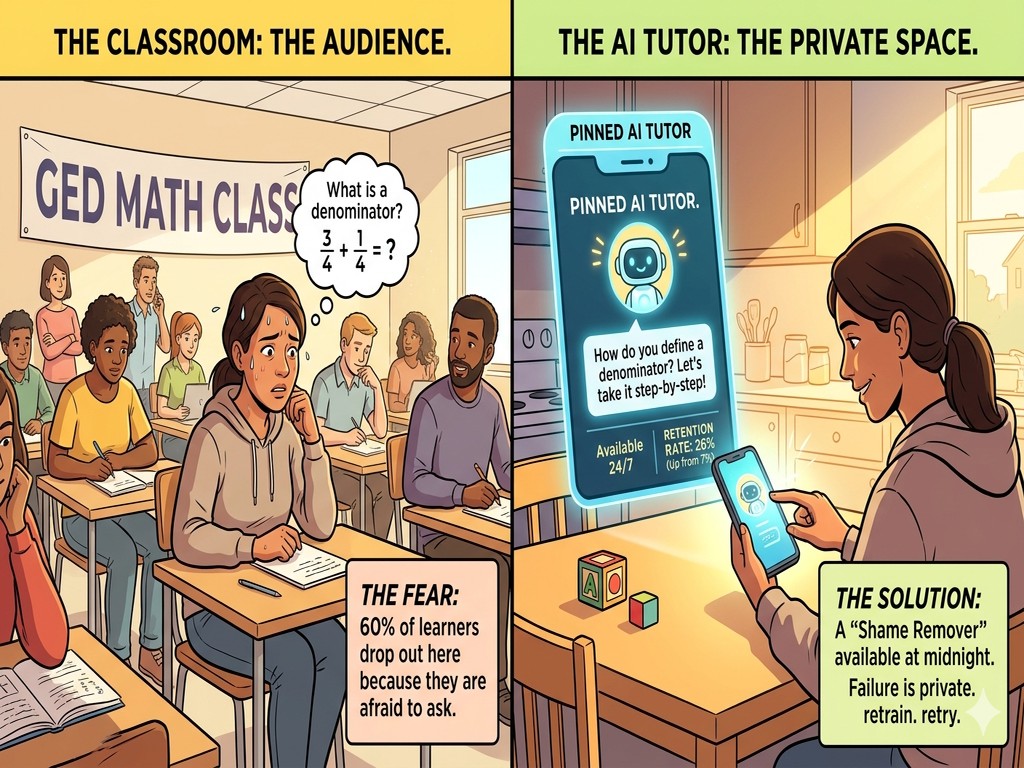
Nearly 60 percent of adults who start GED preparation drop out at the same point: math. Not because they cannot learn it, but because the distance between what they remember and what the test demands feels unbridgeable — and bridging it means admitting, out loud, that you do not know what a denominator is. In a classroom, that admission has an audience. For most people, that is enough to walk away.
The Tutor That Does Not Judge
This is the problem that a new generation of AI-powered tutoring tools is quietly solving — not by teaching math differently, but by removing the one thing that made learning it impossible: other people watching.
Tools like Pinned AI Tutor, built by the AI Bridge Foundation, are designed around a single insight: the biggest barrier to a GED is not content — it is shame. Pinned AI Tutor gives each learner a focused, bite-sized session on one specific topic — fractions, decimals, solving for x — using the Socratic method. It does not hand over answers. It asks questions, checks understanding, and waits. It does not raise an eyebrow. It does not sigh. It does not remember that you asked the same question yesterday. And because it runs on a phone, it meets learners where they actually are: on buses, in break rooms, at the kitchen table after the kids are asleep.
For a population that has spent years avoiding exactly this kind of vulnerability, that privacy turns out to matter more than any curriculum redesign. One education leader described the function of AI tutoring for adult learners simply: it is a "shame remover" — a private space where someone can ask what a fraction is at 11 p.m. without anyone knowing.
The Number That Changes the Argument
The skeptic's response is predictable: feeling safe is nice, but does it actually help people pass? The data from across the AI tutoring ecosystem says yes, and not in the way you might expect.
Early results from AI-powered GED prep platforms show a roughly 3-percentage-point rise in first-attempt pass rates. That sounds modest until you learn that over 70 percent of first-time GED failures miss passing by fewer than 5 points. An average score boost of around 5 points lands squarely in that pass-or-fail gap — the difference between another year of trying and a credential that opens doors.
But the more striking number is retention. Traditional GED programs see only about 7 percent of new learners still studying after their first week. AI-powered platforms have pushed that to nearly 26 percent — almost four times higher. That is not a marginal improvement. That is the difference between a program that loses people and one that keeps them.
A 2024 study published in PLOS ONE, with 274 participants, found that AI-generated math hints produced learning gains statistically indistinguishable from those of human tutors, with no difference in time-on-task. The AI did not teach better. It taught just as well — and it was available at midnight, without an appointment, without a waiting list.
The Most-Asked Questions Tell the Real Story
The questions adults ask these AI tutors reveal a hidden curriculum that traditional GED prep has been glossing over for years. They are not asking about quadratic equations or statistical analysis. They are asking what "solve for x" means. They are asking how decimals work. They are asking the things they were supposed to learn in sixth grade and either missed or forgot, and that no prep course wants to spend time on because it does not look like test prep.
This is exactly why the Socratic approach matters. When a learner gets a problem wrong, a well-designed AI tutor does not just show the correct answer. It asks where the thinking went sideways. It breaks the problem into smaller pieces. It lets the learner try again. That loop — fail, understand why, retry — is the foundation of how learning actually works. It is also the loop that shame interrupts. When you are afraid of getting it wrong, you do not try again. You close the app. You tell yourself you will come back tomorrow. You do not come back.
AI tutors keep that loop running because they make failure private. There is no classroom of eyes when you get it wrong for the third time. There is just a patient response and another chance. For adults who have spent years associating math with embarrassment, that privacy is not a feature. It is the entire product.
Nineteen Million People Are Waiting
There are 19 million American adults without a high school diploma. Over 60 percent of GED learners now access prep materials on mobile devices — not in classrooms or libraries, but on phones, during the small windows of time their lives allow. The GED prep app ecosystem hit record engagement in early 2026, with tens of thousands of new users joining monthly.
The tools keep expanding — from math into science, reading, and social studies. Nonprofit organizations like the AI Bridge Foundation are building AI tutors designed specifically for the adults that traditional programs have struggled to retain — tools that are free, accessible on any device, and built around the idea that learning should feel like a conversation, not a test.
The question is no longer whether AI tutoring works for adult learners. The evidence is in. The question is what happens to the 19 million people who need it if the tools do not reach them — or if they never find out that asking the "stupid" question is exactly how learning starts.