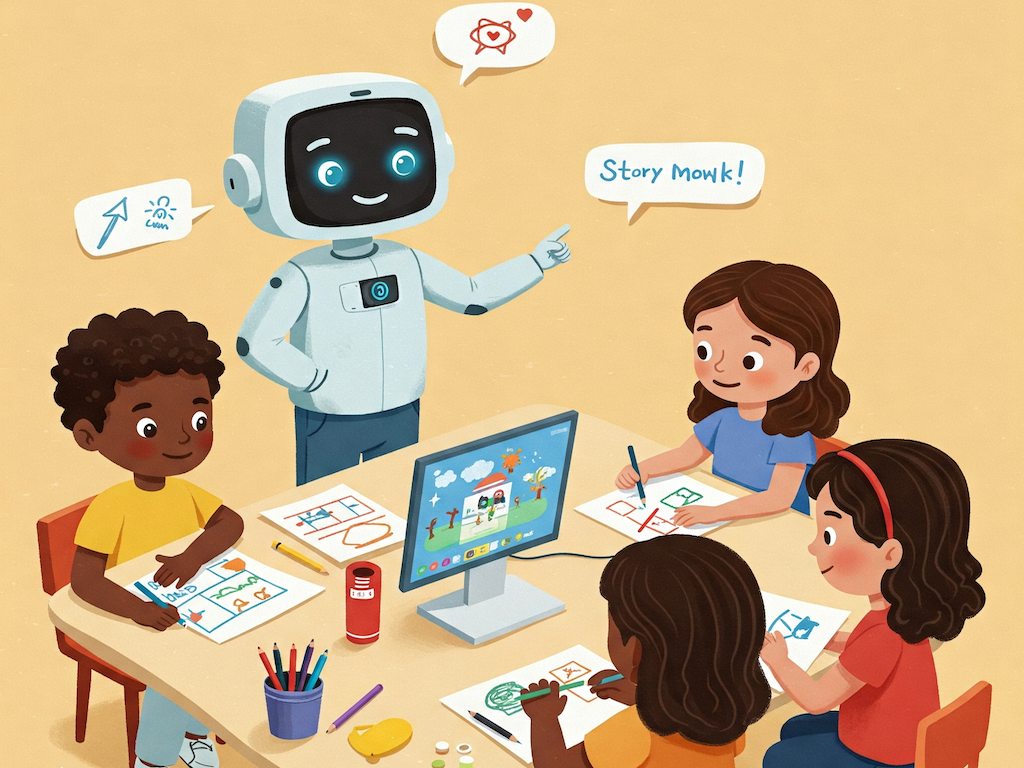
From Readers to Storytellers: How AI Inspires Kids to Read by Writing
For many kids, sitting down to read a book feels like homework — especially when they're surrounded by video games, YouTube, and social media. The competition for their attention isn't even close. A book sits there quietly. Everything else on a screen is engineered to be irresistible.
But what if reading wasn't the end goal? What if it became a stepping stone to something kids actually want to do — writing their own stories?
AI-powered storytelling tools make this possible. Instead of passively reading someone else's words, kids get to shape narratives, choose what happens next, and invent their own endings. Reading stops being a chore and starts being fuel for something creative.
How It Works in Practice
A child starts with a simple idea: "A lonely fox finds a glowing stone in the forest." An AI assistant like ChatGPT or Scribble by Eleven Labs picks it up and asks questions:
"What happens when the fox touches the stone?"
"Is there a villain trying to steal it?"
"How does the story end?"
These prompts guide the child through building a story step by step, without overwhelming them. The AI doesn't write the story for them — it helps them think through it. Platforms like Storybird take a different approach, offering art prompts and writing challenges that encourage kids to create illustrated books from their own imagination.
Boomwriter is used in many classrooms where students each write a chapter of a group story, vote on which chapters to include, and the final result is a published, collective book — authored by the kids themselves.
Why Creating Drives Reading
When kids create their own stories, they start noticing how other authors do it. How does this book build suspense? How does that character feel real? Reading becomes research for their own writing — not an assignment, but a resource.
That shift in motivation is powerful. A kid who's writing a mystery story suddenly wants to read mysteries. A kid building a fantasy world starts paying attention to how Tolkien or Rick Riordan handles world-building. The reading happens naturally because it serves something the child actually cares about.
Safe Space to Experiment
Unlike classroom writing assignments, AI-powered storytelling isn't about spelling tests or grammar grades. The AI won't laugh at a wild plot twist or mark up a sentence with red ink. It celebrates creativity, encourages exploration, and patiently offers suggestions.
This matters especially for reluctant readers — kids who've struggled with traditional literacy approaches and associate reading and writing with failure. A low-pressure, playful environment lets them experiment without fear of judgment.
Reading, Writing, and Imagination in One Loop
AI is opening the door to a new kind of literacy experience — one that blends reading, writing, and imagination into a single loop. Kids stop seeing books as chores and start seeing them as invitations to create.
And when kids feel like their words matter, they're far more likely to keep reading, keep writing, and keep dreaming.