The Electrician Who Out-Earns Your Surgeon
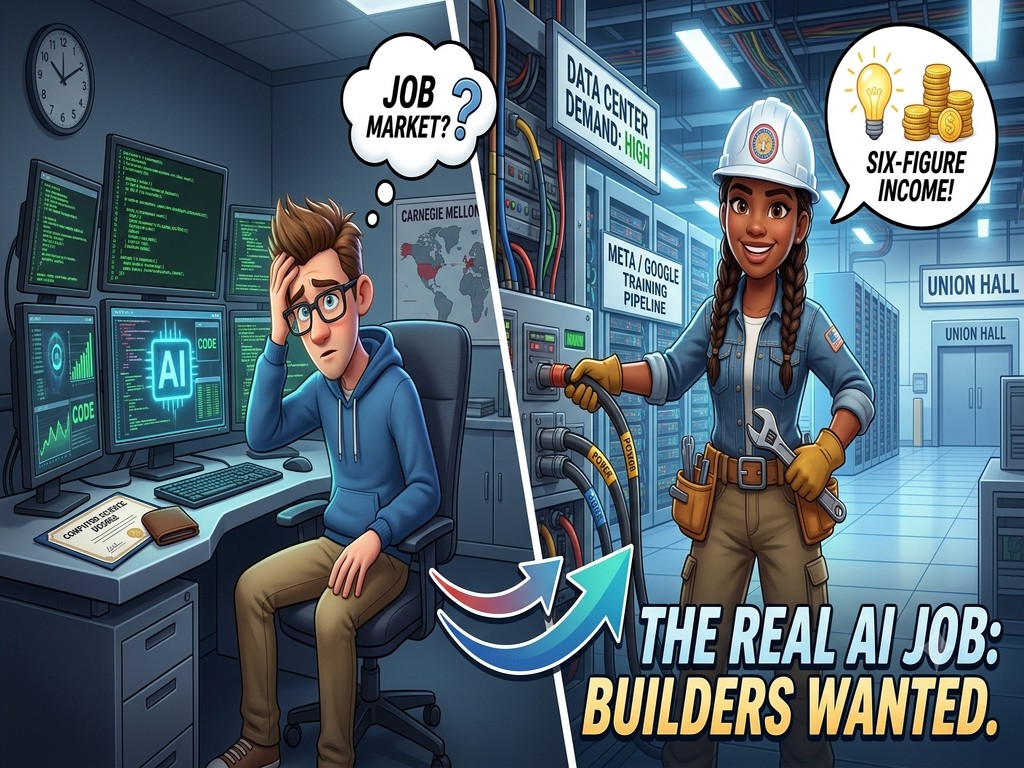
In May 2026, Jensen Huang stood in front of 5,800 Carnegie Mellon graduates — some of the most sought-after computer science students in the country — and told them the real opportunity belongs to electricians, plumbers, and iron workers.
The CEO of the world's most valuable semiconductor company looked at an audience that had spent four years learning to build AI and said: "AI gives America the opportunity to build again. Electricians, plumbers, iron workers, technicians, builders — this is your time."
He wasn't being poetic. He was reading a balance sheet.
The Numbers Nobody's Guidance Counselor Mentioned
Mike Rowe — the Dirty Jobs guy — met data center electricians under 30 earning $280,000 a year. Speaking at BlackRock's 2026 Infrastructure Summit, he described them getting "poached like pro athletes" between competing projects. He called the education system's framing of trades a "vocational consolation prize."
The average construction worker on a data center project now earns $81,800 — a 32% premium over non-data-center work, according to AI hiring platform Skillit. And that's the average, not the ceiling. The ceiling is a kid five years out of high school pulling down more than a surgeon still paying off med school.
Goldman Sachs projects 81,000 specialized electrician openings every year just to keep pace with data center demand. Randstad's 2026 analysis of 150 million U.S. job postings found something that would have been unthinkable a decade ago: it now takes longer to hire an electrician (56 days) than a software developer (54 days).
The person wiring the data center is harder to find than the person programming what runs inside it.
The Apprenticeship That Pays You to Show Up
Here's what makes this different from the usual "trades are underrated" speech: major tech companies are now paying people to learn.
Meta launched "America's Workforce Academy" — a program that covers tuition, airfare, lodging, and a daily stipend across facilities in Louisiana, Ohio, Indiana, and Texas. Complete the training, and you're guaranteed employment. It's the largest private-sector job-guarantee trades program in U.S. history.
Google and Meta combined have poured over $165 million into training pipelines for the people who will physically build their AI infrastructure. Not the people who will use it — the people who will wire it, cool it, and keep it running.
Meanwhile, IBEW chapters now run evening-and-weekend programs where apprentices earn $42,000 their first year while their former classmates are taking on student debt. Two nights a week of classes. Paid work the rest of the time. No loans, no applications, no four-year gamble.
The Union Hall That Doubled
IBEW Local 26 in Northern Virginia has doubled its membership to over 14,700 since 2018. They hold 97% of the electrical work for AWS, Microsoft, Google, and Meta data centers in the region.
That's not a union struggling to stay relevant. That's a union that can barely train people fast enough.
The data center boom didn't just create jobs — it created leverage. When every major tech company needs the same 81,000 electricians and there aren't enough, the people who can do the work name their price. No algorithm, no AI model, no software update can wire a building. You need hands, training, and a person willing to show up at 6 AM.
What This Actually Means for You
If you're 17 and everyone's telling you that college is the only path — or if you're 35 and wondering whether it's too late to start over — the math has changed.
A four-year degree costs an average of $104,000 in debt and takes 48 months of earning nothing. An electrical apprenticeship pays you from day one, costs nothing upfront, and lands you in a market where companies are fighting over your time.
You don't need to understand how AI works. You don't need to learn to code. You don't need to build a portfolio, ace an interview at a startup, or figure out which bootcamp is worth the money. The companies building AI need someone to run conduit through a concrete floor at 6 AM — and they'll pay $80,000 to start for the privilege.
This isn't a motivational speech about the dignity of work. It's a market signal. The companies building the future of AI are telling you — with their wallets — that the fastest path to a six-figure income doesn't go through a lecture hall.
It goes through a union hall.