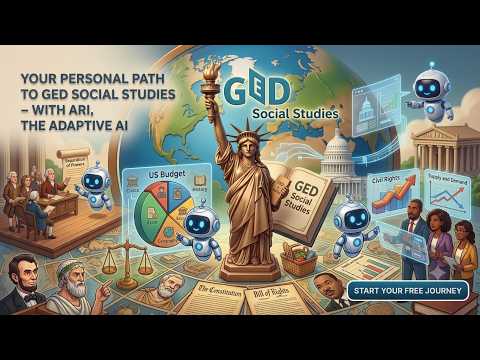
GED Test Preparation

GED Social Studies

This test doesn't ask you to memorize dates or presidents. It gives you a passage — about government, history, or economics — and asks what does this mean?

Ari teaches you to read those passages and think through them. If you can follow the news, you can learn to pass this test.

Start Studying — Free Try a Question First
Video: GED Social Studies with Ari
Think you don't know anything about social studies? You already do. You pay taxes, you've seen elections on TV, you know gas prices go up and down. The GED just asks you to think about WHY these things happen. Ari helps you connect what you already know to what the test asks.

How Ari Is Different from a Textbook

Explains Until You Get It

Confused? Ask again. Ari uses different words, different examples, a different angle — as many times as it takes. No one's watching, no one's judging.

Skips What You Know

Already understand how elections work? Ari moves on. Confused by checks and balances? Ari stays there until it makes sense.

Uses Real Life

Why are groceries more expensive? What does a governor actually do? Why can't the president just do whatever he wants? Ari starts with your questions.

Works on Your Phone

Study on break, on the bus, waiting for your kids. 15 minutes is enough. No laptop needed.

What's Actually on the Test

Four areas. You read short passages and answer questions about what they mean.

Civics
50%

How the government works — the Constitution, three branches, your rights, elections, laws. Half the test.

U.S. History
20%

Major events and WHY they happened — Revolution, Civil War, civil rights. Not memorizing dates.

Economics
15%

How money and the economy work — supply and demand, taxes, trade, personal finance.

Geography
15%

How the world is connected — resources, migration, globalization, environment.

20 Topics. Everything the Test Covers.

Each one is a conversation with Ari. Start anywhere — they don't need to go in order.

Civics & Government (50%)
1. Foundations of American Government

Core principles underlying American democracy: federalism, separation of powers, checks an...

Civics & Government (50%)
2. Constitutional Government & Principles

The U.S. Constitution's structure, the Bill of Rights, amendment process, and key constitu...

Civics & Government (50%)
3. Structure & Functions of Government

How federal, state, and local governments are organized, their specific functions, and how...

Civics & Government (50%)
4. Rights & Responsibilities of Citizens

Civil rights vs civil liberties, voting rights evolution, civic duties, and how citizens p...

Civics & Government (50%)
5. Public Policy & Civic Life

How public policy is made, the role of political parties and media, elections and campaign...

U.S. History (20%)
6. Colonialism & Settlement

European colonization of America, colonial regions, interactions with Native Americans, an...

U.S. History (20%)
7. American Revolution & Constitution

Causes of the American Revolution, key events, the Declaration of Independence, and the cr...

U.S. History (20%)
8. Expansion & Reform

Westward expansion, manifest destiny, reform movements, and growing sectional tensions ove...

U.S. History (20%)
9. Civil War & Reconstruction

Causes of the Civil War, key events, the Emancipation Proclamation, Reconstruction policie...

U.S. History (20%)
10. Industrialization & Modern America

Industrial Revolution, immigration, Progressive Era, World Wars, Great Depression, and the...

Economics (15%)
11. Basic Economic Concepts

Scarcity, opportunity cost, factors of production, and economic decision-making that affec...

Economics (15%)
12. Supply & Demand

How supply and demand determine prices, market equilibrium, and factors that shift supply ...

Economics (15%)
13. Economic Systems

Comparing market, command, and mixed economies, understanding how different systems answer...

Economics (15%)
14. Government & the Economy

How government influences the economy through fiscal policy, monetary policy, and economic...

Economics (15%)
15. Personal Finance & Global Economics

Personal financial literacy, credit and debt, and how international trade and globalizatio...

Geography & World (15%)
16. Physical Geography

Landforms, climate patterns, natural resources, and how the physical environment shapes hu...

Geography & World (15%)
17. Human Geography

Population distribution, urbanization, cultural regions, and how human activities organize...

Geography & World (15%)
18. Population & Migration

Population growth patterns, migration push/pull factors, immigration policy, and demograph...

Geography & World (15%)
19. Natural Resources & Environment

Resource distribution, environmental challenges, sustainability, and the tension between d...

Geography & World (15%)
20. Global Interactions & Development

Globalization, international organizations, development levels, and how countries interact...

What a Study Session Looks Like

It's a conversation, not a lecture. Here's an example:

Ari Finds Your Level

"A state passes a law that goes against a federal law. What happens?" — Ari starts with a real scenario to see what you already understand about how government works.

You Talk It Through

You say "the federal law wins." Ari confirms — then asks the harder question: "What about speed limits? Why does each state get to set its own?" Now you're learning federalism without even realizing it.

Ari Checks You Got It

New scenario: "Your city wants to ban plastic bags. Does it need permission from the federal government?" If you get it, you move on. If not, Ari explains differently.

Try It Right Now

Ask Ari a question about the government, history, or the economy. Or ask about the exam itself. No sign-up needed.

Hey! 👋 I'm Ari. I help people pass the GED Social Studies test. Want to try a sample question? Or ask me anything — what's on the test, how long you need to study, whatever's on your mind.

Built for People Like You

This is for you if...
  • You need to pass Social Studies to get your GED
  • You've been out of school and history class feels like a lifetime ago
  • You learn better by talking through ideas than reading a textbook alone
  • You tried studying before but didn't know where to focus
  • You need this credential — for a job, for college, for yourself
What you don't need
  • No history background — Ari starts where YOU are
  • No textbooks or study guides to buy
  • No computer — works on your phone
  • No set schedule — study whenever you have time
  • No money — completely free, no hidden costs

You Can Pass This Test.

20 topics. A coach that meets you where you are. As much practice as you need. No cost, no catch.

Start Studying — Free
Chat with us