GED Test Preparation

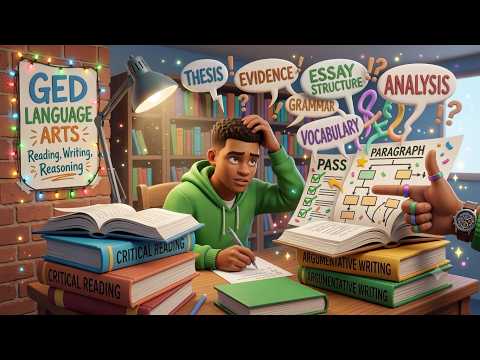
GED Language Arts

This test has two parts: reading (can you understand what a passage is saying?) and writing (can you write a short essay about what you read?).

If you can read a news article and have an opinion about it — you have the foundation. Ari helps you build the rest.

Start Studying — Free Try a Question First
Video: GED Language Arts with Ari
Nervous about the essay? You don't need to be a "good writer." The essay just asks you to read two short articles, pick which one makes a better argument, and explain why using quotes from the articles. Ari breaks it into steps so small that anyone can do it.

How Ari Helps You Prepare

Reading Without the Struggle

Ari gives you short passages and asks simple questions first. As you get comfortable, the questions get harder — at YOUR pace.

Essay in Small Steps

First you learn to write one sentence (thesis). Then one paragraph. Then you connect them. The full essay is just those small pieces together.

Grammar That Makes Sense

No memorizing rules. Ari shows you a sentence with an error, you spot it, and you learn the fix in context. The way grammar actually sticks.

Works on Your Phone

Practice reading and grammar anywhere. For essay practice, a keyboard helps — but you can plan and outline on your phone too.

What's on the Test

Reading, arguing, grammar, and one essay. Here's how it breaks down:

Reading
35%

Understand what you read — main idea, inferences, author's purpose, how text is organized.

Arguments
45%

Judge whether evidence is strong, spot logical flaws, compare two viewpoints. The biggest section.

Grammar
20%

Fix sentence errors — fragments, run-ons, agreement, punctuation. All in context, not isolated rules.

Essay
45 min

Read two passages, pick which argument is stronger, explain why with quotes. That's it.

14 Topics. Every Skill the Test Measures.

Start anywhere. Each topic builds one specific skill through conversation with Ari.

Reading Comprehension (35%)
1. Central Themes & Evidence

Finding the main idea of a passage, identifying supporting evidence, and distinguishing ce...

Reading Comprehension (35%)
2. Making Inferences

Drawing conclusions from what's implied but not directly stated, using context clues, and ...

Reading Comprehension (35%)
3. Figurative Language & Rhetoric

Understanding how authors use word choice, figurative language, and tone to create meaning...

Reading Comprehension (35%)
4. Text Structure & Purpose

How authors organize information — cause/effect, compare/contrast, sequence, problem/solut...

Argumentation & Response (45%)
5. Evaluating Evidence & Sources

Judging whether evidence is strong or weak, relevant or irrelevant, and whether a source i...

Argumentation & Response (45%)
6. Analyzing Arguments

Identifying claims, recognizing logical fallacies, evaluating reasoning, and distinguishin...

Argumentation & Response (45%)
7. Comparing Claims & Viewpoints

Analyzing how two authors approach the same topic differently, comparing their evidence, a...

Argumentation & Response (45%)
8. Structured Writing

Organizing an essay with a clear thesis, logical paragraphs, smooth transitions, and a str...

Argumentation & Response (45%)
9. Evidence-Based Writing Practice

Practicing the full extended response: reading two passages, forming a thesis, writing bod...

Grammar & Language (20%)
10. Sentence Structure

Fixing fragments, run-on sentences, comma splices, and creating clear, complete sentences....

Grammar & Language (20%)
11. Subject-Verb Agreement

Making subjects and verbs match in number, especially in tricky situations with compound s...

Grammar & Language (20%)
12. Punctuation & Mechanics

Commas, semicolons, apostrophes, capitalization, and the punctuation rules most commonly t...

Grammar & Language (20%)
13. Word Choice & Clarity

Choosing precise words, eliminating wordiness, maintaining consistent tone, and improving ...

Extended Response (Essay)
14. Practice Essay

Putting it all together — timed essay practice analyzing two passages, from planning throu...

What a Study Session Looks Like

Ari Gives You a Passage

A short paragraph — maybe about a new city policy. Then: "What's the author's main point?" You read it, think about it, answer in your own words.

Ari Pushes Deeper

"Good — now what EVIDENCE does the author use to support that point? Is it strong evidence or just an opinion?" You're learning critical reading without realizing it.

You Build Real Skills

Each conversation teaches you to read more carefully, spot weak arguments, and express your thinking clearly. Those are the exact skills the GED tests.

Try It Right Now

Ask Ari about the test, try a reading question, or ask about the essay. No sign-up needed.

Hey! 👋 I'm Ari. I help people pass the GED Language Arts test — both the reading questions and the essay. Want to try a sample question? Or ask me anything about the test.

Built for People Like You

This is for you if...
  • Reading feels slow or confusing and you want to get faster at understanding passages
  • Writing an essay feels overwhelming and you don't know where to start
  • Grammar rules never made sense in school the first time around
  • You need this test to move forward — better job, college, personal goal
  • You learn better through practice and conversation than reading a textbook
What you don't need
  • No English degree — Ari teaches from scratch
  • No books to buy or workbooks to complete
  • No computer required — works on your phone
  • No perfect grammar — you'll learn as you go
  • No money — 100% free, always

You Can Pass This Test.

14 topics. Reading, writing, and grammar — taught step by step. No cost, no catch.

Start Studying — Free
Chat with us