GED Test Preparation

GED Science

You don't need to memorize the periodic table or know every bone in the body. The GED Science test asks you to think through problems — read about an experiment, look at data, and figure out what it means. Ari teaches you that skill through conversation. No textbooks. No jargon. Just real understanding, at your pace.

Start Studying — Free See How Ari Works
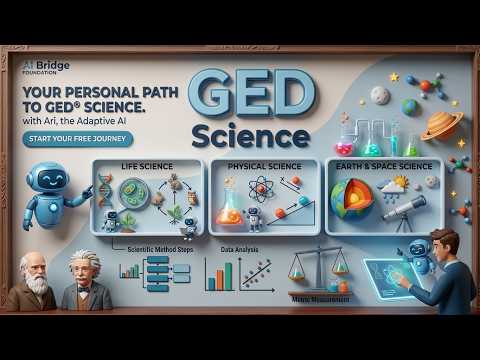

Video: GED Test Preparation
Worried you're "bad at science"? Most people who say that were never taught to reason through it — they were told to memorize facts. The GED doesn't test memorization. It gives you information and asks what it means. Ari teaches you how to think that way. You might surprise yourself.

How Ari Is Different from a Textbook

Explains Until You Get It

Don't understand something? Ask again. Ari rephrases, gives a different example, tries a new angle — as many times as you need. No judgment.

Skips What You Know

Already understand how food chains work? Ari moves on. Struggle with chemical reactions? Ari stays there until it clicks.

Connects to Real Life

Why does ice float? Why do you sweat? How do vaccines work? Ari teaches science through things you already experience every day.

Works on Your Phone

Study on break, on the bus, whenever you have 15 minutes. No laptop required. Just your phone and an internet connection.

How Ari Works

Ari is an AI tutor that adapts to how you respond — here's what it does across sessions.

Your AI Tutor

Ari adjusts based on your responses. After a few sessions, it shifts its approach:

  • Teaches the concept first, then checks if it landed
  • Adjusts difficulty based on how you're responding
  • Remembers what you struggled with across sessions
  • Varies format: multiple choice, scenarios, worked examples
  • Flags potential misconceptions based on your answers
Your Learning Profile

After each session, the system updates a profile based on how you interact:

  • Notes which explanation styles you respond to
  • Detects when you seem disengaged and changes approach
  • Tracks what topics you've covered and what's remaining
  • Uses your interests to make examples more relevant
  • Builds on prior sessions instead of starting fresh
Study Suggestions

Ari can suggest what to focus on — but these are AI-generated suggestions, not guarantees:

  • Set a target timeline — Ari suggests a study sequence
  • Ask what to review — it suggests topics based on coverage gaps
  • Highlights areas where you seem less confident
  • Flags topics you haven't practiced in a while
  • Explains why it's suggesting each topic next

Ari is designed around learning science principles — but it's still an AI and can make mistakes.

How Ari Works →

Power Tips — Using Ari Effectively

Ari is an AI language model. It works well for studying — but it has real limitations.

What Works Well
Ask it to explain things differently

"Explain that differently" or "Give me a real-world example."

Ari can rephrase, use analogies, or break things into steps. If one explanation doesn't click, ask for another angle.

Say "quiz me"

"Quiz me on this topic" or "Give me a practice question."

Self-testing builds stronger memory than re-reading. Questions match what you've been studying.

Ask for structured breakdowns

"Show me a comparison table" or "List the steps."

Tables, step-by-step lists, and side-by-side comparisons can help organize complex material.

Ask for a study plan

"I have 30 days and can study 5 hours a week — help me plan."

Ari can suggest a sequence based on what you've covered so far. Use it as a starting point, not gospel.

What to Know
Ari can be wrong

It's a language model — it generates plausible-sounding text based on patterns, just like ChatGPT, Gemini, and Claude. It can state incorrect information confidently. Always verify important facts from official sources.

It's not good at debate

Ari assumes you're here to learn. If you argue or try to trip it up, it won't push back well — it may agree with incorrect statements or get confused. It's a study aid, not a sparring partner.

Progress indicators are the model's best guess

Any progress or mastery shown is the result of the model's pattern matching — not a real measurement. It can never be fully accurate because it's predicting, not testing.

Know what Ari is — and isn't

Ari is a free study tool. It doesn't administer exams, issue credentials, or measure your actual readiness. Exams and credentials come from independent organizations. Ari can help you study — that's it.

What's Actually on the Test

Three areas. You'll read passages and look at data — then answer questions about what you read.

Life Science
40%

The science of living things — your body, how traits get passed down, how species change, how ecosystems work.

Topics: Cells, Human Body, Genetics, Evolution, Ecosystems

Physical Science
40%

How matter behaves, what happens in chemical reactions, how things move, and how energy works.

Topics: Matter, Chemical Reactions, Force & Motion, Waves

Earth & Space
20%

How Earth works — what's under the surface, why weather happens, what's out in space, and how humans affect the planet.

Topics: Earth's Structure, Weather, Universe, Human Impact

13 Topics. Everything the Test Covers.

Each one is a conversation with Ari, built around real scenarios.

Life Science (40%)
1. Cells & Cell Processes

Cell structure, organelles and their functions, photosynthesis, cellular respiration, cell...

Life Science (40%)
2. Human Body & Health

Major body systems, how they interact, the immune system, and how nutrition and lifestyle ...

Life Science (40%)
3. Genetics & Heredity

DNA, genes, inheritance patterns, Punnett squares, mutations, and how traits are passed fr...

Life Science (40%)
4. Evolution & Natural Selection

How species change over time through natural selection, evidence for evolution, and adapta...

Life Science (40%)
5. Ecosystems & Interdependence

Energy flow through ecosystems, food webs, symbiotic relationships, population dynamics, a...

Physical Science (40%)
6. Matter & Its Properties

States of matter, atomic structure, elements and compounds, physical vs chemical propertie...

Physical Science (40%)
7. Chemical Reactions

Chemical equations, conservation of mass, types of reactions, acids and bases, and factors...

Physical Science (40%)
8. Force, Motion & Energy

Newton's laws of motion, speed and acceleration, kinetic and potential energy, work, and c...

Physical Science (40%)
9. Waves & Technology

Wave properties, sound and light, the electromagnetic spectrum, and how wave technology is...

Earth & Space Science (20%)
10. Earth's Structure & Processes

Earth's layers, plate tectonics, the rock cycle, earthquakes, volcanoes, and how Earth's s...

Earth & Space Science (20%)
11. Weather & Climate

Atmosphere, weather patterns, climate zones, the water cycle, climate change, and severe w...

Earth & Space Science (20%)
12. The Universe & Solar System

Solar system structure, Earth-moon-sun relationships, seasons, stars and galaxies, and gra...

Earth & Space Science (20%)
13. Human Impact on Earth Systems

Natural resources, pollution, conservation, renewable vs non-renewable energy, and environ...

What a Study Session Looks Like

It's a conversation, not a lecture. Here's a real example:

Ari Finds Your Level

"A raisin sits in a glass of water for an hour. It swells up. Why?" — Ari starts with a real scenario to see what you already understand.

You Talk It Through

You say "the water goes in." Ari asks what MAKES water move in — and teaches you osmosis through what you already noticed, not a textbook definition.

Ari Checks You Understood

New scenario: "Now you put that swollen raisin in salt water. What happens?" If you get it, you move on. If not, Ari explains differently.

Built for People Like You

This is for you if...
  • You're working on your GED and Science feels like the hardest part
  • You've been out of school for a while and need to rebuild from basics
  • You learn better by talking things through than by reading alone
  • You've tried studying before but the textbooks felt impossible
  • You need to pass this test to move forward — a better job, college, or just proving to yourself you can do it
What you don't need
  • No science background — Ari starts from where YOU are
  • No textbooks or materials to buy
  • No computer — works on your phone
  • No set schedule — study whenever you have time
  • No money — it's completely free, forever

Your Data Stays Yours

We're a nonprofit, not an ad company. We will never monetize your information.
No spam emails. No newsletters. We'll never fill your inbox.

Never Sold

Your data is never sold, rented, or shared with third parties. Ever.

No Tracking

No Google Analytics. No ad cookies. No retargeting. We don't build profiles on you.

One Cookie

A single session cookie keeps you logged in. Disappears when you close the browser.

Delete Anytime

Want your data gone? One email and we wipe everything. No hoops.

You Can Pass This Test.

13 topics. A coach that adapts to you. As much practice as you need. No cost, no catch.

Start Studying — Free
Take it with you

All tools available on your phone — free on Google Play

Get it on Google Play

Disclaimer: GED® is a registered trademark of the American Council on Education, which is not affiliated with this website. AI Bridge Foundation provides a free, general self-study support tool. Responses are AI-generated and may be inaccurate or wrong. Any progress or mastery indicator is the AI model's own output based on pattern matching — not a measure of actual knowledge or readiness. We do not administer exams or issue any credential; all certifications referenced are provided by independent third parties. 100% free — no fees, no work contract, no consideration required.

Chat with us