Skilled Trades

EPA Section 608: Universal Refrigerant Handling

Every HVAC technician needs this card. The EPA 608 proves you can legally handle refrigerants — and this course gets you there through real service scenarios, not boring textbook reading.

Start Learning — Free See How Ari Works
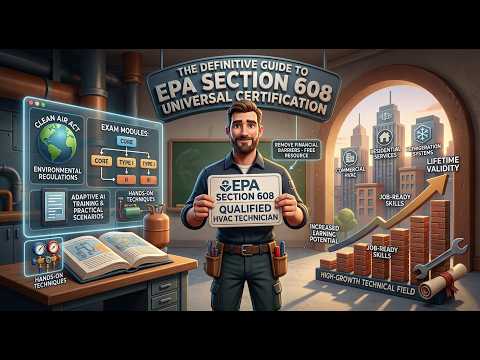

Video: Skilled Trades

Who This Is For

This is for you if...
  • You're entering the HVAC trade and need your EPA card
  • You're a maintenance tech who needs to legally handle refrigerants
  • You're in trade school and want extra practice before the exam
  • Regulations and pressure-temperature charts feel overwhelming
  • You learn better through real service call scenarios than reading manuals
What you get
  • No prerequisites — start with zero HVAC experience
  • Solid understanding of refrigerant handling across all 4 sections
  • Lifetime certification — your EPA card never expires
  • Relevant to HVAC technician, refrigeration mechanic, building maintenance

What You'll Learn

Four exam sections. Everything the EPA requires you to know.

Core
40%

Ozone science, Clean Air Act, refrigerant types, the refrigeration cycle, recovery/recycling/reclamation, safety, and shipping

Type I
15%

Small appliances (≤5 lbs) — household refrigerators, window AC, dehumidifiers. Recovery requirements and techniques.

Type II
25%

High-pressure systems — commercial AC, heat pumps, rooftop units. Leak detection, recovery, P-T relationships, safety.

Type III
20%

Low-pressure systems — centrifugal chillers. Purge units, vacuum charging, rupture discs, R-123 safety.

How Ari Works

Ari is an AI tutor that adapts to how you respond — here's what it does across sessions.

Your AI Tutor

Ari adjusts based on your responses. After a few sessions, it shifts its approach:

  • Teaches the concept first, then checks if it landed
  • Adjusts difficulty based on how you're responding
  • Remembers what you struggled with across sessions
  • Varies format: multiple choice, scenarios, worked examples
  • Flags potential misconceptions based on your answers
Your Learning Profile

After each session, the system updates a profile based on how you interact:

  • Notes which explanation styles you respond to
  • Detects when you seem disengaged and changes approach
  • Tracks what topics you've covered and what's remaining
  • Uses your interests to make examples more relevant
  • Builds on prior sessions instead of starting fresh
Study Suggestions

Ari can suggest what to focus on — but these are AI-generated suggestions, not guarantees:

  • Set a target timeline — Ari suggests a study sequence
  • Ask what to review — it suggests topics based on coverage gaps
  • Highlights areas where you seem less confident
  • Flags topics you haven't practiced in a while
  • Explains why it's suggesting each topic next

Ari is designed around learning science principles — but it's still an AI and can make mistakes.

How Ari Works →

Power Tips — Using Ari Effectively

Ari is an AI language model. It works well for studying — but it has real limitations.

What Works Well
Ask it to explain things differently

"Explain that differently" or "Give me a real-world example."

Ari can rephrase, use analogies, or break things into steps. If one explanation doesn't click, ask for another angle.

Say "quiz me"

"Quiz me on this topic" or "Give me a practice question."

Self-testing builds stronger memory than re-reading. Questions match what you've been studying.

Ask for structured breakdowns

"Show me a comparison table" or "List the steps."

Tables, step-by-step lists, and side-by-side comparisons can help organize complex material.

Ask for a study plan

"I have 30 days and can study 5 hours a week — help me plan."

Ari can suggest a sequence based on what you've covered so far. Use it as a starting point, not gospel.

What to Know
Ari can be wrong

It's a language model — it generates plausible-sounding text based on patterns, just like ChatGPT, Gemini, and Claude. It can state incorrect information confidently. Always verify important facts from official sources.

It's not good at debate

Ari assumes you're here to learn. If you argue or try to trip it up, it won't push back well — it may agree with incorrect statements or get confused. It's a study aid, not a sparring partner.

Very long chats lose detail

Ari keeps the most recent part of a conversation sharpest. In one very long session, earlier details get summarized and can fade. Keep sessions to a reasonable length and focused on one topic — don't try to cover everything in a single marathon chat.

Progress indicators are the model's best guess

Any progress or mastery shown is the result of the model's pattern matching — not a real measurement. It can never be fully accurate because it's predicting, not testing.

Know what Ari is — and isn't

Ari is a free study tool. It doesn't administer exams, issue credentials, or measure your actual readiness. Exams and credentials come from independent organizations. Ari can help you study — that's it.

18 Topics. Complete Coverage.

Every EPA exam section mapped to a conversation with Ari.

Core (40%)
1. Ozone Depletion & Environmental Impact

The learner will understand how chlorine-containing refrigerants destroy stratospheric ozone, identify refrigerant class...

Core (40%)
2. Clean Air Act & Montreal Protocol

The learner will understand the federal legislation and international agreements that govern refrigerant handling, ident...

Core (40%)
3. Section 608 Regulations & Compliance

The learner will understand the specific regulatory requirements of Section 608 including equipment classifications, rec...

Core (40%)
4. Refrigerant Types & Classification

The learner will identify common refrigerants by R-number designation, classify them into CFC/HCFC/HFC/HFO categories, u...

Core (40%)
5. Substitute Refrigerants & Oils

The learner will understand the relationship between refrigerants and lubricating oils, identify compatible oil types fo...

Core (40%)
6. The Refrigeration Cycle

The learner will understand the basic vapor-compression refrigeration cycle, identify the state of refrigerant at each p...

Core (40%)
7. Recovery, Recycling & Reclamation

The learner will distinguish between recovery, recycling, and reclamation processes, understand when each is appropriate...

Core (40%)
8. Dehydration & Evacuation

The learner will understand why evacuation is necessary after service, know the required vacuum levels for different equ...

Core (40%)
9. Refrigerant Safety

The learner will identify the health hazards of refrigerant exposure, understand proper use of personal protective equip...

Core (40%)
10. Shipping & Cylinder Handling

The learner will understand DOT requirements for transporting refrigerant cylinders, proper labeling, the difference bet...

Type I - Small Appliances (15%)
11. Small Appliance Recovery Requirements

The learner will understand the definition of small appliances, know the specific evacuation requirements for systems wi...

Type I - Small Appliances (15%)
12. Small Appliance Recovery Techniques & Safety

The learner will understand methods for recovering refrigerant from small appliances with both operative and inoperative...

Type II - High-Pressure (25%)
13. High-Pressure Leak Detection & Repair

The learner will identify signs of leakage in high-pressure systems, understand leak testing methods and their order of ...

Type II - High-Pressure (25%)
14. High-Pressure Recovery Techniques & Requirements

The learner will understand evacuation requirements for high-pressure equipment based on system size, repair type, and e...

Type II - High-Pressure (25%)
15. High-Pressure Refrigeration Systems

The learner will identify components of high-pressure refrigeration systems, understand pressure-temperature relationshi...

Type II - High-Pressure (25%)
16. High-Pressure Safety & Equipment Rooms

The learner will understand safety considerations specific to high-pressure equipment, know ASHRAE Standard 15 equipment...

Type III - Low-Pressure (20%)
17. Low-Pressure Leak Detection & Repair

The learner will understand the unique characteristics of low-pressure systems that operate below atmospheric pressure, ...

Type III - Low-Pressure (20%)
18. Low-Pressure Recovery, Recharging & Safety

The learner will understand recovery techniques specific to low-pressure systems, know evacuation requirements, understa...

Why HVAC?

Recession-Proof

Every building with AC needs certified technicians. HVAC demand doesn't disappear in economic downturns — buildings still need cooling and heating.

$50K–$75K+ Salary

HVAC technicians earn well above average, with significant overtime opportunity. Commercial and industrial techs earn even more.

Fast Entry

The EPA 608 is a knowledge test — no degree, no apprenticeship hours required. Study, pass, and you're legally certified to handle refrigerants.

Your Data Stays Yours

We're a nonprofit, not an ad company. We will never monetize your information.
No spam emails. No newsletters. We'll never fill your inbox.

Never Sold

Your data is never sold, rented, or shared with third parties. Ever.

No Tracking

No Google Analytics. No ad cookies. No retargeting. We don't build profiles on you.

One Cookie

A single session cookie keeps you logged in. Disappears when you close the browser.

Delete Anytime

Want your data gone? One email and we wipe everything. No hoops.

Get Your EPA Card.

18 topics. Real service scenarios. Free forever. Don't spend hundreds on prep courses when you can learn through conversation with an AI that adapts to you.

Start Learning — Free
Take it with you

All tools available on your phone — free on Google Play

Get it on Google Play

Disclaimer: EPA Section 608 certification is administered by EPA-approved testing organizations (ESCO Institute, RSES, etc.). AI Bridge Foundation is not affiliated with the EPA or any testing organization. AI Bridge Foundation provides a free, general self-study support tool. Responses are AI-generated and may be inaccurate or wrong. Any progress or mastery indicator is the AI model's own output based on pattern matching — not a measure of actual knowledge or readiness. We do not administer exams or issue any credential; all certifications referenced are provided by independent third parties. 100% free — no fees, no work contract, no consideration required.

Chat with us