Networking

CompTIA Network+ N10-009: Networking Certification

The foundation for every IT career path — networking, security, cloud, systems administration. Five domains, up to 90 questions, 90 minutes. Learn to build, manage, and troubleshoot real networks.

Start Learning — Free See How Ari Works
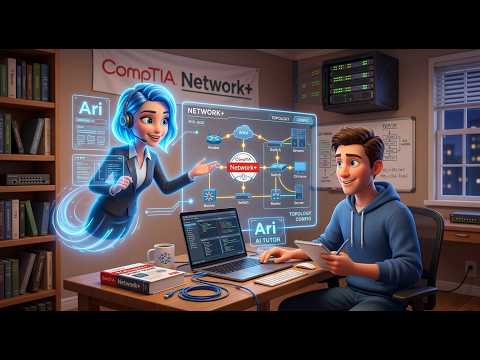

Video: Networking

Who This Is For

This is for you if...
  • You want to move from help desk into network administration or engineering
  • You have A+ and need the next step on the CompTIA pathway
  • Subnetting, VLANs, and routing protocols still feel confusing
  • You struggle with performance-based questions requiring real troubleshooting
  • You learn better by solving network problems than reading textbook theory
What you get
  • No prerequisites — start from any IT background level
  • Solid understanding of networking fundamentals
  • Real subnetting practice — not just formulas, actual scenario-based problems
  • Troubleshooting skills that transfer directly to the job
  • Foundation for Security+, CCNA, and cloud certifications

What You'll Learn

Five exam domains. Weighted exactly how CompTIA tests them.

Troubleshooting
24%

Methodology, cabling issues, service problems, performance bottlenecks, command-line tools — the largest domain on the exam

Networking Concepts
23%

OSI model, ports & protocols, IP addressing, subnetting, cloud, SDN, zero trust, IPv6 — the theoretical foundation

Implementation
20%

Routing, switching, VLANs, wireless configuration, physical installations — building real networks

Network Operations
19%

Documentation, monitoring, disaster recovery, DHCP/DNS/NTP services, VPN & remote management

Network Security
14%

Encryption, IAM, attacks (DDoS, ARP poisoning, evil twin), hardening, NAC, ACLs, security zones

How Ari Works

Ari is an AI tutor that adapts to how you respond — here's what it does across sessions.

Your AI Tutor

Ari adjusts based on your responses. After a few sessions, it shifts its approach:

  • Teaches the concept first, then checks if it landed
  • Adjusts difficulty based on how you're responding
  • Remembers what you struggled with across sessions
  • Varies format: multiple choice, scenarios, worked examples
  • Flags potential misconceptions based on your answers
Your Learning Profile

After each session, the system updates a profile based on how you interact:

  • Notes which explanation styles you respond to
  • Detects when you seem disengaged and changes approach
  • Tracks what topics you've covered and what's remaining
  • Uses your interests to make examples more relevant
  • Builds on prior sessions instead of starting fresh
Study Suggestions

Ari can suggest what to focus on — but these are AI-generated suggestions, not guarantees:

  • Set a target timeline — Ari suggests a study sequence
  • Ask what to review — it suggests topics based on coverage gaps
  • Highlights areas where you seem less confident
  • Flags topics you haven't practiced in a while
  • Explains why it's suggesting each topic next

Ari is designed around learning science principles — but it's still an AI and can make mistakes.

How Ari Works →

Power Tips — Using Ari Effectively

Ari is an AI language model. It works well for studying — but it has real limitations.

What Works Well
Ask it to explain things differently

"Explain that differently" or "Give me a real-world example."

Ari can rephrase, use analogies, or break things into steps. If one explanation doesn't click, ask for another angle.

Say "quiz me"

"Quiz me on this topic" or "Give me a practice question."

Self-testing builds stronger memory than re-reading. Questions match what you've been studying.

Ask for structured breakdowns

"Show me a comparison table" or "List the steps."

Tables, step-by-step lists, and side-by-side comparisons can help organize complex material.

Ask for a study plan

"I have 30 days and can study 5 hours a week — help me plan."

Ari can suggest a sequence based on what you've covered so far. Use it as a starting point, not gospel.

What to Know
Ari can be wrong

It's a language model — it generates plausible-sounding text based on patterns, just like ChatGPT, Gemini, and Claude. It can state incorrect information confidently. Always verify important facts from official sources.

It's not good at debate

Ari assumes you're here to learn. If you argue or try to trip it up, it won't push back well — it may agree with incorrect statements or get confused. It's a study aid, not a sparring partner.

Very long chats lose detail

Ari keeps the most recent part of a conversation sharpest. In one very long session, earlier details get summarized and can fade. Keep sessions to a reasonable length and focused on one topic — don't try to cover everything in a single marathon chat.

Progress indicators are the model's best guess

Any progress or mastery shown is the result of the model's pattern matching — not a real measurement. It can never be fully accurate because it's predicting, not testing.

Know what Ari is — and isn't

Ari is a free study tool. It doesn't administer exams, issue credentials, or measure your actual readiness. Exams and credentials come from independent organizations. Ari can help you study — that's it.

25 Topics. Complete N10-009 Coverage.

Every exam sub-objective mapped to a conversation with Ari.

Networking Concepts (23%)
1. OSI Model & Data Encapsulation

Describe the seven OSI layers, place protocols and devices at the correct layer, and trace how data is encapsulated and ...

Networking Concepts (23%)
2. Network Appliances & Functions

Compare and contrast networking appliances, applications, and functions including routers, switches, firewalls, IDS/IPS,...

Networking Concepts (23%)
3. Cloud Concepts & Connectivity

Summarize cloud concepts and connectivity options including deployment models, service models, network functions virtual...

Networking Concepts (23%)
4. Ports, Protocols & Traffic Types

Identify common TCP/UDP ports, distinguish connection-oriented from connectionless transport, and classify traffic as un...

Networking Concepts (23%)
5. Cabling, Connectors & Media

Select and identify copper and fiber media, connectors, and transceivers for a given distance and speed, and apply corre...

Networking Concepts (23%)
6. Network Topologies & Architectures

Compare and contrast network topologies, architectures, and types including mesh, star, spine-and-leaf, three-tier hiera...

Networking Concepts (23%)
7. IP Addressing & Subnetting

Interpret IPv4 and IPv6 addressing, calculate subnets using CIDR, and distinguish public, private, and special-use range...

Networking Concepts (23%)
8. Modern Network Environments

Summarize evolving use cases for modern network environments including SDN, SD-WAN, VXLAN, zero trust architecture, SASE...

Network Implementation (20%)
9. Routing Fundamentals

Explain how routers forward packets using routing tables, distinguish static from dynamic routing, and compare common ro...

Network Implementation (20%)
10. Switching, VLANs & Spanning Tree

Explain how switches forward frames via MAC tables, segment networks with VLANs and trunks, and prevent loops with Spann...

Network Implementation (20%)
11. Wireless Networking (Wi-Fi)

Explain Wi-Fi standards, bands and channels, antenna and placement choices, and wireless security. Recognizing interfere...

Network Implementation (20%)
12. Physical Installations & Environment

Explain important factors of physical installations including rack infrastructure, IDF/MDF placement, power systems, cab...

Network Operations (19%)
13. Organizational Processes & Documentation

Explain the role of network documentation in daily operations, apply lifecycle and change management processes to mainta...

Network Operations (19%)
14. Network Monitoring Technologies

Apply SNMP, flow analysis, packet capture, and log aggregation technologies to monitor network health, detect anomalies,...

Network Operations (19%)
15. Disaster Recovery & High Availability

Explain redundancy and high-availability designs, disaster recovery metrics and site types, and backup and power protect...

Network Operations (19%)
16. Network Services (DNS, DHCP, NTP)

Explain how DNS resolves names, DHCP assigns addresses, and NTP synchronizes time, plus NAT. Recognizing their record ty...

Network Operations (19%)
17. Network Access & Management Methods

Evaluate VPN technologies for secure remote connectivity, compare management connection methods for device administratio...

Network Security (14%)
18. Network Security Concepts

Apply encryption and PKI to protect data, evaluate identity and access management frameworks for authentication and auth...

Network Security (14%)
19. Network Attacks & Impact

Identify common Layer 2, application-layer, and social engineering attacks, evaluate their impact on network availabilit...

Network Security (14%)
20. Security Features & Defense Techniques

Apply device hardening practices, configure network access control mechanisms, and design security zones to reduce the n...

Network Troubleshooting (24%)
21. Troubleshooting Methodology

Apply the structured CompTIA troubleshooting methodology to systematically identify, diagnose, and resolve network probl...

Network Troubleshooting (24%)
22. Troubleshooting Cabling & Physical Issues

Diagnose Layer 1 problems: copper and fiber cabling faults, interface errors, duplex mismatches, and power/environmental...

Network Troubleshooting (24%)
23. Troubleshooting Network Services

Diagnose and resolve common switching, routing, and IP addressing problems that disrupt network services. These issues a...

Network Troubleshooting (24%)
24. Troubleshooting Performance Issues

Diagnose and resolve network performance degradation caused by congestion, bottlenecks, interference, and misconfigurati...

Network Troubleshooting (24%)
25. Network Troubleshooting Tools

Select and apply the correct software, hardware, and device command tools to diagnose network faults efficiently. Knowin...

Why Network+?

Gateway to Everything

Network+ is the bridge between A+ and Security+, CCNA, cloud certs, and systems administration. Every IT specialization requires networking fundamentals.

$55K–$85K Starting Range

Network technician, junior network admin, help desk (Tier 2), NOC analyst — Network+ validates you can manage real infrastructure, not just answer phones.

Vendor-Neutral Foundation

Unlike Cisco CCNA, Network+ covers concepts across all vendors. Learn the principles once, apply them to Cisco, Juniper, Aruba, Meraki — any equipment you encounter.

Your Data Stays Yours

We're a nonprofit, not an ad company. We will never monetize your information.
No spam emails. No newsletters. We'll never fill your inbox.

Never Sold

Your data is never sold, rented, or shared with third parties. Ever.

No Tracking

No Google Analytics. No ad cookies. No retargeting. We don't build profiles on you.

One Cookie

A single session cookie keeps you logged in. Disappears when you close the browser.

Delete Anytime

Want your data gone? One email and we wipe everything. No hoops.

Your Networking Career Starts Here.

25 topics. Scenario-based learning. Free forever. Don't spend $400+ on prep courses when you can learn through conversation with an AI that adapts to how you think.

Start Learning — Free
Take it with you

All tools available on your phone — free on Google Play

Get it on Google Play

Disclaimer: CompTIA® and Network+® are registered trademarks of the Computing Technology Industry Association. AI Bridge Foundation is not affiliated with CompTIA. AI Bridge Foundation provides a free, general self-study support tool. Responses are AI-generated and may be inaccurate or wrong. Any progress or mastery indicator is the AI model's own output based on pattern matching — not a measure of actual knowledge or readiness. We do not administer exams or issue any credential; all certifications referenced are provided by independent third parties. 100% free — no fees, no work contract, no consideration required.

Chat with us