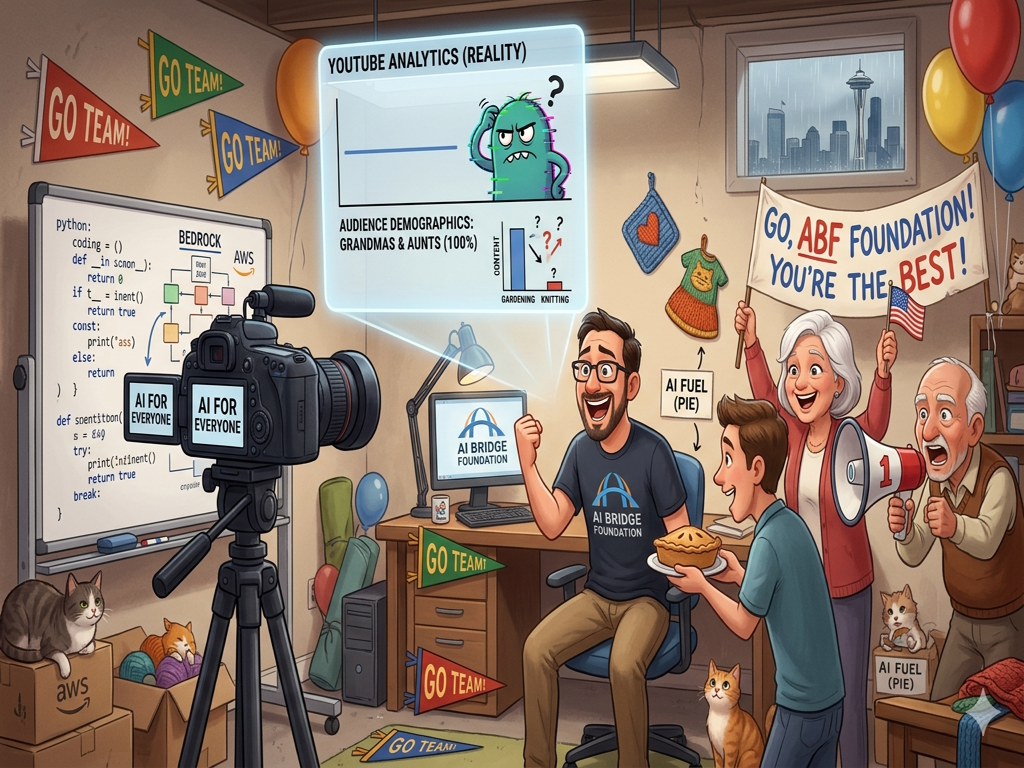
Our YouTube Channel: The Greatest Failure That Built a Venture Studio
When we first launched the AI Bridge Foundation YouTube channel, we weren't looking for fame. We didn't have a "MrBeast" complex or a desire to go viral. We just wanted to be useful. We were building these complex AI tools—the Tutor, the Lab, the Studio—and we needed a place to host video guides. We figured YouTube was just a free video player for our website visitors.
Then, we made the classic "First-Timer" mistake. In the early days, the channel was a ghost town. So, we did what anyone would do: we shared the link with our families. We asked them to subscribe, to watch, and to "like" the videos. And they did—with a passion that was both heartwarming and, as it turns out, mathematically devastating.
Our aunts and grandmothers were our biggest fans. They watched every second of high-level Python coding tutorials. They left heart emojis on videos about AWS Bedrock and neural networks. But here is the problem: YouTube's algorithm is a very literal creature. It looked at our data and concluded: "Ah, I see! This AI content is clearly intended for people who enjoy knitting, gardening, and family recipe videos!"
Suddenly, our videos weren't reaching the 20-year-old computer science students or the scrappy entrepreneurs in their garages. We were being cheered on by the best fans in the world, but the algorithm had effectively put us in a "Family & Hobby" box. We were shouting into the wrong room, and the door was locked.
This triggered a "Mad Scientist" phase.
We stopped coding for a second and became students of the "Attention Economy." We stayed up late analyzing trending formats and obsessing over Click-Through Rates (CTR). We watched so many MrBeast videos that we started dreaming in high-contrast thumbnails and 2-second jump cuts. We were looking for the "magic trick" that would fix our reach.
That's when the vultures arrived. Our inboxes started filling up with SEO companies promising "10,000 subscribers overnight" for a fee. They offered a shortcut—fake views and bot subscribers to make us look successful. It was disheartening and frustrating to feel like the only way to win was to cheat. But we said no. We didn't want a fake audience; we wanted to understand the struggle.
And that frustration became the spark for the AI Venture Studio.
We realized that if we—a team literally building AI systems—were getting defeated by a recommendation algorithm, how was a solo creator or a small business owner supposed to stand a chance? We saw a massive gap between "having a tool" and "having an audience." We realized that "success" isn't a straight line, and most people give up because the "middle part" is so lonely and confusing.
We decided to stop hiding our "low view counts" and started documenting the real, messy journey. We realized that the "messy middle"—the part where you're trying, failing, recalibrating, and getting your ego bruised—is actually the most valuable thing we can share.
Today, our subscriber count isn't breaking the internet, and our videos aren't going viral every hour. But we've traded popularity for impact. Every view on our channel represents a real person who actually needs guidance—someone we can help one-on-one through the Venture Studio.
We're still creating, still failing, and still learning. We aren't gurus; we're just builders who refuse to give up until the bridge is finished.