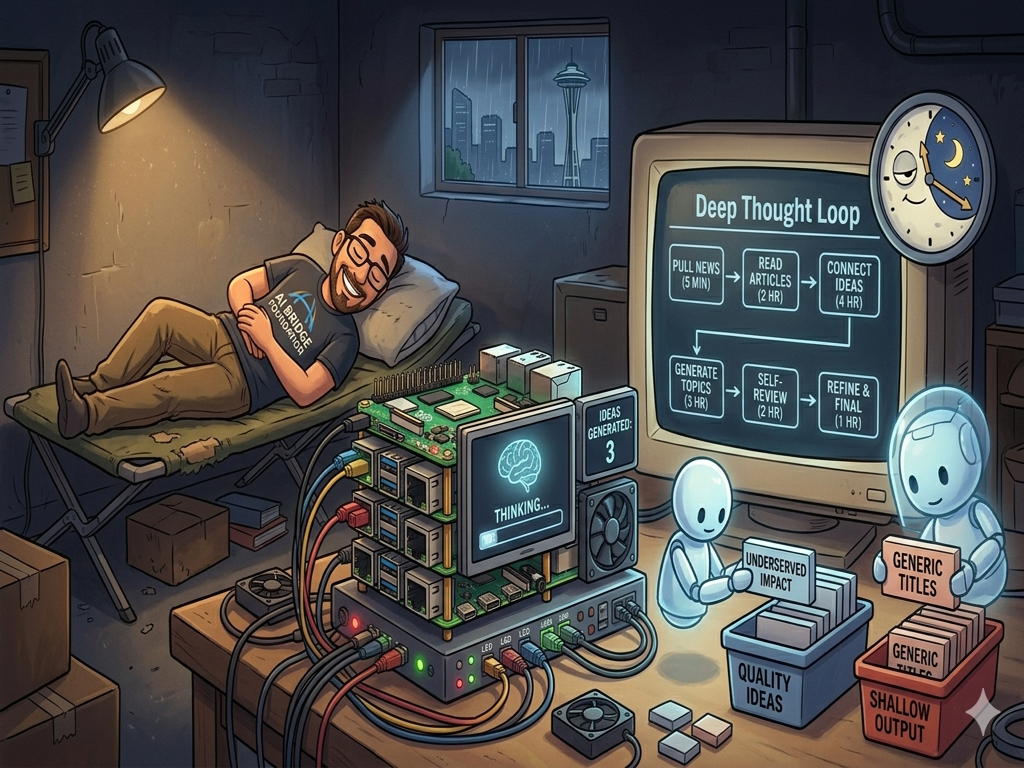
The Overnight Thinker: Why I Built a "Slow" AI to Do My Homework
Let me start with a confession: I have been in software for almost 20 years.
Naturally, when people tell me, "Just use a No-Code automation tool—it's easy!" I try. I really do. I looked at the big players like Make.com. Click here, drag this box, connect that bubble. Done. And objectively? It's powerful. But for me, something felt... off.
Maybe it's a "20 years in the trenches" problem, but I don't just want things to run. I want to understand how they think.
The Bottleneck (Me)
At the AI Bridge Foundation, everything depends on the "Mental Load." Researching grants, finding news for the Venture Studio, coming up with scenarios for the Challenge Lab—it was mostly me. And that doesn't scale. Not if we're serious about keeping up with how fast AI moves.
I had a very specific vision. I didn't want "automation" in the sense of a mindless robot spitting out 50 useless titles. I wanted to wake up and see that something had been thinking while I was asleep.
I wanted an AI that does its homework.
The Raspberry Pi Rebellion
I set out to build a system that thinks deeply, reviews its own work, and—most importantly—doesn't send me a surprise $500 cloud bill in the morning.
Naturally, I made things harder for myself. Instead of using massive, expensive cloud servers, I started running Gemma on a Raspberry Pi. Yes, a computer the size of a deck of cards. It's not fast. It's not fancy. It's definitely not "impressive" on a corporate slide deck.
Every night, while the world is quiet, this tiny machine goes to work:
It pulls in the latest AI news.
It reads the articles.
It tries to connect the dots.
It generates topics... then reviews them... then refines them.
Over and over again.
Is it fast? No. It's painfully slow. But here's the beauty of it: I'm asleep. I don't care if it takes six hours to produce five ideas, as long as those five ideas actually matter.
The First Morning It Worked
I still remember waking up, making coffee, and opening my laptop fully expecting the usual disaster—garbled text, half-finished thoughts, maybe just an error log staring back at me. Instead, there were four topic ideas sitting in a neat little file. One of them had connected a federal AI literacy grant to our GED program. I'd been looking at both of those things for weeks and never made that connection myself.
It wasn't magic. It was just a tiny machine that had the patience to read thirty articles while I was dreaming about who-knows-what, and quietly asked itself, "What do these have in common?" That's the thing about slow thinking—it catches what fast skimming misses.
I sat there with my coffee getting cold, scrolling through its notes, and thought: "Okay. This weird little experiment might actually be onto something."
Quality Over Noise
In the morning, I don't get a list of 100 generic "Top 10 AI Trends" posts. I get maybe three or four ideas that are grounded in reality. They are filtered through our specific lens: How does this help an underserved community? We aren't just generating content; we're translating. We're taking the high-speed noise of the AI world and turning it into something that says: "Hey—this actually matters to you. Here's why."
Without that filter, AI output is just noise with better grammar. With it, even a tiny model on a tiny computer can surprise you—because it knows what it's looking for.
The Question Everyone Asks
"Why not just use the cloud?"
Fair. Cloud APIs are faster, smarter, and infinitely more capable. I could call a frontier model and get better raw output in seconds. But that misses the point of what we're trying to do here.
If we tell people in underserved communities that AI is for them too, but then our entire operation runs on infrastructure they could never afford—what are we really saying? The Raspberry Pi isn't just a cost-saving measure. It's a statement. It says: this can be done with what you have. If a computer the size of a deck of cards can do overnight research, imagine what someone with a used laptop and a free weekend could build.
The Stubborn Assistant
We're still tweaking the prompts. We're still adjusting the logic. Sometimes I still think, "I could have just used a click-and-drag tool and been done months ago."
But then I look at what this slow, stubborn little machine produces. It doesn't just dump output and move on; it revisits its own thoughts. It refuses to be shallow.
And honestly? That feels a lot closer to what we actually need. If we're serious about helping people learn how to think, build, and grow, then the goal isn't "More content, faster."
The goal is better thinking—even when we aren't awake.