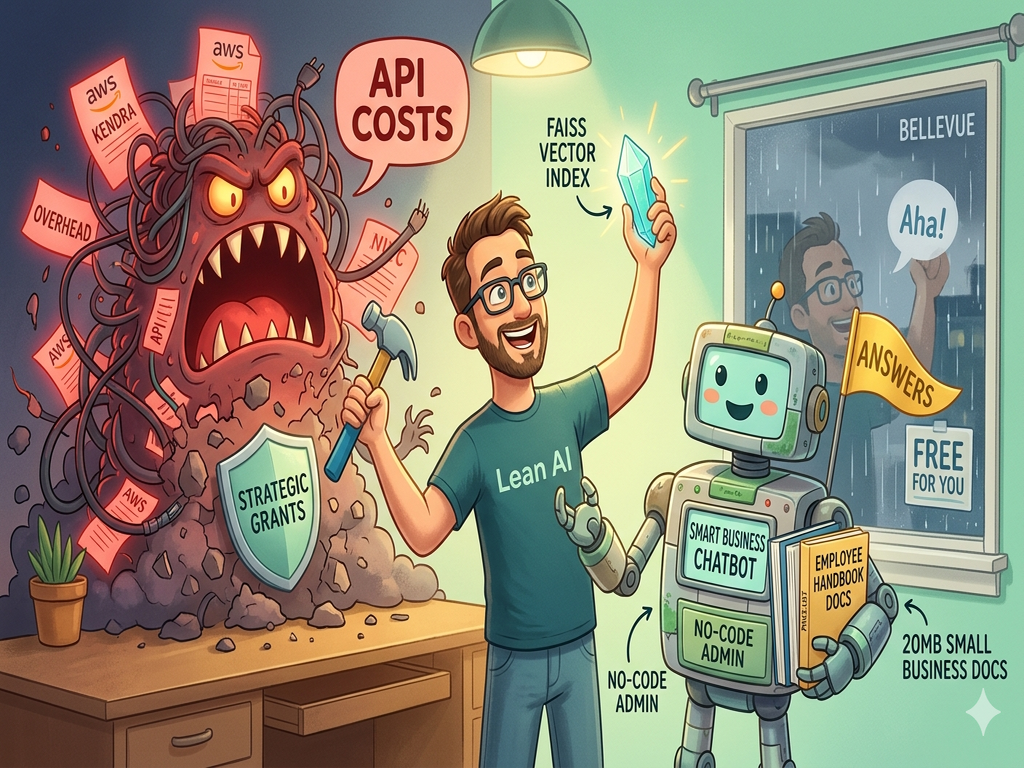
From Big Ideas to Small Bills: The Story Behind Our "Free" Smart Business Chatbot
It started, like many good ideas do, with a big promise. When we launched the AI Bridge Foundation, we told ourselves something simple but ambitious: AI should be accessible to everyone. Not just big companies. Not just engineers. Everyone.
For a moment, that idea felt easy. Almost obvious. Then the cloud bill arrived.
At first, we did what most teams do. We looked at the "best" tools out there—the powerful, enterprise-grade solutions. On paper, they were perfect. Tools like AWS Kendra could do everything we imagined and more. But the more we explored, the more something felt off. It was like walking into a luxury car dealership when all we needed was a reliable bike.
Sure, a Ferrari is impressive. But what if all you're trying to do is help a local bakery answer customer questions about their menu? Or help a neighborhood nonprofit make sense of a few messy PDFs? Somewhere between the slick demos and the terrifying pricing calculators, reality set in: The tools built for big companies weren't built for the people we were trying to serve.
That's when the tone of the project changed. We stopped asking, "What's the most powerful system we can build?" and started asking, "What's the simplest system that actually works?"
That shift led to our "scrappy neighbor" moment. We began rebuilding from the ground up. We kept AWS Bedrock as the "brain"—because intelligence still matters—but everything around it had to be lean, intentional, and brutally cost-aware.
Then came the stretch of late nights. The kind where you're staring at logs, refreshing dashboards, and wondering why something that should be simple... isn't. That's when we found our answer in something most small business owners will never hear about: FAISS.
It isn't flashy. It isn't marketed by a giant corporation. But it is incredibly efficient. Instead of relying on expensive, always-running infrastructure, we built a lightweight indexing system that lived on our own EC2 instance. It was fast. It was cheap. And for the first time, it felt like we were building something aligned with our mission.
Then came another decision that felt almost too simple: We limited uploads to 20MB.
There was no complicated technical justification. We just asked, "What does a small business actually need?" They don't need to index millions of documents; they need their employee handbook, their pricing sheet, and a few key files. By keeping things small, everything became faster, cheaper, and more reliable. We realized that sometimes constraints don't limit a product—they define it.
What emerged wasn't just another AI tool. It was something we now call Smart Business Chatbot. But internally, we call it the "No-Headache Bot."
Today, a small business owner can log in, upload a few documents, and instantly have a working chatbot. No technical setup. No confusing interfaces. No need to understand what an "API" is. Just something that works.
The part we're most proud of isn't the code or the architecture. It's the fact that because we obsessed over every penny and every unnecessary layer, we made the system lean enough to offer it for free. Small businesses don't have to think about pricing tiers or usage limits; they can just use it.
Looking back, this journey taught us something unexpected. It's not that hard to build something powerful. What's truly hard is building something simple, useful, and accessible—especially when every tool around you pushes toward complexity.
We're still refining it. We're still trying to make it even lighter. But we're no longer trying to build for the biggest companies. We're building for the person working out of a garage, a small office, or a shared community space—someone who doesn't need a Ferrari.
Just something that gets them where they need to go.