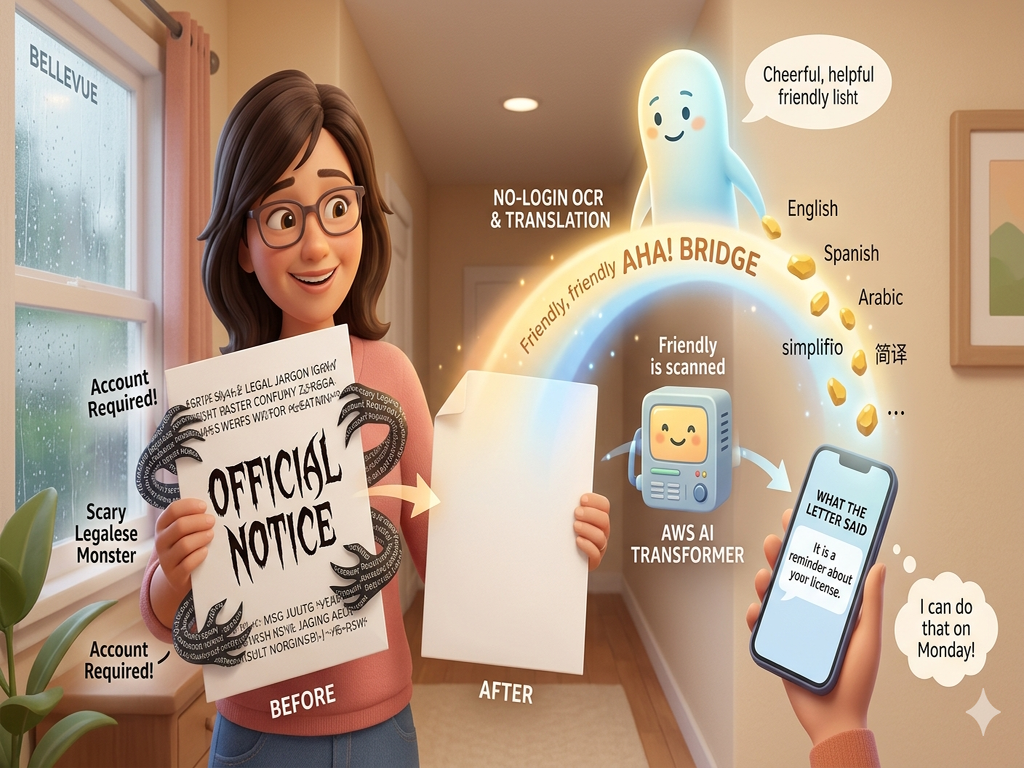
"What the Letter Said" — Because Sometimes You Just Need to Understand the Letter First
After we built the Pinned AI Tutor, we kept coming back to a single, nagging question: What else can we build that actually helps people in their real, messy, daily lives?
We weren't looking for something impressive or complex. We just wanted something useful. That quest for "useful" led us to a tool that has become one of our favorites: "What the Letter Said."
The idea didn't come from a boardroom. It came from a side-thought while we were writing an article about how AI translation has improved. We started thinking about the letters that people are actually afraid to open. You know the ones—the thin government envelopes, the IRS notices, the dense legal documents.
Even for native English speakers, that "legalese" is a language of its own. It's designed to be precise, but it usually just ends up being intimidating. Now, imagine trying to decipher that stress while English is your second or third language. That's not just a translation problem; that's a heartbeat-skipping-a-beat problem.
So we thought—what if we just made it simple?
Take a photo. Let the AI read it. Turn it into plain, "human" English. Then translate that into your native language.
Since we were already working within the AWS ecosystem, we hooked into their OCR (Optical Character Recognition) tools to extract the text from images. We built a system that cleans up the messy scan, extracts the core message, and translates it into 11 different languages.
But we made one very intentional, non-negotiable decision: No login. No accounts. No friction. If you are standing at your mailbox holding a letter that makes your stomach sink, the last thing you want to do is "Verify your email address" or "Create a password with one special character." You just want to know what the letter says. So, we made it so you just open the page, take the picture, and get your answer.
When we launched, we felt great. People could finally read their mail. But then, a second "Aha!" hit us—and this one was much bigger.
Understanding the words is only the first step. The real weight of a scary letter isn't "What does this word mean?" It's "What do I do now?"
The tool could translate perfectly, but it couldn't tell you: Should I call this number? Is this a scam? What happens if I wait until Monday? We know the limits—AI can't give legal or financial advice. But we also know that "guidance" is what people actually need. We're currently exploring how to bridge that gap—moving from "Here is what the letter says" to "Here is how you can start thinking about your next step."
Out of everything the AI Bridge Foundation has built, "What the Letter Said" is special to us because it's so immediate. It's a tool for the quiet, stressful moments that happen every day.
We just hope that when someone finds it, it helps them do one small, brave thing: Open the envelope, read the page, and finally feel like they aren't lost.
We don't normally reference URLs for our tools in these posts — but this one deserves it: What the Letter Said