The Tiny, Blinking AI That Didn't Need the Internet
At some point, we stopped looking at the cloud and started looking at the floor. We asked a very inconvenient, very practical question: What happens when the internet just isn't there? We had spent all this time building the Pinned AI Tutor and the Challenge Lab, but they all lived on a digital "leash." They needed a high-speed connection to exist. We started wondering about Digital Equity—the people who don't have that luxury, the rural communities left behind, or the places where a Wi-Fi signal is actually forbidden.
If AI is going to be a bridge, it can't just be a bridge for people with 5G.
That curiosity led us down a rabbit hole of hardware, cooling fans, and a lot of caffeine. We started simple. We took an 8GB laptop, installed Ubuntu, and tried running a local model called Phi-3. We hit "enter" on a question and… we waited. We went and grabbed a coffee. We came back. It was still thinking. It was a humbling moment that gave us a massive new appreciation for just how much horsepower is hiding behind the "instant" responses of ChatGPT and Gemini. Those things are fast for a reason.
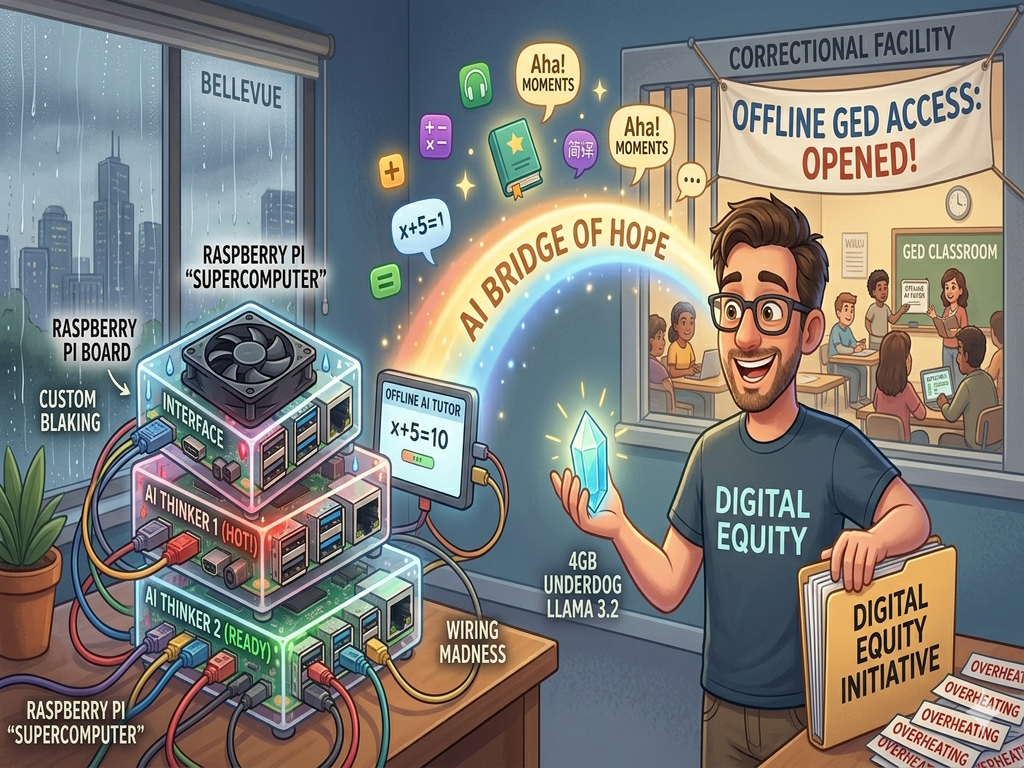
But we didn't want to give up on the dream of a "Tutor in a Box." We moved the experiment to a Raspberry Pi 5—a tiny, green circuit board that fits in the palm of your hand. We imagined a student sitting in front of a small, friendly device—no login, no Wi-Fi, just a screen and a keyboard. Pure, focused learning.
We started testing different versions of an AI model called Llama 3.2. We tried the "smartest" version, but we were back to the coffee-break speed. Then, we tried a smaller, leaner version. Suddenly, the cursor started dancing. It was snappy. It was usable. It was an "Aha!" moment: in the world of offline AI, sometimes smaller isn't just better—it's the only way to actually get an answer.
Then, things got a little nerdy. We thought, What if one Pi isn't enough? So, we started building a mini-cluster right on the desk. We had one machine acting as the student's screen and two other Raspberry Pis dedicated solely to "thinking." If one started getting too hot—which, trust me, they do—the other one would step in to help. We had accidentally built a tiny, blinking, slightly overheating AI data center in the corner of the room. And the crazy part? It actually worked.
As we stepped back from the tangle of cables, the most important question finally hit us: Who actually needs a tutor that doesn't need the internet? The answer was staring us in the face: correctional facilities and under-resourced areas. These are places where people are incredibly motivated to earn their GED, but internet access is strictly limited or non-existent. The students are there, the goals are there, but the digital divide was standing in the way.
By shrinking the AI down to fit into a self-contained, offline box, we realized we could bring high-level tutoring into rooms where a signal can't go. It's not perfect, it's not blazing fast, and it definitely needs a good cooling fan, but it's a door that wasn't there before. And honestly, watching a tiny green board solve a complex math problem without a single bar of Wi-Fi… that's an experiment worth every late night.