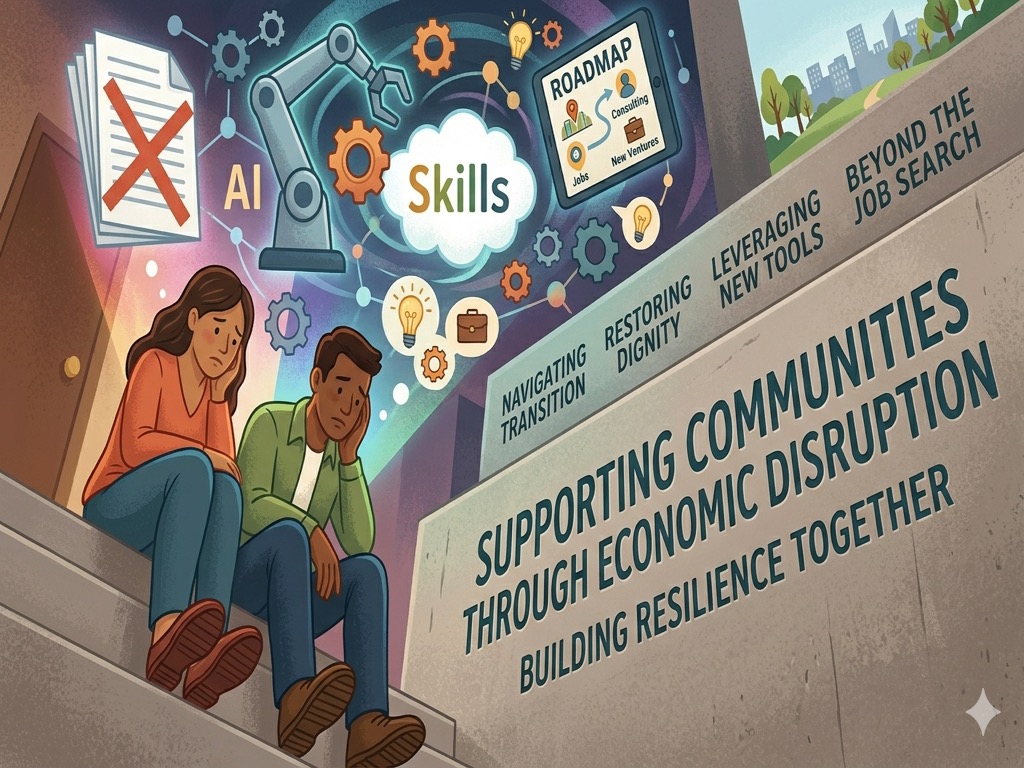
Layoffs, AI, and Cities in Shock: Supporting Communities Through Economic Disruption
Introduction
The headlines tell us about numbers, but communities feel the impact in souls. When a major industry contracts or a massive layoff hits, it isn't just a line item on a corporate spreadsheet — it is a seismic shift that rattles the foundation of entire cities.
The effects show up everywhere: quieted storefronts, anxiety in school hallways, hushed conversations at kitchen tables. Whether artificial intelligence was the direct cause of a restructuring or an indirect force reshaping the market, the result is often the same — a sudden loss of stability that feels deeply personal.
Before talking about tools or solutions, it's important to acknowledge the weight of this moment. Layoffs create shock, uncertainty, and grief. Those feelings are not weakness; they are a natural response to a world changing faster than many social and economic systems can keep up with.
It Wasn't You — It Was the System
There is a long-standing belief that hard work and loyalty protect people from job loss. That belief is being dismantled.
Many recent layoffs are not about individual performance. They are the result of structural decisions: automation, cost-cutting, consolidation, or rapid changes in how work is organized. Entire teams disappear at once, regardless of effort or impact.
When thousands of roles are eliminated, it isn't a "skills gap" on the part of workers — it's a system gap. Career paths were designed for a level of stability that no longer exists. People didn't fail the system; the system is in transition.
Removing personal blame matters. Shame makes it harder to think clearly and move forward. This moment does not define a person's worth or potential. It simply marks an unexpected turning point — one that many were never taught how to navigate.
Turning the Tool Toward People
There is a real irony in suggesting that AI — often associated with job disruption — could also help people recover. Skepticism is understandable. Using AI in this moment should always be a choice, not an expectation.
If AI is going to reshape work, it should also be used to support the people affected by that change. In the immediate aftermath of a layoff, the volume of information can be overwhelming. Severance documents, benefit notices, deadlines, applications, and emails often arrive all at once, when energy and focus are at their lowest.
AI is not a replacement for human support, but it can help people navigate systems that are confusing, slow, or difficult to access. Used responsibly, it can reduce cognitive overload and create space for clearer thinking during a destabilizing time.
From Panic to Planning
The hardest part of a career disruption is often not a lack of skill, but a loss of perspective.
People carry years of experience, problem-solving ability, and institutional knowledge with them, yet when a job disappears, it can feel as if those skills vanished too. Panic thrives in uncertainty. Planning begins when options become visible.
This is where AI can be most helpful. It can assist people in identifying transferable skills, exploring adjacent industries, or reframing their experience in ways that make sense beyond a single role or company. It can also provide a low-pressure way to practice unfamiliar conversations or imagine paths that previously felt out of reach.
When more than one path forward becomes visible, fear begins to loosen its grip. Momentum replaces paralysis. Dignity is restored when people can see choices again.
Navigating a Different Future of Work
It's important to be honest: the nature of work is changing. Careers are becoming less linear and less predictable. Stability is increasingly tied not to one employer, but to adaptability over time.
This does not mean everyone needs to become technical or reinvent themselves overnight. It means that as AI continues to shape the labor market — whether people welcome it or not — support for navigating that change is essential.
This moment does not signal the end of work. It marks a transition. And transitions require guidance, patience, and shared understanding. Expecting individuals to manage this shift alone ignores the scale and speed of the transformation underway.
Resilience Beyond the Job Search
Recovery is about more than securing the next paycheck. It's about rebuilding confidence, clarity, and long-term stability.
Resilience is not the ability to predict the future. It is the ability to be supported when disruption arrives. Access to AI literacy and learning tools can help people reflect on their skills, plan learning at a realistic pace, and prepare for future changes before they become crises.
Resilience is not reserved for a select few. It is something that can be built when people have access to the right resources. With support, individuals move from feeling at the mercy of economic forces to actively shaping their own paths forward.
Technology Must Serve the Person
Technology is not neutral. It reflects the values of the systems that deploy it. Too often, decisions about technology prioritize efficiency and profit over human impact.
If AI is going to shape the future of work, it must also help people survive its disruptions. Social recovery after large-scale layoffs requires intention. Tools matter most when people are vulnerable.
Technology should serve people — not diminish them or leave them behind. A job title is not a measure of human worth. A future shaped by technology should leave room for dignity, agency, and care.