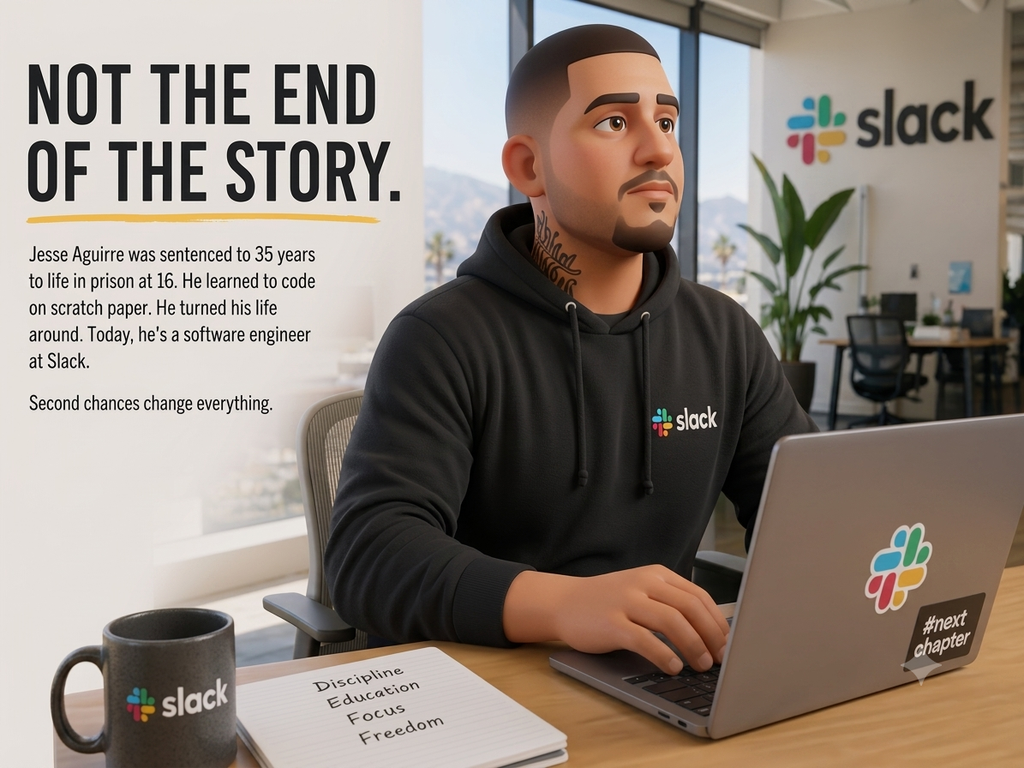
From a Life Sentence at 16 to Software Engineer at Slack — Before the IPO
Jesse Aguirre was sixteen years old when a judge sentenced him to 35 years to life in a California prison. He'd grown up in Lynwood, a tough neighborhood in South Los Angeles, and had been pulled into a local gang by the time he was twelve. On a March night in 2010, a fight broke out among a group of boys in Buena Park. Someone fired a shotgun. Jesse didn't pull the trigger, but the court said he handed the gun to the person who did. He was tried as an adult. He hadn't finished high school.
A Kid With a Life Sentence
Jesse was shipped to Ironwood State Prison in Blythe, California — a desert facility hours from anyone he knew. He was a teenager surrounded by adults serving decades. Judge William Froeberg, who imposed the sentence, said from the bench: "It doesn't give me any great pleasure to impose this sentence on this young man. Gang activity is a no-win activity."
Inside Ironwood, Jesse started making different choices. He earned his GED, joined self-help programs like Narcotics Anonymous and Alternatives to Violence, and dropped out of his gang. He didn't receive a single disciplinary write-up during his entire incarceration.
Writing Code on Scratch Paper
Then he found The Last Mile, a nonprofit founded by Chris Redlitz and Beverly Parenti that teaches coding and business skills inside prisons. For the first month, students didn't even have computers. They learned from books and wrote code by hand on scratch paper with pens.
Jesse's first project? He handwrote the code to recreate the In-N-Out Burger website, working from nothing but a printed screenshot of the homepage. No internet. No Stack Overflow. Just paper, a pen, and determination.
A Christmas Eve Second Chance
In 2014, a California appeals court found that Jesse had received ineffective legal counsel and reduced his sentence. Then, on Christmas Eve 2017, Governor Jerry Brown signed a commutation order, citing Jesse's exemplary behavior: "[He] dropped out of his gang and has devoted himself to self-improvement." After nearly eight years, Jesse walked out of prison at twenty-four years old.
Freedom didn't mean things were easy. He applied for more than fifty apartments before finding a place to live — landlord after landlord turned him away because of his record.
From Apprentice to Engineer
In 2018, Slack launched Next Chapter, built in partnership with The Last Mile and FREEAMERICA. The idea was radical: give formerly incarcerated people a real shot at engineering careers in Silicon Valley. Not charity — a paid apprenticeship with mentorship and a path to a full-time job.
Jesse was one of three people selected from ten candidates through the same rigorous interview process Slack used for its regular engineers. His engineering manager, Drew McGahey, was struck by how the apprentices approached problems. "They all learned how to code in an environment where they didn't have access to the internet," he said. "They've got drive."
In June 2019, just days before Slack went public on the New York Stock Exchange, all three apprentices were offered full-time positions with stock options. Slack was Jesse's first full-time employer — ever.
"When I got my job offer, I felt like a guy from college getting drafted to the NBA," Jesse said. "But with my background, I also feel like I have a lot to prove."
Building a New Life
Jesse grew into a full-stack software engineer, working with JavaScript, React, and Node.js. He became one of the more senior members of his team. New hires came to him for advice. He ran a Friday coding group to help other Slack engineers understand the test-automation process. All three inaugural apprentices received promotions.
When reporters asked what surprised him most about life after prison, he didn't talk about the salary or the stock options. "I appreciate the small stuff now — being able to get dropped off anywhere, ordering Uber Eats on my phone, hearing my mom on the phone whenever I want."
Why This Story Matters
Jesse's story is not about one lucky break. It's about what happens when someone gets access to real skills and a real opportunity — and what we lose when they don't.
Two-thirds of people released from prison in the United States are rearrested within three years. The Next Chapter program, which started with Jesse and two others at Slack, has since expanded to eleven companies — including Zoom, Dropbox, and Square — creating engineering careers for formerly incarcerated people across the country.
At AI Bridge Foundation, we believe that technology skills should not be reserved for people who grew up with every advantage. Jesse Aguirre learned to code on paper in a prison cell. Given the chance, he became a software engineer at one of the most important technology companies in the world. There are thousands of people like Jesse — talented, driven, and overlooked — waiting for that same chance. Our work is to make sure they get it.