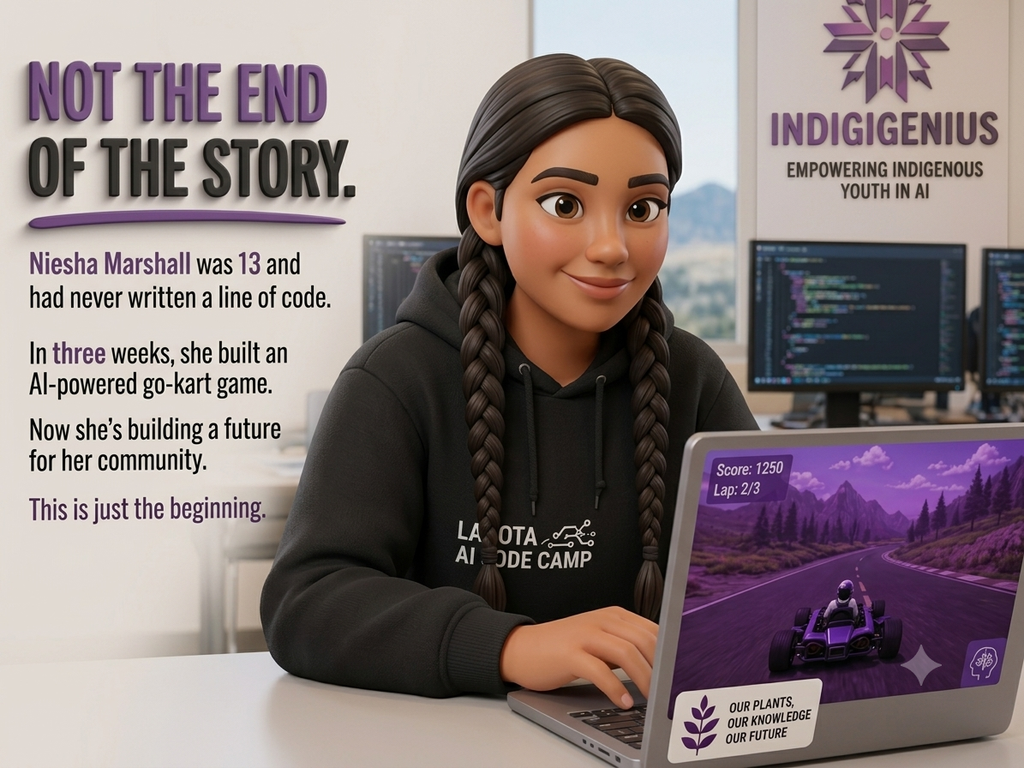
From a Year Without School to Building AI on the Reservation: Niesha Marshall's Story
Niesha Marshall's only idea of what coding looked like came from the movies: a geeky guy alone in a corner, hacking into the government. She was 13, living near the Rosebud Reservation in South Dakota, and she hadn't been in a classroom for over a year. COVID had shut everything down, and she just wanted to get out of the house — to see someone other than her family.
A Year in the Dark
Before the summer of 2021, Niesha had never written a line of code. She was a Lakota teenager from a place where 18% of people on tribal lands lack internet access and a routine Windows update on seven computers once crashed the internet for an entire university campus. The digital world felt far away.
Then someone told her about a free summer camp in the Black Hills.
Three Weeks That Changed Everything
The Lakota AI Code Camp is a three-week intensive run by IndigiGenius, a nonprofit co-founded by Mason Grimshaw and Michael Running Wolf. Grimshaw is Sicangu Lakota, an enrolled member of the Rosebud Sioux Tribe who went on to study at MIT and become a data scientist. Running Wolf is Lakota and Northern Cheyenne, now an AI ethicist at the Mila-Quebec Artificial Intelligence Institute. Their message to kids like Niesha was simple. As Grimshaw put it: "We're from the same reservation. And I did it. So, you can do it too."
Held at Black Hills State University in Spearfish, South Dakota — about 220 miles from Rosebud — the camp taught Python, data science, machine learning, and app development. The organizers had to buy gaming computers for every student because the rural internet was too unreliable for cloud-based machine learning.
Nobody expected what happened next. The students finished a week's worth of content by day three. "We ran out of content," Running Wolf said.
A Purple Go-Kart and a Sacred Plant
In under three weeks — with zero prior experience — Niesha built an AI-powered purple go-kart game. She watched it zip across her computer screen and couldn't believe what she'd done. "I was really proud of myself," she said. "I just couldn't believe it, that I created this AI."
But the camp wasn't just about individual projects. For their final group project, the students built a machine learning app that could identify plants sacred to the Lakota people. They hiked through the Black Hills, photographed local flora, then labeled their data with the help of Linda Black Elk, a local ethnobotanist and knowledge keeper. High schoolers with no coding background — training their own AI model from scratch, grounded in their own culture.
More Than Code
What made the camp stick for Niesha wasn't just the technology — it was the belonging. "One of the best parts of the camp, you can use native humor and people would understand," she said. "The camp felt like family to me."
That sense of family matters in a community where Native students earn just 0.1% of doctoral degrees in computing. Native Americans make up roughly 2% of the U.S. population but barely register in computer science. Running Wolf estimates there are only about 12 Indigenous AI scientists in all of North America.
Niesha came back for multiple summers. She started recruiting friends. She convinced at least one to join her — "the free computer helped," she admitted. She's now considering a career in AI, possibly in video game design.
A Ripple Across Indian Country
Since its launch, the Lakota AI Code Camp has run for at least three consecutive summers. Grimshaw and Running Wolf are now training mostly Native high school teachers through a program called T3PD to deliver culturally relevant computer science courses in their own communities. They're planning to replicate the camp in California and are in discussions with Brendan David-John, a Seneca professor of computer science at Virginia Tech, about launching a Seneca youth coding camp in upstate New York.
As Running Wolf put it: "My interest is to uplift communities and make sure they can be owners of this technology and have agency over the AI… But no one is going to build that for us."
Why This Story Matters
Niesha Marshall's story is exactly why AI Bridge Foundation exists. She didn't have connections, resources, or a head start. She had a year out of school, a reservation with spotty internet, and no idea that someone who looked like her could build artificial intelligence. All it took was one program — free, culturally grounded, taught by people from her own community — to change the entire trajectory of what she believed was possible.
If a 13-year-old with no coding experience can build an AI project in three weeks, imagine what becomes possible when every underserved community has access to programs like this. That's the bridge we're building.