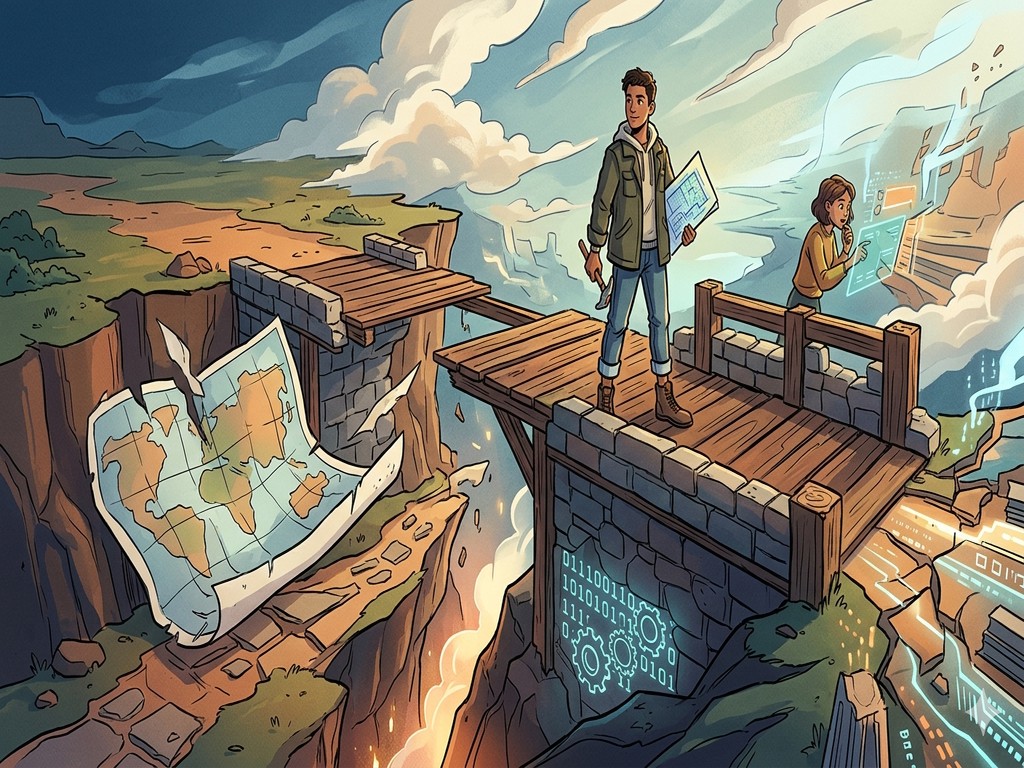
The Bridge and the Map: Navigating the AI Wilderness
On a quiet afternoon, a student sits at her desk, staring at a question she has answered a hundred times before: What year was the Magna Carta signed? Her fingers hover over the keyboard. She knows the answer—or at least, she used to. But somewhere in the back of her mind, a new thought interrupts: an AI could answer this instantly, more accurately, and with more context than she ever could. For a moment, the question doesn't feel difficult. It feels unnecessary.
That moment is happening in classrooms everywhere. A ninth grader in Houston asks why she needs to memorize the periodic table when her phone can pull it up in two seconds. A community college student in Detroit wonders why he's learning to format spreadsheets when ChatGPT can build one from a sentence. These aren't lazy questions. They're honest ones. And they point to something the education system hasn't fully reckoned with yet.
For decades, schools handed students maps. Carefully drawn, neatly labeled guides to history, science, and mathematics. Memorize every landmark, every coordinate, every established path. For a long time, that made sense. The world moved slowly enough that the terrain stayed familiar. If you knew the map, you could find your way.
But the ground has started to shift.
When Storage Isn't Enough
For a long time, we confused the ability to retrieve information with intelligence itself. If a student could recall a date, define a term, or repeat a process, we considered them "educated." But machines now do this effortlessly. If knowledge is merely storage, the machine has already surpassed us.
Think of the difference between memorizing a recipe and understanding the chemistry of cooking. One follows instructions; the other adapts when the ingredients change. In a world where the ingredients are constantly shifting, that difference is everything. The student who only memorized the map waits for a direction that may never come. The one who understands the terrain begins to shape a path forward.
The Art of the Debug
This shift is most visible in how we handle mistakes. In a traditional classroom, a wrong answer is a dead end—a red mark that signals failure. But outside those walls, in the systems we build and the problems we face, there are rarely "final" answers. There are only attempts, outputs, and adjustments.
AI makes this reality even clearer. A student in a coding class asks ChatGPT to write a function, and the code looks perfect—until it breaks on edge cases the AI didn't consider. The student who just copies the output is stuck. The student who reads it, tests it, and figures out why it failed has learned more in ten minutes than a week of lectures could teach.
When we teach students to "debug" their thinking—to treat a broken result as the beginning of understanding rather than the end of the process—we build a quiet resilience. The ability to face uncertainty without freezing, and to iterate instead of retreating.
From Passengers to Architects
Today, we are drowning in content created at the push of a button. Essays, images, and opinions are generated in seconds. It has never been easier to be a passenger—to let the algorithm decide what we read, what we write, and eventually, what we think.
But the real shift in power belongs to the architects.
A 22-year-old in Phoenix used AI to build a small business website, write her own lease agreement, and create a marketing plan—all without a degree in any of those fields. She didn't just use the tool. She directed it, questioned its output, and made judgment calls about what to keep and what to throw away. That's architecture. The future belongs to people who can take a messy, undefined problem and break it into pieces that a machine can help solve—while knowing which pieces still need a human touch.
The Human Edge
For all the speed machines bring, there remains a boundary they cannot cross. A machine can optimize for efficiency, for scale, and for profit. It can identify patterns across millions of data points. But it cannot decide what should matter. It cannot feel the weight of a decision that affects a community, or understand the quiet human cost behind a "perfect" solution.
That responsibility still belongs to us.
Learning to think in the AI age is not about becoming more like machines. It is about becoming more fully human—combining logic with judgment, and efficiency with empathy. When we teach someone to build a bridge, we are not just teaching them how to span a gap. We are asking them to consider why that bridge should exist, and who it is meant to serve.
The New Measure
The map is not useless. It offers context and a sense of where we have been. But it is no longer enough to get us where we are going.
The people who will thrive are not the ones who memorized the terrain. They are the ones who learned how to cross it, even as it changes. And if that is true, it leaves us with a question harder than any test we currently give: if students are meant to build bridges, not memorize maps—what, exactly, are we measuring when we grade them?