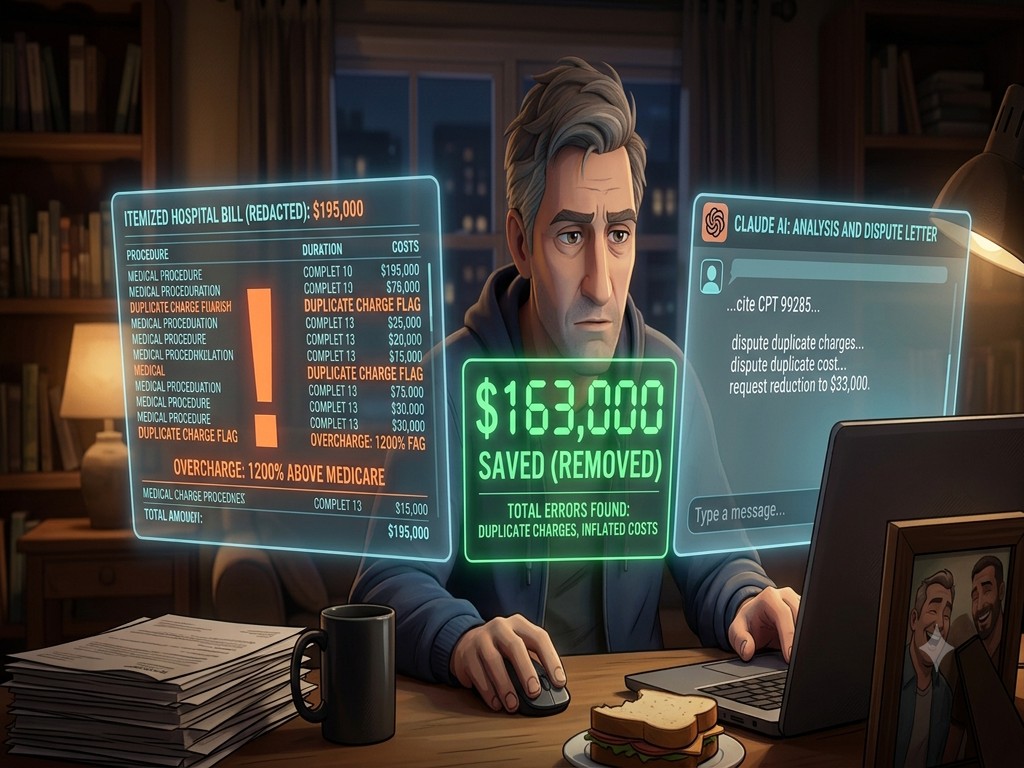
How a $20 AI Subscription Erased $163,000 from a Hospital Bill
A man's brother-in-law had a heart attack and died after four hours in intensive care. The hospital sent a bill for $195,000. No insurance was active at the time, so the family owed nearly all of it.
Instead of paying, he opened Claude — a $20/month AI chatbot — and pasted in the itemized charges. Within minutes, Claude flagged duplicate charges, supply costs inflated 500% to 2,300% above Medicare rates, services billed as "inpatient" when the patient was never formally admitted, and charges for procedures that apparently never happened. He ran the same bill through ChatGPT. Both AIs agreed.
He wrote a six-page letter to the hospital citing every violation. They reduced the bill to $33,000.
One evening of work. One $20 subscription. $163,000 gone.
You don't need to be a programmer or a medical billing expert to do this. You need two documents and a few copy-paste prompts.
Get Your Itemized Bill First
The summary most hospitals mail you isn't useful — it just shows broad categories like "Cardiology: $70,000." You need the line-by-line breakdown with procedure codes.
Call the billing department and say exactly this: "I'd like a fully itemized statement with CPT codes and quantities for each service." Under federal price transparency guidelines, they're required to provide it. Some hospitals will stall — keep asking.
If you have insurance, also grab your Explanation of Benefits (EOB) — that's the letter your insurer sends showing what they agreed to cover. If you're uninsured, skip this. You'll use Medicare rates as your baseline instead, which is what AI compares against.
Three Prompts That Do the Work
Open ChatGPT, Claude, or Gemini — any of them work. Before you paste your bill, redact your Social Security number, date of birth, full name, medical record number (MRN), and insurance member ID. Replace them with placeholders like [NAME] or [DOB]. Then use these:
Prompt 1 — Find overcharges and duplicates:
"Here's my itemized hospital bill. Compare each line item to Medicare reimbursement rates for my state. Flag anything billed more than 200% above Medicare rates. Also identify any duplicate charges — services that appear to be billed once as a bundle and again as individual components."
What you'll get back: A list of specific line items that look inflated or doubled. In the $195,000 case, roughly half the bill turned out to be duplicates — master-level charges that also had their components billed separately.
Prompt 2 — Catch charges that don't make sense:
"Based on a [your length of stay] stay in [department name], which of these charges seem inconsistent with the services that would typically be provided? Flag anything that looks like it may not have actually occurred."
What you'll get back: Items that seem unlikely given your situation. Things like ventilator charges on the same day as an emergency admission, or specialist consultations that don't match your diagnosis.
Prompt 3 — Draft your dispute letter:
"Write a formal letter to the hospital billing department disputing the charges you flagged. Cite specific CPT codes, the Medicare rate comparison, and any billing compliance violations you found. Keep it professional but firm. Include a request to reduce the bill to [your target amount]."
What you'll get back: A letter you can send as-is or edit. The AI cites regulations and specific dollar amounts, which signals to the billing department that you've done real homework.
One important warning: AI can occasionally hallucinate CPT codes or Medicare rates that don't exist. Before you send anything, do a quick Google search of the flagged codes to confirm they match your actual procedures. A letter citing a fabricated code will get tossed immediately.
Free Tools If You Don't Want to DIY
Two free tools built by patient advocates handle this without copy-pasting:
Counterforce Health (counterforcehealth.org) — Upload your denial letter or bill. Their AI generates a full appeal with medical citations in under 60 seconds. They report a 70% reversal rate on insurance denials. Free for patients.
FightHealthInsurance.com — Paste your insurance denial, get a ready-to-send appeal letter. Built specifically for claim denials. Free for everyone.
When AI Isn't Enough
If the hospital ignores your letter, three options:
Ask about financial assistance. Most hospitals are legally required to offer charity care programs but will never mention them. Say: "Do you have a financial assistance application?" The income thresholds are often more generous than people expect.
Call the Patient Advocate Foundation (patientadvocate.org). They assign you a free case manager who negotiates directly with the hospital on your behalf.
File a complaint with your state attorney general. If you've found fabricated charges — not just high prices but services that never happened — that's fraud. Your AI-generated documentation makes the complaint easy to file because the violations are already listed with codes and dollar amounts.
Most people who get a giant medical bill either pay it, ignore it until it goes to collections, or set up a payment plan for the full amount. The family in this story did none of those things. They spent one evening asking a machine to check the math — and it found $163,000 in errors that the hospital quietly removed when confronted with the evidence.