The Ari Educational Platform — How Two Teen Courses Became an Engine for Everything
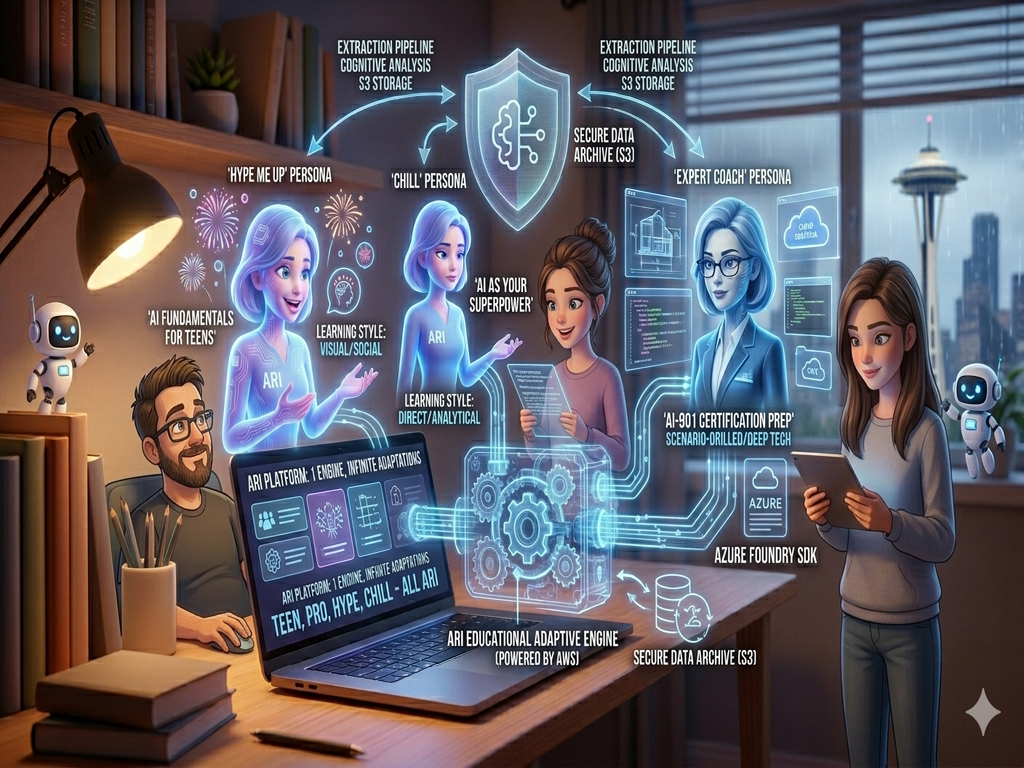
My daughters were my first testers. I didn't bribe them. Didn't assign it as homework. I just pulled up the course and said "try chatting with this." They thought it was fun. Like, actually fun — not the "educational app" kind of fun where you click through three screens and never open it again. They kept going back. They picked different vibes for Ari. One went full Hype Me Up and got celebrations for every insight. The other chose Chill and got zero fluff. Same course, completely different energy. They didn't even realize they were learning the same things.
Then I shared it with family friends. Their kids tried it — and then the adults jumped in too. Grown-ups were going through an AI course called "for Teens" and not caring one bit about the label. Turns out when something adapts to how YOU think and type, the age on the title stops mattering.
That's when I started seeing the pattern.
A little context: none of this would exist without the $10,000 AWS Social Impact credit we received earlier this year. That grant gave us the infrastructure to build Ari properly — conversations stored in S3, Claude Sonnet on Bedrock, the whole adaptive learning system running on real cloud infrastructure instead of clever workarounds. It turned a dream into something we could actually ship.
Building AI Fundamentals for Teens was the hard one. First course on the platform — we were inventing everything as we went. Session management, S3 storage, the extraction pipeline that analyzes each conversation and figures out how the student learns, progress tracking, the whole vibe system. Every piece was brand new. It took real sweat.
Then we built AI as Your Superpower — Course 2. Totally different content. This one teaches teens to stop using AI as a homework machine and start using it to actually think better. More of a coaching vibe, less sibling energy. But here's the thing — building it was fast. Suspiciously fast. Because the platform was already there. We just needed new content and a new personality for Ari.
That's when I had my "oh wait" moment. We didn't build two courses. We built the Ari Educational Platform. An engine. Swap the topics, change the persona, and you've got a completely different course — with all the adaptive intelligence baked in for free.
So I tested it. Microsoft retired the AI-900 exam and replaced it with AI-901. Our old course was obsolete overnight. Instead of panicking, I sat down and built an AI-901 prep course on the Ari platform. Twelve topics, professional tone, exam-style scenario drills, code walkthroughs. Plugged it in. Worked immediately. The same system that teaches a 14-year-old what machine learning is can now coach a developer through Azure Foundry SDK patterns. That's when I knew this was bigger than a couple of courses.
And now I'm looking at everything else we offer and thinking: why not all of it? GED prep — four subjects, currently running on static question banks. PCAP Python certification — same deal. Every one of these could run on the Ari platform. Same adaptive learning, same personalization, same "AI that actually remembers you" experience. Not a quiz app. A learning partner that gets better every session.
Here's what makes me unreasonably excited: we're a tiny nonprofit. No engineering team. No content department. But a new course on this platform is basically a JSON file, a persona, and a landing page. That's it. The engine handles everything else. We can build at the speed of "someone had a good idea and wrote solid content" — not at the speed of software development.
I started this foundation because I believe education should be free. The Ari platform makes that sustainable. We built the engine once. Now we just keep filling it.
My daughters thought it was fun. Family friends thought it was useful. Developers studying for certs thought it was effective. Same platform, same Ari, completely different experiences for each person. That's the thing I'm most proud of.
We're just getting started — and the fun part is figuring out what to build next.