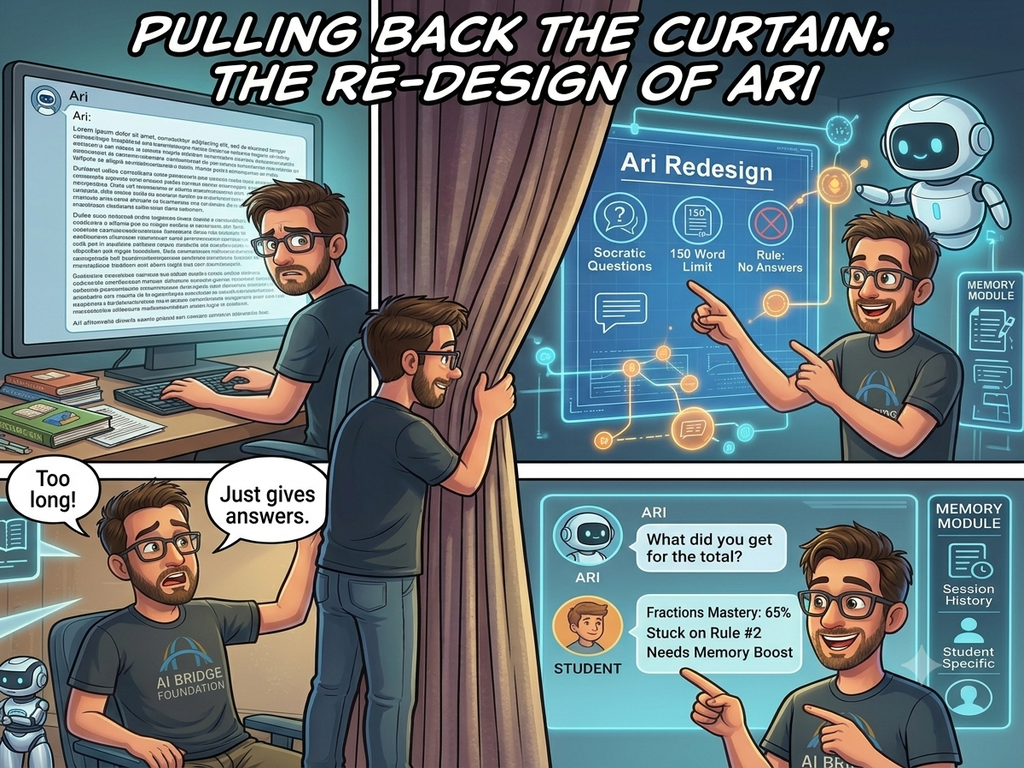
How Ari Actually Teaches You (Part 1): Everything We Got Wrong
We want to pull back the curtain on something we've spent months designing: how Ari actually teaches you. This is Part 1 of three — not a feature list, but the story of everything we got wrong.
Simple Prompt Engineering Doesn't Work
We started where everyone starts. Write a system prompt: "You are a helpful tutor. Explain things clearly. Be encouraging." Plug in a topic. Hit send. The response is polite, covers the material, sounds professional. Ship it.
Then we tested it with real people. The results were mediocre — which is worse than bad, because mediocre is hard to diagnose. Ari would explain things clearly, but it explained EVERYTHING. A student who already knew percentages got a full lecture on percentages anyway. A student who gave a wrong answer got an immediate correction — polite, thorough, and completely forgettable. They'd read the response, say "ok," and move on without understanding what went wrong.
Ari was lecturing, not teaching. It looked like tutoring. It felt like reading a textbook that could respond to you.
The Socratic Disaster
We read about Socratic questioning — the idea that good tutors ask questions instead of giving answers. Makes the student think. Decades of research behind it. So we tried it: never give the answer, always ask a question first.
It was infuriating. Students would come to a brand new topic knowing nothing, and Ari would immediately ask "What do you think happens to the price when there's a 20% discount?" One of our early testers just stopped responding. Not because it was hard — because it was annoying. They came to learn, not to guess.
The fix sounds obvious in retrospect: teach the concept first — short, 2-3 sentences — then ask a question to verify they got it. "A 20% discount means you pay 80%. So a $45 item at 20% off: $45 × 0.80 = $36. Now you try: what do you pay for a $60 item at 15% off?" Concept, then verify. Not withholding information and calling it pedagogy.
Students Got Tired of Typing
Here's one nobody warns you about. When every single question is open-ended and requires a typed paragraph, students get fatigued. Especially on mobile. They'd give shorter and shorter answers — not because they stopped understanding, but because typing on a phone keyboard after 15 minutes gets exhausting.
We added variety. Multiple choice for drilling. True/false for quick concept checks. Fill-in-the-blank for practice. Open-ended for deeper moments. The format changes based on what Ari is trying to accomplish. Drill mode? Multiple choice. Teaching moment? Open-ended. Quick retention check? True/false. This kept sessions from feeling like work.
The Mobile Problem
Speaking of mobile — most of our users are on their phones. When the keyboard comes up on a phone screen, you lose half your screen. If the chat UI has a hero banner, a topic description, navigation buttons, and THEN the conversation — the student can barely see one message at a time while typing.
We had to strip everything that wasn't essential. On mobile, the topic summary disappears. The hero section hides. The chat area expands to fill the screen. Every pixel matters when you're trying to have a learning conversation on a 6-inch display with a keyboard taking up the bottom half.
The Stuck Loop
Early Ari had an embarrassing habit:
Student: "I don't understand."
Ari: Rephrases the same explanation slightly differently.
Student: "I still don't get it."
Ari: Rephrases it again, just using bigger words.
This is what bad human tutors do — they say it louder. We added a hard rule: stuck after two attempts means switch to a completely different approach. Not a reworded version of the same idea. A different representation entirely — a real-life analogy, a visual example, a scenario from the student's actual world.
The Memory Problem
All of this works well in a single session. Ari teaches, adapts, switches angles, asks the right questions. For 20 minutes, it's a great tutor.
Then you close the tab. Come back tomorrow. And Ari has no idea who you are.
The approach that failed yesterday? Ari tries it again. The money analogy that finally made things click? Gone. Your misconception that kept coming back? Ari has to rediscover it from scratch.
We needed Ari to remember — not just what topics you covered, but how you learn. What works for you. What doesn't. What you keep getting wrong.
But here's what we discovered: remembering is a completely different skill from teaching. The AI that's great at explaining concepts in real-time is not the same AI that can read a 30-message conversation and decide "this student learns best through step-by-step examples and struggles with word problems."
That's a different brain entirely. And building it was harder than anything we'd done on the teaching side.
That's Part 2.