The Unlicensed Teachers Flying Your Kid's AI Classroom
Something remarkable happened in American classrooms over the past two years, and most parents missed it entirely. Teachers adopted AI faster than any technology in education history — faster than interactive whiteboards, faster than Chromebooks, faster than Google Classroom itself.
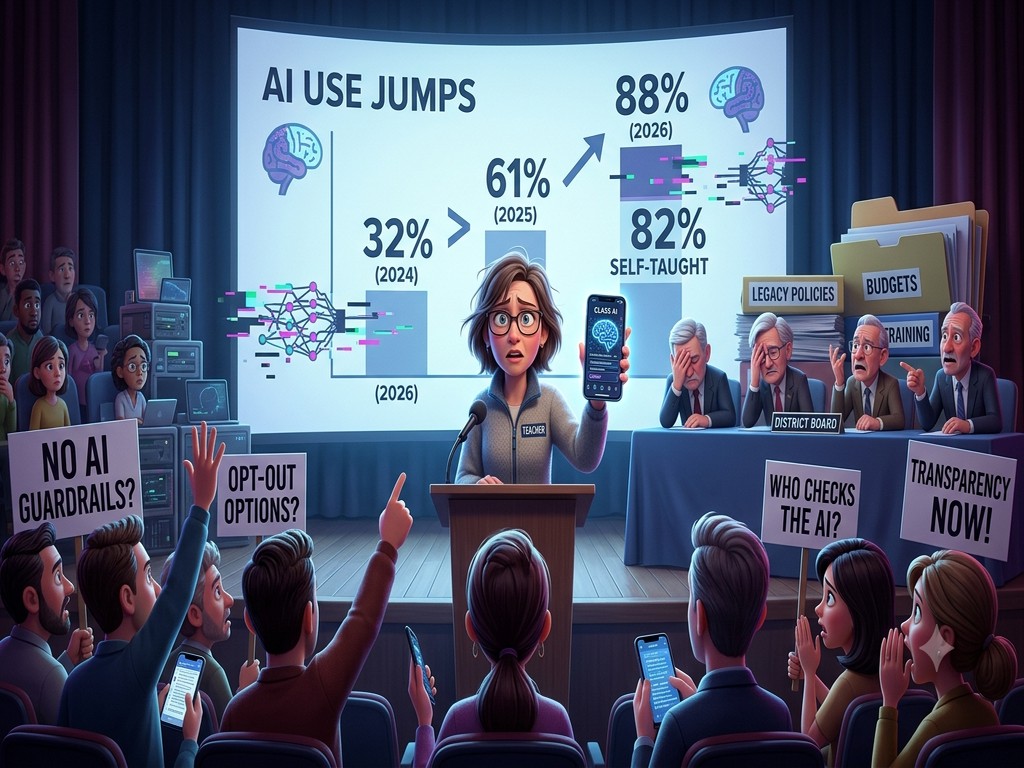
According to the EdWeek Research Center, AI use among teachers jumped from 32% in 2024 to 61% in 2025. By 2026, only 12% of teachers say they don't touch AI at all. That's not a slow rollout. That's a tidal wave.
They Figured It Out Themselves
Here's the part that should make you pause — not in fear, but in respect. A May 2026 Gallup/Walton Family Foundation poll of 2,069 teachers found that 34% received literally no guidance on AI from their schools. Another 48% got informal tips — a hallway conversation, a forwarded article, a five-minute mention at a staff meeting.
That means 82% of teachers using AI in classrooms right now are essentially self-taught.
Think about that. These are people with full course loads, 30 kids per class, and a stack of ungraded papers at home. They still found time to learn a brand-new technology on their own because they saw it could help their students. That's not recklessness. That's initiative outrunning institutional support.
The District Gap
The problem isn't teachers moving too fast. It's districts moving too slow.
When teachers adopt something powerful without training, the results are uneven. One teacher uses ChatGPT to build personalized reading exercises for struggling students. Another uses it to auto-generate quizzes without checking for errors. Both are "using AI." The difference is preparation — and most districts offered none.
Compare this to any other profession. When hospitals adopt a new diagnostic tool, doctors get certified. When airlines update cockpit software, pilots train in simulators. When schools adopt AI? Apparently a forwarded link counts.
While Districts Hesitated, Tech Giants Didn't
This school year, Google embedded its Gemini AI directly into Google Classroom, Docs, and Slides — free, automatic, and available on millions of student Chromebooks. In most districts, parents weren't specifically notified it was turned on.
This is where the distinction matters. A teacher using AI to plan lessons or write feedback is one thing — that's a professional tool behind the scenes. But AI baked into the apps students open every day is something else entirely. Your third-grader isn't just in a classroom where the teacher uses AI. Your third-grader is using AI, whether anyone made that decision consciously or not.
That's not necessarily dangerous. Google's classroom tools have guardrails. But it does mean the conversation has shifted from "should teachers use AI?" to "what's my kid doing with it right now?"
What's Worth Asking Before Fall
This isn't a "demand a moratorium" situation. It's a "know what questions to ask" situation.
Three things worth finding out:
What training has my kid's teacher had? Not "are they using AI" — that ship sailed. But did they get real preparation, or are they winging it? Some districts now require certification hours. Many still don't.
What alternatives exist for privacy concerns? A full AI opt-out is increasingly unrealistic — these tools are woven into the operating systems students already use. A better question: are there non-AI assignment options or alternative tools available if your family has concerns about data collection or AI-assisted grading?
How are these tools being checked? AI makes mistakes. It can grade inconsistently, generate wrong information, or flag the wrong students. Does your district audit the tools it uses? How often? Who reviews the results?
The Bigger Picture
A 2026 EdTech Magazine survey found over 70% of parents are concerned about biased AI evaluations and data privacy in schools. Those concerns are valid.
But the story here isn't "teachers are doing something dangerous." It's that teachers saw the future arriving and ran toward it — mostly alone, mostly unsupported, mostly on their own time. The least districts can do is catch up with training, transparency, and clear policies.
Your kid's teacher probably learned AI the same way you learned TikTok — by fumbling around until it clicked. They figured it out because they cared enough to try. The difference is, nobody's grading your TikTok skills.