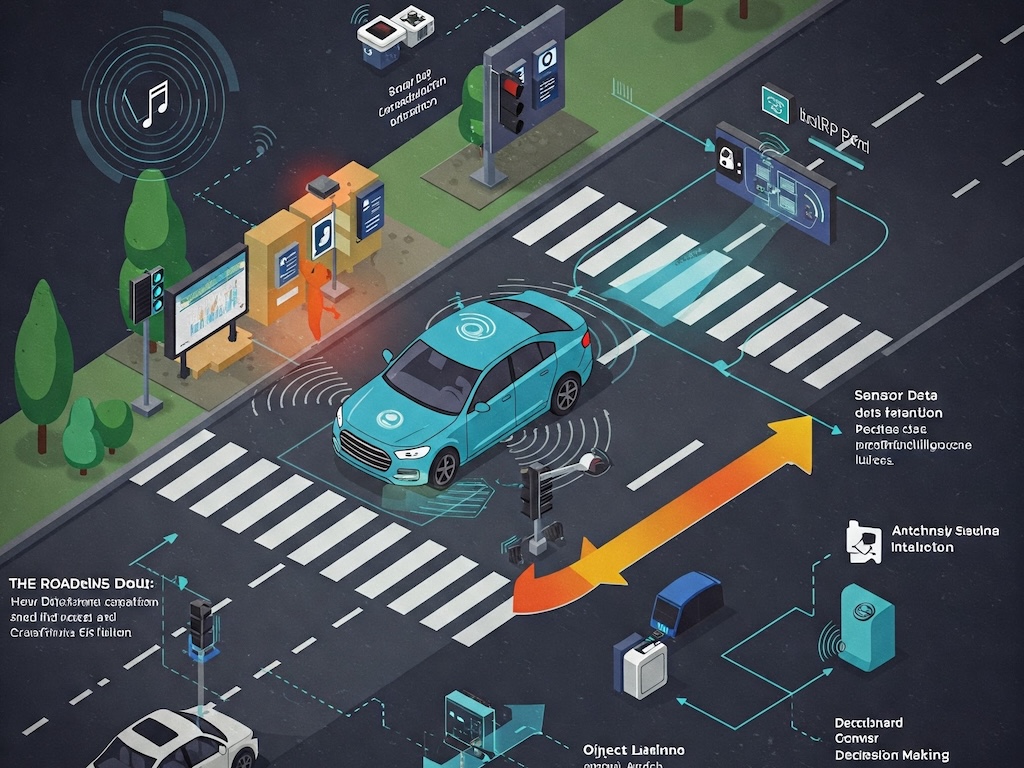
The Road Ahead: How Self-Driving Cars See and Decide
Self-driving cars are already being tested on roads around the world. Waymo operates robotaxis in Phoenix and San Francisco. Tesla's Autopilot handles highway driving for millions of owners. Cruise, Zoox, and others are running pilot programs in multiple cities. This isn't science fiction anymore — it's engineering in progress.
At the heart of every self-driving car is AI that does three things: sees the road, understands what's happening, and decides what to do next.
Learning to Drive by Watching
Before a self-driving car can operate safely, its AI has to be trained. Engineers feed the system massive amounts of real-world driving data — videos, images, and sensor readings from millions of miles of driving. The data includes traffic lights, pedestrians crossing, stop signs, cars merging, construction zones, and everything else that happens on a road.
The AI learns to recognize patterns in this data the same way it learns to recognize objects in images — by seeing enough examples that it can identify what's happening in a new situation it hasn't seen before.
Seeing Through Multiple Sensors
A self-driving car doesn't rely on a single camera. It combines multiple sensor types, each with a different strength:
- Cameras recognize signs, lane markings, traffic lights, and other vehicles
- Radar detects the speed and distance of nearby objects, even in rain or fog
- LiDAR (laser-based sensors) builds a detailed 3D map of everything around the car
The AI fuses data from all these sensors together to build a real-time picture of the car's surroundings — far more detailed than what any human driver sees.
Understanding the Scene
Raw sensor data isn't useful on its own. The AI has to interpret it — identifying that a shape is a pedestrian, that a light is red, that the car ahead is braking. This step is called perception, and it has to work fast and accurately in all conditions: rain, fog, night, glare, construction zones.
The AI also predicts what other road users are likely to do next. A pedestrian standing at a curb might step into the street. A car with its turn signal on is probably about to change lanes. These predictions help the self-driving system plan ahead rather than just react.
Making Decisions
Once the AI understands the scene, it has to decide what to do — brake, accelerate, change lanes, yield, or stop. These decisions happen multiple times per second and must balance safety, traffic rules, and efficiency.
The system also has to handle edge cases — a ball rolling into the street (a child might follow), an emergency vehicle approaching, a road not on the map. These are the hardest problems in self-driving, and they're the reason the technology is still being tested rather than deployed everywhere.
Where It Stands Today
Self-driving technology works well in controlled environments — highways, mapped urban areas, good weather. The remaining challenge is handling the full complexity of real-world driving: unpredictable humans, unmapped roads, extreme weather, and situations the AI has never encountered in training.
Progress is real and measurable, but so are the remaining gaps. The cars are getting better every year — and the AI behind them is the reason why.