The Machine Said It Was Her: Angela Lipps’s Five Lost Months
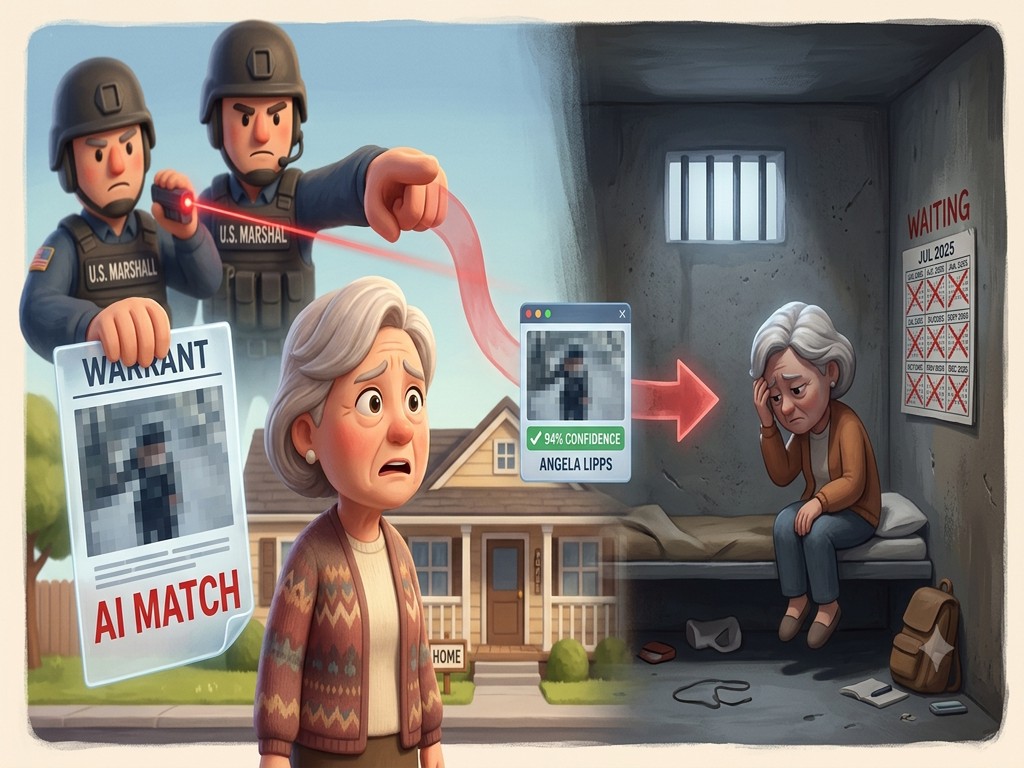
Angela Lipps was babysitting her four grandchildren on July 14, 2025, when U.S. Marshals showed up at her door with guns drawn. They told her she was under arrest for bank fraud in Fargo, North Dakota — a city more than 1,600 miles from her home in Elizabethton, Tennessee. A city she had never visited.
The evidence against her was a facial recognition match. Software had compared her face to blurry surveillance footage from a bank where someone used a fake military ID to commit fraud. The system said it was her. That was enough.
The Technology That Can't See Clearly
Facial recognition doesn't work the way most people imagine. It doesn't look at a photo and say "that's Angela Lipps." It generates a probability score — a number that says how likely two faces are to be the same person. The lower the image quality, the less reliable that number becomes.
The surveillance footage from Fargo was blurry. Angela Lipps is a 50-year-old woman — and research consistently shows these systems perform worst on women and older people. The woman in the footage was using a fake military ID in a state Lipps had never set foot in.
Here's the detail that makes this worse: West Fargo police received the same AI match. They looked at it and declined to file charges because they determined a facial recognition hit alone wasn't sufficient evidence. Fargo police treated it as a closed case.
Five Months for a Computer's Best Guess
After her arrest, Lipps was extradited over 1,000 miles to Fargo and held for nearly five months. Her attorneys later stated that "basic investigative efforts were never made." Nobody checked whether she had ever left a 100-mile radius of her home. Nobody checked whether she owned a passport. Nobody pulled her bank records to see if she was in Tennessee on the dates of the crimes.
The alibi that eventually freed her — Tennessee bank transactions proving she was home during every single incident — existed from day one. It was sitting in a database, waiting for someone to look. Nobody did.
On Christmas Eve 2025, the charges were dismissed.
What She Actually Lost
By the time Lipps walked free, she had lost her home, her car, and her dog. Five months in jail while your life falls apart doesn't reverse itself when a judge says "never mind."
A GoFundMe campaign raised over $70,000 — generous, but a fraction of what it costs to rebuild a stable life from zero in your fifties. There is currently no federal law requiring compensation for people wrongfully jailed due to algorithmic misidentification.
Fargo's police chief acknowledged errors in March 2026 and issued a new facial recognition policy. Lipps reportedly never received a direct apology.
This Keeps Happening
Angela Lipps is not an isolated glitch. At least nine documented wrongful arrests in the United States have been tied to facial recognition misidentification. Six of the first seven involved Black individuals.
In June 2026, Robert Dillon, 52, of Fort Myers, Florida, sued police after the technology wrongly linked him to a child-luring crime 300 miles from his home. The ACLU alleges officers concealed the AI's role when applying for the arrest warrant — meaning a judge approved the warrant without knowing a computer generated the lead.
The ACLU has catalogued more than a dozen such cases overall. The common thread isn't one malfunctioning system. It's a policing culture that treats a machine's confidence score as a shortcut past actual detective work — and no consistent legal requirement to disclose that AI was involved in the identification.
What You'd Never Know to Do
If this ever happens to you or someone you know, there is one urgent step most people miss: demand that your attorney subpoena your own location data immediately. Cell tower records, bank transaction locations, GPS logs from your phone, tollbooth records — these prove where you physically were on the dates in question.
The problem is timing. Telecom companies rotate cell tower data out of retention after months. Bank location metadata isn't kept forever. The evidence that proves your innocence has an expiration date, and most people don't know it exists until it's too late.
Angela Lipps's Tennessee bank records saved her. But she spent five months in jail before anyone thought to pull them.
The Question Nobody's Answering
Right now, police departments in most states can use facial recognition without telling you it was involved in your arrest. There's no federal disclosure requirement. There's no standard for image quality. There's no minimum confidence threshold a match has to meet before it becomes the basis for a warrant.
The machine said it was her. It wasn't. And the system had no built-in way to catch that mistake before it cost a grandmother five months of her life and everything she owned.