Your Voice Is Worth $5 a Month to a Criminal — And Your Family Can't Tell the Difference
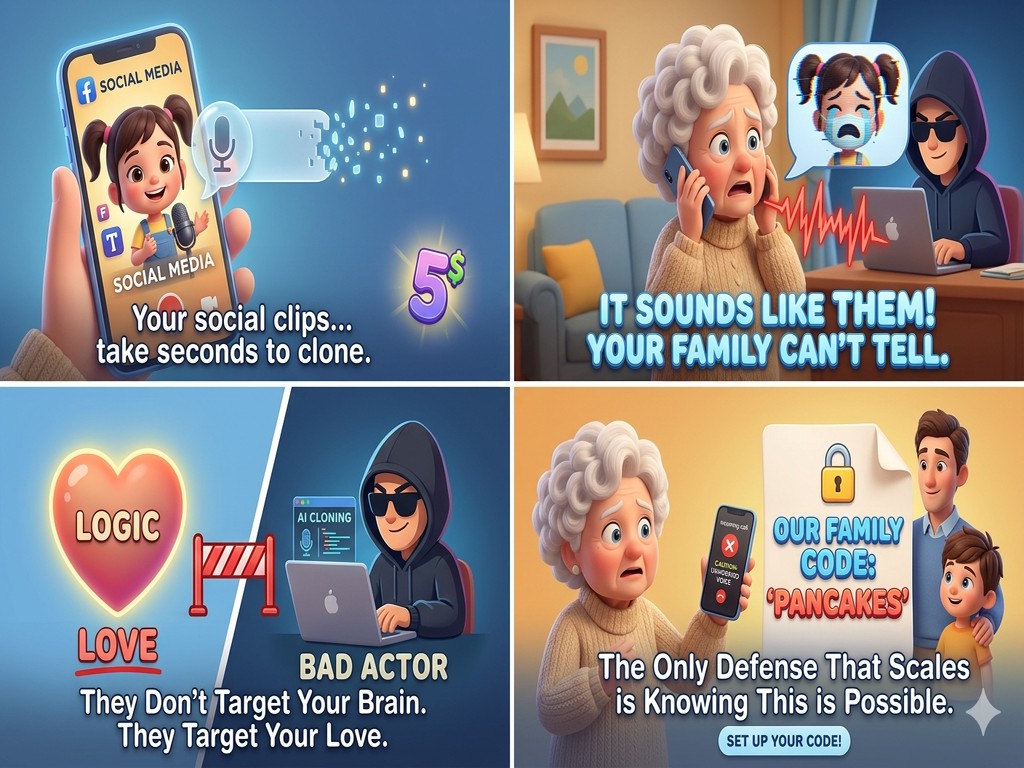
A mother in the San Francisco Bay Area picked up her phone and heard her daughter sobbing. The voice was shaking, panicked, begging for help — claiming she'd been kidnapped. The mother nearly wired money before realizing her daughter was safe at school. The voice on the phone was built from a clip her daughter had posted on social media. It took a scammer less than five seconds of audio to pull it off.
That's not a movie pitch. That's a CBS News report from 2024. And the tool that made it possible costs less than a Netflix subscription.
The Five-Dollar Kidnapping Kit
ElevenLabs — one of the most popular voice-cloning platforms on the market — offers cloning starting at $5 a month. A convincing replica of someone's voice requires only three to five seconds of recorded audio. A voicemail greeting. A TikTok. A birthday video your kid posted two years ago.
The barrier to pulling off a voice scam used to be talent. You needed to be a good actor, a skilled mimic. Now you need a credit card and a browser. The technology isn't experimental or underground — it's a consumer product with a pricing page.
Why It Works So Well
When Consumer Reports tested six major voice-cloning companies in March 2025 — Descript, ElevenLabs, Lovo, PlayHT, Resemble AI, and Speechify — four out of six had no meaningful safeguards preventing someone from cloning a voice without the speaker's consent. No verification. No proof that the voice belongs to you.
That matters because cloned-voice scams don't target your logic. They target your love. When you hear your daughter crying, your grandson panicking, your spouse whispering that something went wrong — you don't pause to analyze audio quality. You react.
The numbers back this up: according to a McAfee global survey, 77% of people targeted by a cloned-voice message lost money. Not "considered sending money" — actually lost it. The voice bypasses every rational filter because it sounds like someone you'd die for.
A Billion Dollars the FBI Just Started Counting
The FBI's Internet Crime Complaint Center logged over $893 million in AI-related scam losses across 22,000 complaints in 2025. That was the first year they even tracked the category. The real total likely crossed $1 billion, because most victims never report it — either out of embarrassment or because they don't realize AI was involved.
One in four Americans received an AI-cloned voice call in the past year. Let that sink in. This isn't a niche problem hitting tech-illiterate seniors in isolation. It's hitting everyone with a phone number and a family member who posts online.
INTERPOL estimates that AI-enhanced fraud is 4.5 times more profitable than traditional cybercrime. Criminals who adopt these tools aren't experimenting. They're optimizing. The ones still doing email phishing are the ones who haven't upgraded yet.
The Law Is Running Behind
In April 2026, Senator Maggie Hassan sent formal letters to ElevenLabs, LOVO, Speechify, and VEED demanding they explain what they're doing to prevent misuse. A bipartisan AI Fraud Accountability Act would make digital impersonation to defraud a federal crime — up to three years in prison. It hasn't passed yet.
Meanwhile, in June 2025, a New York man was sentenced to prison for stealing roughly $20,000 from three New Hampshire families using a cloned-voice "grandparent scam." He called elderly victims, mimicked their grandchildren's voices, and begged for emergency cash. He was caught. Most aren't.
The gap between what's technically possible and what's legally prosecutable is where the damage lives. The tools are legal. The platforms are accessible. The victims have almost no recourse.
What You Can Actually Do
Set up a family code word — a phrase that only your family knows, that you'd ask for in any emergency call. It sounds simple, almost silly. But when a perfect copy of your son's voice calls you at 2 a.m. saying he's been in an accident, the only thing that can override your instinct is a system you built before the panic hit.
Don't trust caller ID. Don't trust the voice. Trust the word.
The technology to clone a voice will only get cheaper and better. The five-dollar tool today will be a free tool tomorrow. The only defense that scales at the same speed is knowing this is possible — and deciding right now what you'll do when the call comes.