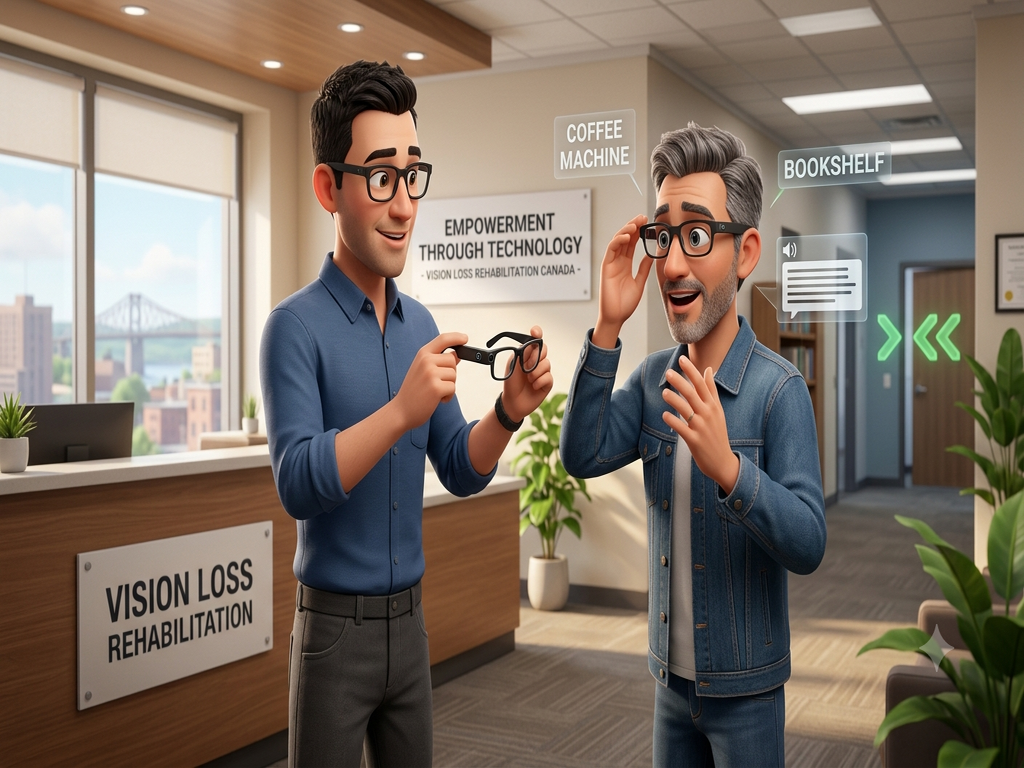
Kevin Carrier Can See the Future — And He's Showing Others How to Find It
Kevin Carrier was a teenager when he learned his eyes were failing him. Stargardt disease — an inherited condition that destroys central vision over time — meant the world was going to get harder to see, year after year, with no cure and no pause button. For a young person in New Brunswick, Canada, that diagnosis could have closed a lot of doors.
The Spark
At university, Kevin met a disability advocate while working with an assistive technologist on campus. That meeting changed his trajectory. He realized that the right tools and the right knowledge could keep those doors open — not just for him, but for thousands of others navigating life with vision loss.
He began volunteering with the CNIB Foundation, facilitating virtual programs that taught Canadians with sight loss how to advocate for themselves and use technology to overcome barriers.
The Work
Today, Kevin is an Assistive Technology Specialist at Vision Loss Rehabilitation Canada in Fredericton. His job is straightforward and profound: he teaches people who are blind or have low vision what tools exist and how to use them.
That includes screen readers, magnification software, text-to-speech, and document summarization — but the real game-changer has been AI.
Kevin demonstrates AI-powered smart glasses that cost about $400. They have a built-in camera, speakerphone, microphone, and touch controls. The AI describes what's in front of you — text on a sign, a person's face, an obstacle on the sidewalk. Kevin calls it "a whole new world."
"An important aspect of assistive technology isn't just being able to do a thing," Kevin says. "It's sometimes being able to do a thing while still competing with your able-bodied peers… and without the help of someone else."
He goes further: "In some ways, you can actually be faster than your sighted peers."
What's Coming
Kevin is clear-eyed about the future. Companies are building real-time AI feedback systems — tools that could eventually say "You can cross the street now" or "There's something in front of you." He believes this technology could "completely change how a blind person or low-vision person or anybody is able to navigate their home, their workplace, their community, shop for themselves, read mail when they get it."
"I think it's tremendously cool, but it's also tremendously important," he says. "And I'm really excited for what's coming down the pike."
The Numbers in New Brunswick
The numbers are stark. More than 35% of New Brunswick's population has a disability. Only 46% of those people are employed. That's a gap driven not just by physical barriers, but by bias — employers and educators who don't know what's possible.
"I think that helping employers and educators understand the possibilities with assistive technologies could help alleviate some of these predetermined ideas in their own mind," Kevin says, "and just help alleviate some of the bias that they might have toward certain individuals."
Why This Story Matters
Kevin Carrier isn't just handing people gadgets. He's handing them independence, speed, and proof that disability doesn't mean inability. He's showing employers that a $400 pair of glasses and the right training can turn "we're not sure they can do the job" into "they're outperforming everyone."
When a person with progressive vision loss can use a $400 device to read their own mail, navigate a grocery store, or compete for a promotion, that's not a tech demo. That's dignity. That's economic participation. And it's happening right now, in Fredericton, New Brunswick, one person at a time.
Sources & Further Reading
- CBC News — "Here's how artificial intelligence is levelling the playing field for workers with disabilities" — Primary feature on Kevin's work (Feb 2025)
- CBC Player — "Talking to your glasses? This standout tech is helping the low-vision community" — Video segment showing the AI smart glasses
- CNIB Foundation — Meet Kevin — Kevin's volunteer profile and advocacy work
- Government of New Brunswick — Disability by the Numbers — Provincial disability statistics