From a Refugee Camp in Malawi to Teaching AI to the Next Generation: Jospin Hassan's Story
Dzaleka Refugee Camp sits about 25 miles outside Lilongwe, the capital of Malawi. It was built for 10,000 people. Tens of thousands more live there now — families from the Democratic Republic of Congo, Burundi, Rwanda, Ethiopia, and beyond, many of whom have been there for years with no clear path forward. This is where Jospin Hassan grew up, and where he decided that the world's most powerful technology shouldn't be reserved for the world's most privileged people.
A Camp With Walls You Can't See
Jospin is a refugee. He has lived in Dzaleka for most of his life. The camp has food, shelter, and some basic services — but what it doesn't have, or didn't for a long time, is opportunity. Educational options were limited. Internet access was scarce. The idea of learning something like artificial intelligence or data science felt like it belonged to another planet.
But Jospin was curious. He got his hands on whatever devices and connectivity he could find, and he started teaching himself. By 2018, he'd hit a wall. He wanted to learn more — data science, programming, the technologies reshaping the global economy — but there was no one around to teach him and no program to join.
That's when he found MIT.
A Door Opens
In 2020, Jospin was accepted into the Certificate Program in Computer and Data Science through MIT Emerging Talent (formerly MIT Refugee Action Hub). It's a year-long online program that gives refugees and displaced learners access to real MIT coursework — computer science, data analysis, professional skills, and networking with a global community.
"My biggest takeaway was networking, collaboration, and learning from each other," he said.
He participated in interactive leadership workshops and completed the 10-week MIT Innovation Leadership Bootcamp. He learned how to think about problems the way engineers do: What are you solving? Who does it help? How will you build it?
And then he brought all of it home.
Building ADAI Circle
Jospin didn't leave Dzaleka to chase a career in Silicon Valley. He stayed.
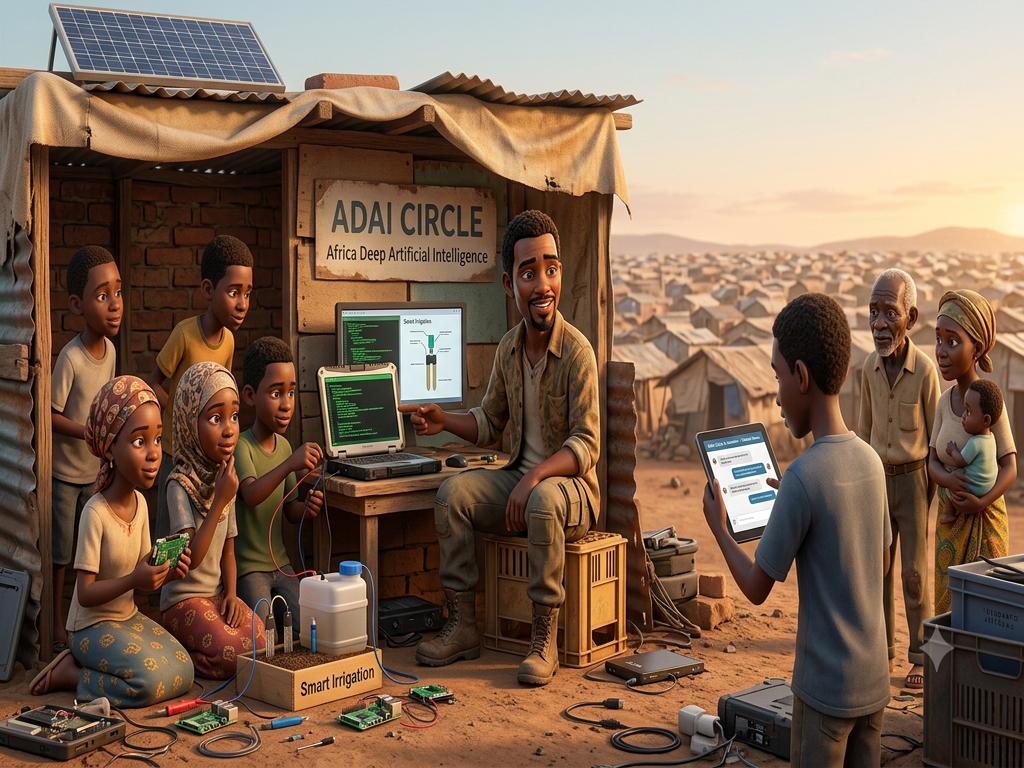
In 2020, he and co-founder Patrick Byamasu launched ADAI Circle — the Africa Deep Artificial Intelligence Circle. Their mission: foster job creation and reduce poverty in Malawi through technology and innovation. They offer programs in data science, AI, software development, hardware design, and mentorship — all for youth and job seekers in and around the refugee camp.
"The world is changing every day, and data scientists are in higher demand," Jospin explained. "For this reason, I decided to expand and share the knowledge that I acquired with my fellow refugees and the surrounding villages."
In April 2020, ADAI Circle enrolled its first cohort of eight students in a 12-month Embedded Systems and IoT course. Those students built a smart irrigation system to help local farmers monitor their crops remotely. In December 2019, even before the formal launch, Jospin partnered with IBM's Call for Code initiative to run a "Girls in Robotics" workshop — over 60 girls learned Python and Raspberry Pi across three days.
By August 2022, they opened the ADAI Innovation Hub — a physical space where anyone in the community can access the internet and learn.
Teaching AI to Kids in a Refugee Camp
In 2022, ADAI Circle connected with MIT RAISE to pilot something ambitious: bringing MIT's RAICA curriculum — Responsible AI for Computational Action — to middle school students in the camp.
The partnership started with months of co-design. Jospin's teachers met weekly with MIT researchers, translating learning materials in real time. By 2023, students were learning about chatbots, natural language processing, and how AI systems work. Some advanced students started using the ChatGPT API to build their own education projects.
"Many of our learners came with no prior exposure to AI," Jospin said. "Today, they are developing real-world projects that address pressing challenges within the Dzaleka Refugee Camp community."
His philosophy is hands-off by design: "We don't want to tell them what to do. We want them to come up with their own ideas."
The Numbers
- 2018: First conceived the idea for ADAI Circle
- 2019: Robotics workshop for 60+ girls with IBM
- 2020: Officially launched; first cohort of 8 students in a year-long program
- 2022: Opened the Innovation Hub; began AI curriculum partnership with MIT RAISE
- 2023: Middle school students piloting MIT's RAICA AI curriculum
- 2024: Featured in MIT News; students building independent AI projects
ADAI Circle has also taken on professional software clients — Cloud Stores Malawi, takenoLAB Learning Platform, Ameryllis Hotel Blantyre — generating revenue to sustain the mission.
Why This Story Matters
Jospin Hassan's story is not about a refugee who escaped his circumstances. It's about a refugee who transformed them — from the inside.
He didn't have a trust fund, a visa to a wealthy country, or a lucky break. He had curiosity, a certificate program that believed refugees deserve world-class education, and the conviction that if he could learn AI, so could the kids in his camp.
Today, middle school students in Dzaleka Refugee Camp are building chatbots and programming robots. Girls who had never touched a computer are writing Python. Young people who were told their futures were limited are designing smart irrigation systems for their neighbors' farms.
"We can't teach everyone and accommodate everyone because there are a lot of schools," Jospin said. "But we offer another place for knowledge."
Sources & Further Reading
- MIT News — "We offer another place for knowledge" — Primary feature on Jospin Hassan and ADAI Circle
- MIT RAISE — Building AI Literacy Together: RAICA and ADAI Circle — Curriculum partnership details
- ADAI Circle — Programs, partners, and timeline
- Refugee Investment Network — Workshop Recap — Jospin's 2022 investor presentation