The Boy Who Audited the Future
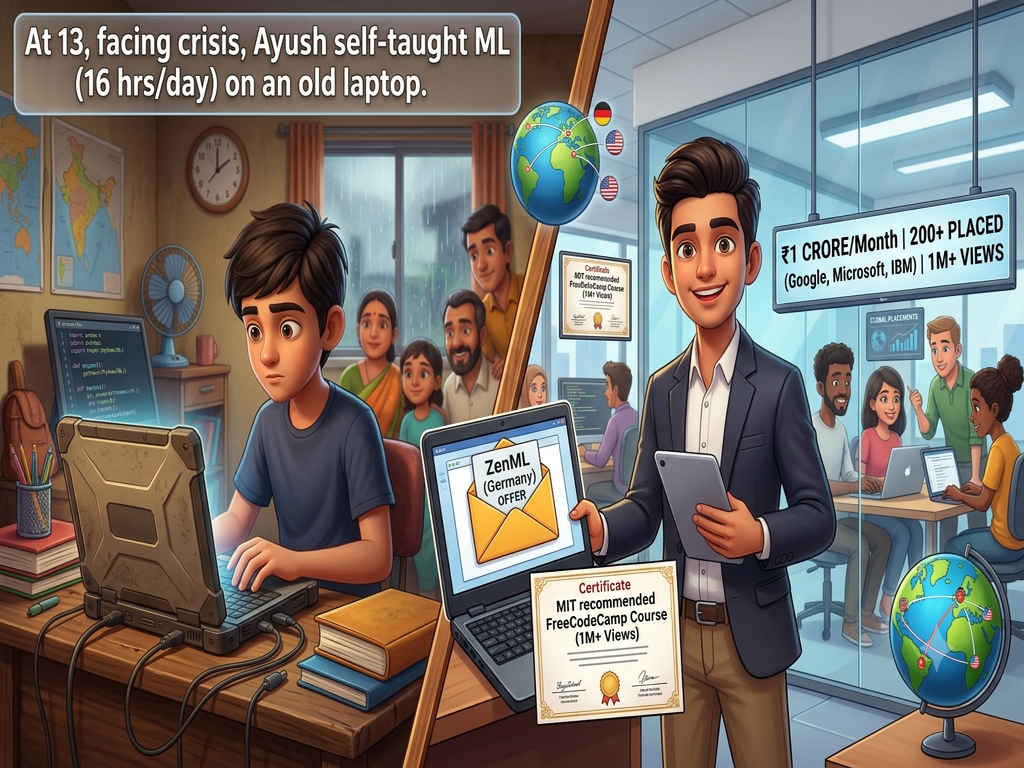
When the world locked down in 2020, thirteen-year-old Ayush Singh wasn't thinking about the global economy. He was thinking about his family's survival. The pandemic had hit his household in India like a sledgehammer, fracturing their financial security. He had no safety net, no wealthy mentors, and no elite school guidance counselor. What he did have was a laptop, an internet connection that choked more often than it flowed, and a desperate, burning curiosity.
While most of the world retreated into Netflix and video games to escape the anxiety of isolation, Ayush dove headfirst into the dense, intimidating world of machine learning. He scoured the internet for scraps — outdated courses, free university lectures, and PDFs of textbooks. For 10 to 16 hours a day, he taught himself a language spoken only by data scientists and elite engineers, treating his education not as a chore, but as a lifeline.
By the time he was still barely old enough to text his friends, Ayush did something unthinkable for a teenager without a résumé: he cold-emailed the founder of ZenML, a machine learning startup based in Germany. He didn't ask for an internship. He just showed them what he could do. Intrigued, the company threw a gauntlet of coding interviews and take-home challenges at him. He leveled them all. Before he was old enough to legally drive, Ayush was hired as an MLOps engineer, collaborating with international startups on cutting-edge infrastructure.
But Ayush understood a fundamental truth of the internet age early on: true leverage comes from building in public. At fourteen, he synthesized everything he had learned and recorded a massive, comprehensive machine learning course for freeCodeCamp. When MIT's official channel stumbled upon it and recommended it to the world, the trajectory of his life changed forever. The course racked up over a million views. The kid who couldn't afford a paid textbook was now teaching the world's engineers how to code.
From there, the momentum was unstoppable. Ayush went on to build NLP systems for US startups, design more viral courses, and eventually transition from a prodigy for hire into an entrepreneur. He founded Antern to democratize the very education that saved him, co-founded Second Brain Labs with backing from former tech executives, and launched the AI Placement Sprint — an 18-week live training program for software engineers breaking into AI roles.
Today, at just nineteen, Ayush's AI education business generates over ₹1 crore a month — roughly $120,000 USD — in revenue. But the true metric of his success isn't the money. It's the 200-plus engineers he has personally trained and helped place at companies like Google, Microsoft, IBM, and American Express.
Ayush Singh's story carries a sharp, disruptive truth. It proves that the old gatekeepers of success — the Ivy Leagues, the IITs, the nepotistic networks — are crumbling. In the AI era, proof of work is the ultimate currency. Ayush didn't wait for someone to open the door to the future. He picked the lock, walked right in, and left it wide open for everyone else behind him.
Sources & Further Reading
- India Today — How the 19-year-old Ayush Singh built a Rs 1 crore-a-month AI education venture — Primary profile
- Economic Times — No IIT, No MIT: After facing financial crisis during COVID-19 — Background and origin story
- freeCodeCamp — Free 10-Hour Machine Learning Course — His first major published course
- freeCodeCamp — MLOps Course — Production-grade ML course
- NDTV — How A 19-Year-Old Built Rs 1 Crore A Month AI Business — Additional coverage
Note: Income figures are reported through Indian media. His freeCodeCamp courses and ZenML work history are independently verifiable.