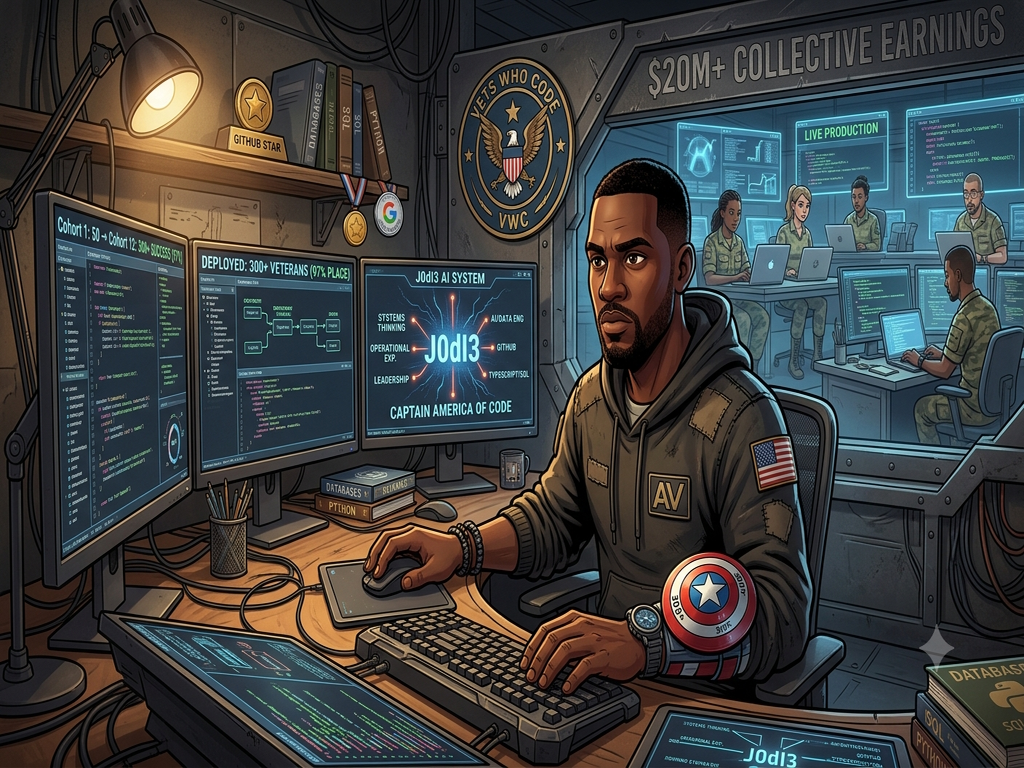
From Combat Boots to Captain America of Code
Jerome Hardaway spent five years in the U.S. Air Force — Security Forces, multiple deployments, including Iraq. He did base security, law enforcement, quick reaction force work. The kind of job where people depend on you with their lives. Then he came home in 2009, right into the worst recession in a generation, and the civilian world told him he wasn't qualified for much of anything.
"Unqualified"
Jerome grew up in Memphis, Tennessee. He studied criminal justice, not computer science. When he separated from the Air Force, he had years of operational experience, leadership under pressure, and a security clearance — but employers didn't know what to do with any of that. He was a Black combat veteran from the South trying to break into an industry that didn't look like him and didn't have a clear door for people with his background.
Someone once told him he'd need a white co-founder or to move to Silicon Valley if he wanted to make it in tech. He didn't do either.
A Book at Barnes & Noble
Instead of waiting for permission, Jerome picked up a book on databases and SQL at a Barnes & Noble and started teaching himself. No bootcamp. No scholarship. Just a book and stubbornness.
It worked. He learned SQL, then PHP, then Rails, then JavaScript. His first tech job was as a database analyst at the Department of Homeland Security's TWIC program, earning roughly double his military pay. Later, LinkedIn and Microsoft sponsored him for accelerated training, and he moved into full-time software engineering.
But the thing that changed everything wasn't his own career. It was a phone call.
$10,000 in 27 Hours
In 2014, a friend asked Jerome for help. A veteran's family couldn't afford burial costs. Jerome built a website using Bootstrap and Heroku — simple tools, nothing fancy — and put it online. They raised $10,000 in under 27 hours.
That moment showed him what he could do with code. Not just for himself, but for other veterans stuck in the same gap he'd been in. He founded Vets Who Code that same year — a 501(c)(3) nonprofit that teaches software development to veterans and military spouses at zero cost. Fully remote, funded entirely by donations.
How It Works
Vets Who Code gets 400 to 500 applicants a year. About 50 are accepted into each 15-week cohort. From day one, students push code to the live platform. No toy projects. Real production work.
In the first year, Jerome personally taught courses at night using Slack and Zoom, helping 50 veterans across 12 states land software engineering jobs. By 2026, the curriculum has expanded into three tracks: Software Engineering (TypeScript, Next.js, GitHub Actions), AI Engineering (Python, SQL, Azure AI, Google Gemini), and Data Engineering (Python, SQL, Azure ecosystem).
The Numbers
As of early 2026, Vets Who Code has trained over 300 veterans and military spouses. Their job placement rate is 97%. Graduates have earned more than $20 million collectively. They've been hired at Microsoft, Amazon, Google, Home Depot, and dozens of other companies.
Jerome himself is now a Senior AI Engineer. He's a GitHub Star, a Google Developer Expert, a Twilio Champion, and a Microsoft Global Hackathon winner. In 2015, the Obama White House invited him to Demo Day — fewer than 50 people were selected, and he was the only African-American male combat veteran running a social enterprise in the room. President Obama reportedly called him the "Captain America of Code."
The nickname stuck.
J0dI3: AI That Understands Veterans
Jerome didn't stop at teaching. He built an AI system called J0dI3 (pronounced "Jody"), powered by a decade of data from veteran career transitions. J0dI3 evaluates resumes, audits GitHub profiles, analyzes LinkedIn presence, and scores portfolios — but it does it differently than a generic hiring tool.
J0dI3 understands that a military mechanic, an EOD technician, or an intelligence analyst already thinks in systems. It recognizes those backgrounds as positive signals for engineering aptitude. It measures what Jerome calls "translation completeness" — whether a career switcher's resume actually bridges military experience into language that tech hiring managers understand.
In other words, it evaluates people the way Jerome wishes someone had evaluated him back in 2009.
Why This Story Matters
Jerome Hardaway's story is not about one person being exceptional. It's about a gap — between what people can do and what the world sees them as qualified to do.
There are thousands of veterans and military spouses right now who have discipline, problem-solving instincts, and the ability to learn fast. What they don't have is someone to show them the door and hand them the key. Jerome proved that a single person with a book and an internet connection can change their own life — and then turn around and change 300 more.
The question isn't whether people can learn AI. It's whether we'll build the bridges to let them.
Sources & Further Reading
- Vets Who Code — 300 Veterans Later — Jerome's account of building VWC over a decade, including J0dI3
- GitHub ReadME — Jerome Hardaway — Feature on his self-teaching journey
- VoyageATL — Conversations with Jerome Hardaway — 2025 interview covering racial barriers and AI work
- Business Insider — Meet the Air Force Veteran Who Founded Vets Who Code — 2020 profile
- Diginomica — How Vets Who Code Helps 300+ Military Veterans — Placement rate and earnings data