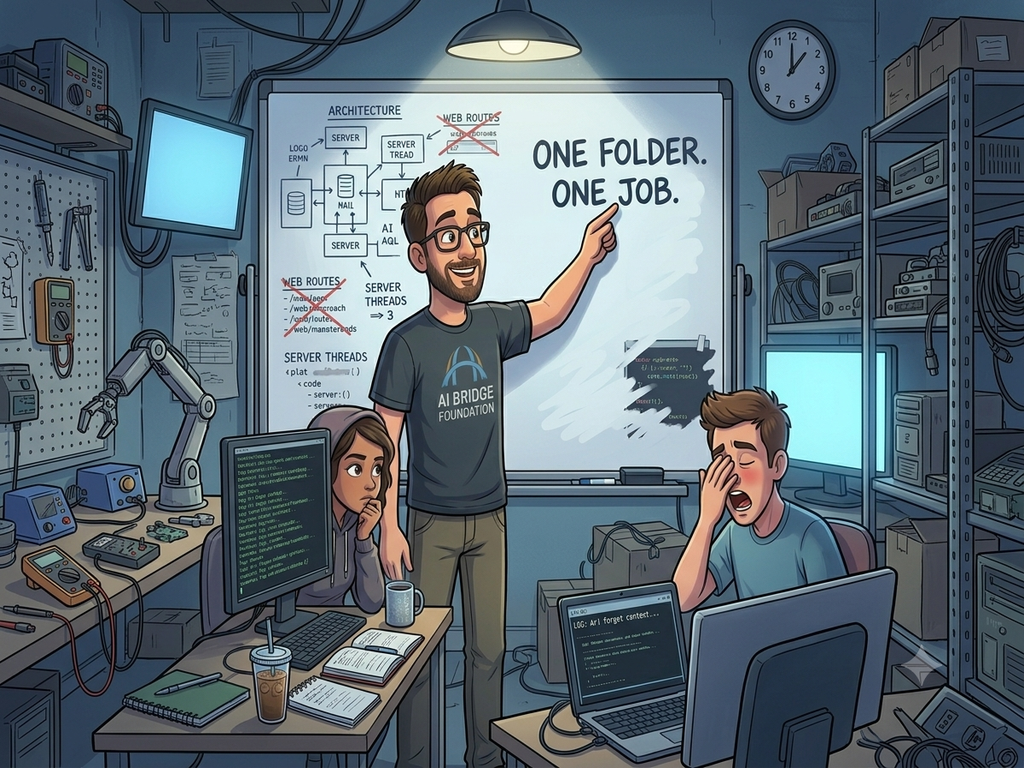
Giving Each Tool Its Own Brain
After we built the Ari platform and saw Ari working across our courses, the natural next question inside the team was: How do we make Ari smarter?
Not smarter in general—smarter at each specific thing Ari does.
Our late-night team conversations kept returning to the same source of frustration. When someone was chatting with Ari about GED math, Ari was focused on GED math. Great!
Except that conversation, that session, and that data extraction pipeline were all sharing space with literally everything else on our platform. Build the Quote. Tough Talk. The letter reader. All of it running on the exact same server, through the exact same web app, fighting for the exact same processing power.
It was like having one human brain trying to act as a math tutor, a business coach, a letter reader, and a volunteer coordinator all at the exact same time. It works... but none of those jobs are getting your absolute best thinking.
The Realization
Different tools serve completely different people in completely different ways. A student studying for their GED and a pressure-washing contractor building a job estimate have nothing in common except that they both talk to Ari.
Why were their systems glued together behind the scenes? What if Ari's teaching brain never had to compete for attention with the quote-building brain or the letter-reading brain?
What if each tool literally had its own isolated brain—its own space to think, its own memory, and its own resources?
Enter AWS Lambda (Or: Paying $0 For Idle Brains)
We didn't pick Lambda because we were chasing trendy cloud buzzwords. We picked it because of who we are: a non-profit foundation running on grants and donations.
Most of our specialized tools sit totally quiet for hours at a time. Nobody is using the estimate builder at 2:00 AM. Nobody is analyzing medical letters on a Sunday morning. With traditional servers, you pay 24/7 whether anyone is using it or not.
With Lambda, quiet tools cost literally nothing. They sleep. The second someone clicks a tool, that specific brain wakes up, does its job, and goes right back to sleep.
For a foundation watching every dollar, that's not just a nice feature—it's a game-changer.
No More Stepping on Each Other
When everything was packed into one giant app, our team kept running into the same problem: two people working on two completely unrelated features would break each other's work.
We learned this the hard way. The team was working on two things at once—improving how Build the Quote generates scope checklists, and refining how Ari handles wrong answers in the teen course. Totally unrelated. Different users, different purposes, different everything.
But because they lived in the same app, a change to the estimate builder introduced a subtle bug in Ari's session handling. Nothing crashed. Ari just... started losing context mid-conversation. A student would be five messages deep into a math explanation and Ari would suddenly forget what they were talking about.
It took hours to trace back. Hours—for a bug that had nothing to do with teaching.
Now? You literally cannot break the teaching engine by improving how estimates are generated. They don't even know each other exist.
A Door We Didn't Expect to Open
This architecture also opened a door we weren't anticipating: it makes it possible for volunteer developers to actually contribute code.
Before, asking a volunteer to help meant handing them the keys to the entire platform. One giant app, everything connected. The onboarding alone would take days, and the risk was too high.
Now we can say: "Here's a folder. It does one specific thing. Make it better." A volunteer can work on improving the letter reader without ever touching or seeing how the teaching engine works. They can't break what they can't access, and they deploy to a test environment completely separate from production.
That changes what "volunteer developer" means for us. It's no longer "we need someone senior enough to navigate our entire system." It's "can you write a Python function that does this one focused job?"
Students building portfolios. Career changers learning cloud infrastructure. Engineers donating hours through company giving programs. The barrier to contributing just dropped dramatically.
The Pattern Keeps Repeating
We started spinning off tools one by one. The letter reader moved first. Then the review advisor. Then the estimate builder. Each one peeled off cleanly—same smooth user experience on the outside, completely independent on the inside.
The main event was Ari's core learning engine. All 13+ courses now run through a single, laser-focused Lambda that does nothing but teach. It doesn't serve web pages. It doesn't handle logins. It just teaches. And because that's all it does, it does it exceptionally well.
Focus produces quality. Whether it's a team member working on a feature, a tool serving a student at midnight, or a volunteer contributing their first lines of code—the less you ask a system to juggle, the better it performs. Every time we give another piece of this platform its own dedicated brain, the whole thing gets a little sharper, a little faster, and a lot more present for the person using it.