Falsely Accused of Using AI? Here's What to Do
If a teacher ever emails you the words "we need to talk about academic integrity," your stomach drops before you even finish the sentence. For a growing number of students, that email arrives when they did nothing wrong. They wrote every word themselves. A piece of software decided otherwise, put a number on it — "87% AI-generated" — and now they have to prove a negative to someone who already thinks they lied.
Here is the thing almost nobody tells you in that moment: the software is probably wrong, and there is good evidence to say so.
Why honest students get flagged
In 2023, researchers at Stanford ran a simple test. They took essays written by real humans — students taking the TOEFL, the English exam for non-native speakers — and ran them through seven of the popular AI detectors. The detectors flagged 61% of those genuine, human-written essays as AI. Nearly all of them, 97%, got flagged by at least one tool. The same detectors barely ever flagged essays by US-born eighth graders.
Read that again. The tool was wrong more than half the time, and it was wrong in one specific direction: against people who learned English as a second language.
The reason is baked into how these things work. Detectors look at how "predictable" your word choices are — they call it perplexity. Writing that's simpler, that uses common words and steady sentence patterns, scores as more predictable, and predictable reads as "machine" to the detector. So who gets caught? People who write plainly. Non-native English speakers. Autistic and neurodivergent writers whose style is clean and consistent. Anyone who was taught to write clearly instead of ornately. The detector isn't catching cheating. It's catching a writing style.
And here's the part that should make you angry. A student who actually wanted to cheat can beat these tools in about ten seconds — paste the AI text back in and say "rewrite this with more varied, sophisticated language." Done. The detector waves it through. So the system lets the real cheater pass and flags the honest kid who writes like a normal person. That's not a glitch. That's the tool working exactly as designed.
The schools already know this
You are not the first person to notice. Back in 2023, Vanderbilt University turned Turnitin's AI detector off completely. Their math was blunt: even if the tool were only wrong 1% of the time — the best-case number Turnitin itself floated — that's about 750 wrongly accused students a year out of the papers they process. They decided that was unacceptable and shut it down. UCLA, UC San Diego, Cal State LA, and Johns Hopkins pulled back too. This fall, an MIT working group went further and recommended schools stop leaning on detectors at all, warning they poison the trust between teachers and students.
This matters for you because it means you're not asking your teacher to believe a wild theory. You're pointing at a conclusion that major universities already reached, in writing, years ago.
What to do in the first day
Don't panic-confess. Scared people apologize for things they didn't do just to make the conversation end — don't. You didn't cheat, so don't say anything that sounds like you did.
Ask for the accusation in writing. What's the exact claim, what's it based on, and is a detector score the only evidence? Get that in an email so it's on the record.
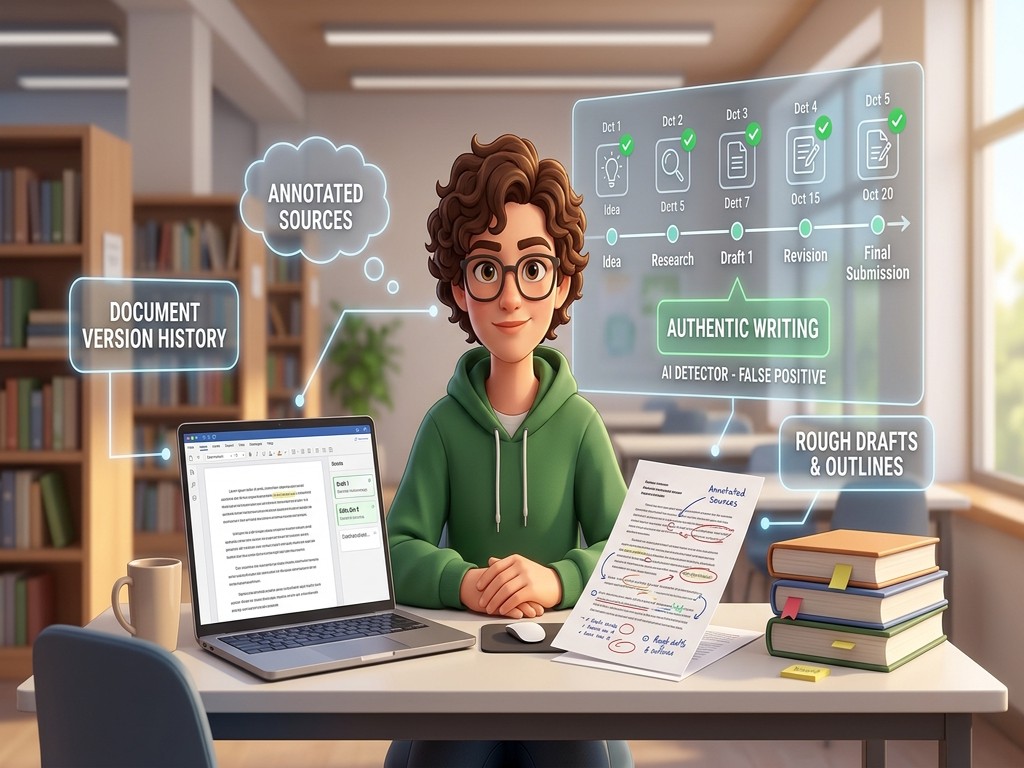
Then gather what you already have, which is more than you think. If you wrote in Google Docs or Word, your version history is a time-stamped recording of your essay being built word by word over hours — something no AI output has. Your rough notes, your browser history from researching, earlier drafts, even the messy outline on your phone all tell the same true story.
The email that actually works
Keep it calm and factual. Something like:
"Thank you for letting me know. I wrote this assignment myself and want to clear this up. I've attached my version history and drafts showing how I wrote it. I'd also note that AI detectors are known to be unreliable — a Stanford study found they wrongly flag over 60% of writing by non-native English speakers, which is why schools like Vanderbilt disabled them. I'd appreciate the chance to walk you through my process, and I'm happy to answer questions about anything I wrote."
That message does three things at once: it stays respectful, it hands over real evidence, and it quietly signals that you know the detector isn't proof. Most reasonable teachers soften right there.
If one doesn't, you escalate — calmly, in writing, up the chain to a department head, academic advisor, or the student ombudsman. Ask what the appeal process is and use it. A detector score is a probability, not a confession, and you have the right to say so.
Protect yourself before it happens
You shouldn't have to defend your own honesty, but a few free habits make it painless if you ever do. Write in a tool that keeps version history and leave it on. Keep your drafts instead of deleting them. Jot your thinking as you go. None of this changes how you write — it just means that if a piece of software ever calls you a liar, you can open your laptop and show, minute by minute, that it was you the whole time.