Why NotebookLM Works and ChatGPT Doesn't — For Studying
Everyone says AI is the future of studying. So you open ChatGPT, paste your question, get an answer, and move on. Your homework looks great. Your understanding didn't move an inch.
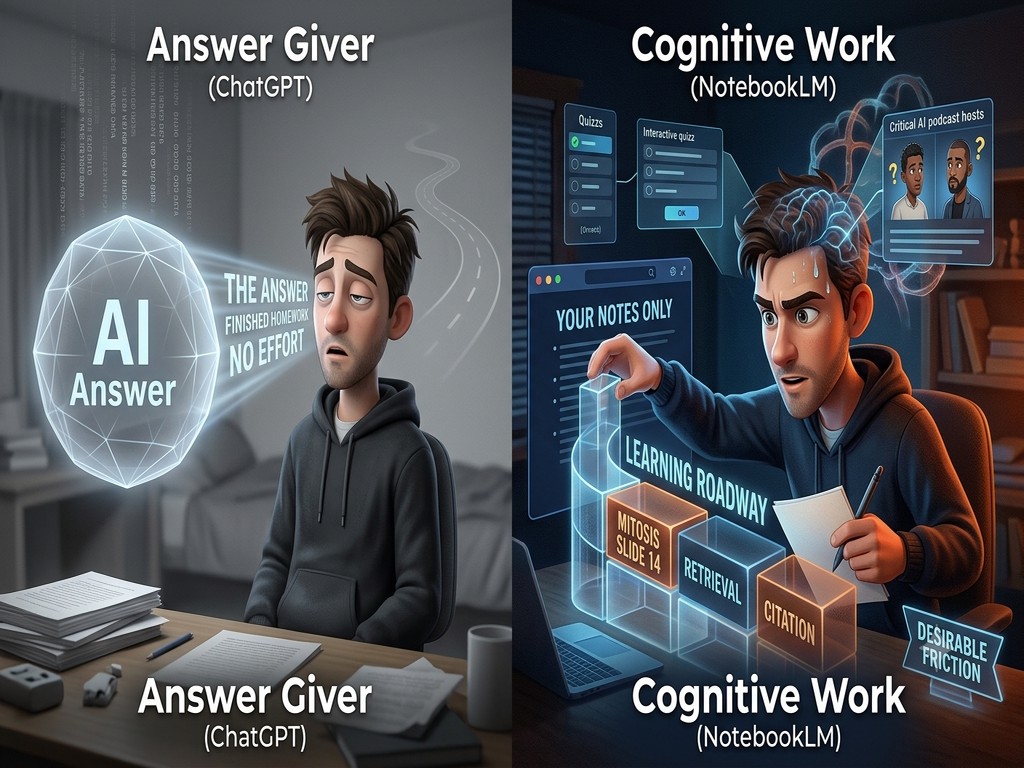
The most popular AI tools are designed to give you answers. But studying isn't about getting answers — it's about building the mental pathways that let you find them on your own. When AI does the finding for you, your brain never builds the road.
Then there's NotebookLM — Google's free study tool — and it's doing something fundamentally different. Not because the AI is smarter. Because the design forces your brain to stay in the game.
ChatGPT Gives You Fish. NotebookLM Makes You Fish.
When you ask ChatGPT a study question, it pulls from the entire internet, gives you a polished answer, and you nod along. It feels productive. But your brain was a passenger the whole time.
Can you turn ChatGPT into a great study tool? Absolutely — if you prompt it with "quiz me, don't give me answers, push back when I'm vague." But most students don't do that. They ask a question, get an answer, and close the tab. The discipline has to come from you every single time.
NotebookLM flips this by building friction into the design. In software, friction is usually the enemy — you want buying and searching to be effortless. But in education, friction is the feature. Cognitive scientists call it "desirable difficulty." The moment something feels slightly hard is the moment your brain starts encoding it. NotebookLM builds that difficulty into the product so you don't have to build it into your willpower.
You upload your own material — lecture slides, textbook chapters, your notes — and the AI only works with what you gave it. Every answer comes with a citation pointing to the exact page in your documents.
This also solves a problem most students don't think about: syllabus mismatch. ChatGPT might explain mitosis correctly — but not using the terminology that shows up on Friday's exam. A grounded tool teaches you the material the way your class expects you to know it.
The Science Behind the Design
Three decades of cognitive research explain why this works.
First, testing beats re-reading — and it's not close. Researchers at Purdue found that students who tested themselves retained over 100% more than students who simply reviewed material. Re-reading feels productive. Testing feels uncomfortable. The uncomfortable one sticks. NotebookLM generates quizzes and flashcards from your own notes — forcing retrieval instead of passive review.
Second, teaching is the deepest form of learning. Students who prepared to teach performed nearly 50% better on tests than students who just studied. NotebookLM's Audio Overview creates a podcast where two AI hosts discuss your material — and your brain shifts into evaluator mode. "Did they get that right? Is that what chapter four said?" You become the teacher checking the student's work.
One caveat: this works best after a first pass of the material. If you've never seen the content, you won't catch what the hosts oversimplify. Read the chapter first, then let NotebookLM reinforce it — that's when evaluator mode kicks in.
Third, your brain has a bandwidth limit. ChatGPT gives you the entire internet — links, tangents, things you didn't ask about. NotebookLM gives you a sealed room with only your material inside. No rabbit holes. Your brain processes twenty pages instead of filtering ten thousand.
What This Actually Looks Like
A student studying for biology opens ChatGPT and types "explain mitosis." They get a polished paragraph from who-knows-where, read it once, and close the tab. On test day, it's fuzzy.
That same student uploads their bio lecture slides into NotebookLM. They listen to an Audio Overview during their commute — two hosts discussing mitosis in the exact language from their professor's slides. They catch something the hosts oversimplified. Then they generate a quiz, get three questions wrong, and now know exactly where their gaps are. They ask NotebookLM to explain those three concepts, and it answers citing slide 14, slide 22, and the textbook PDF they uploaded.
One workflow consumed information. The other constructed understanding.
The Real Question
When you pick any AI study tool, stop asking "which one gives the best answers?" Ask "which one makes me do the thinking?" Every AI gives good answers now. What's scarce is the mental work that turns an answer into knowledge you actually own.
The AI tools that make learning easier and the AI tools that make learning effective are not the same tools. Easier feels good tonight. Effective shows up on test day.
Don't outsource your thinking to AI. Outsource the heavy lifting of organizing the material — then force your brain to do the heavy lifting of understanding it.