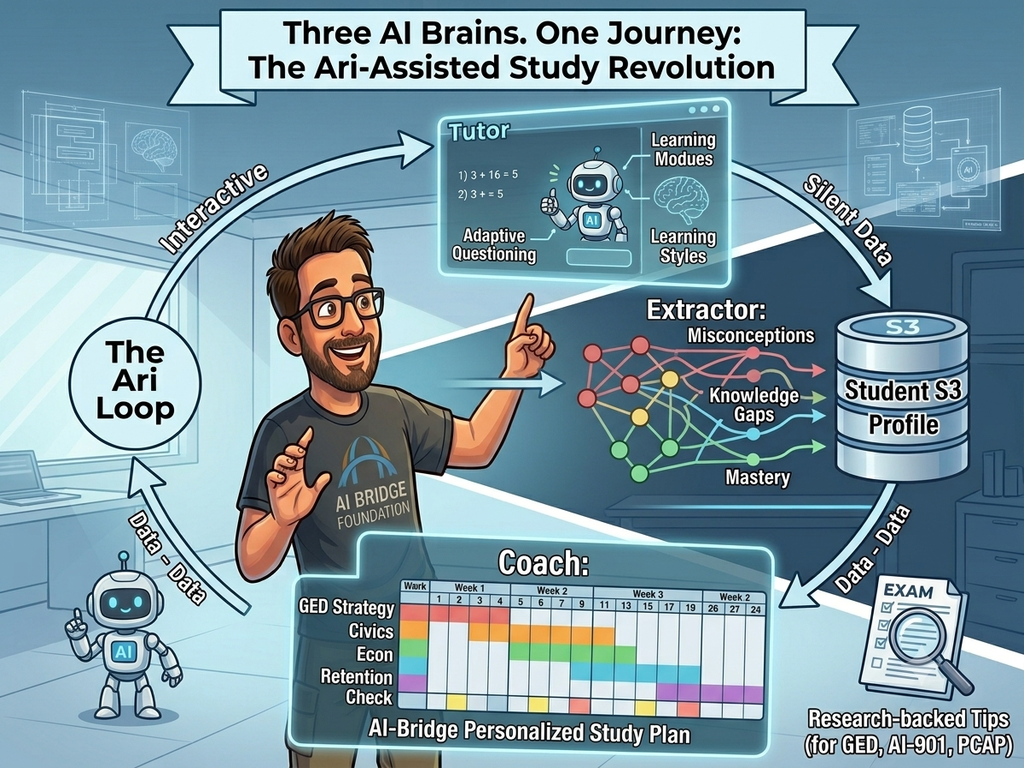
How Ari Actually Teaches You (Part 3): The Coach That Sees Everything
This is Part 3 of three. In Part 1, we built the Tutor — the Ari that teaches you in real-time. In Part 2, we built the Extractor — the silent brain that watches your sessions and builds a model of how you learn. Both work. But something was still missing.
A friend pointed it out during a casual conversation. "Your AI teaches well. But who tells the student what to study tonight?"
The Question We Kept Seeing
We'd been asking ourselves the same thing — so we went looking for whether other people felt it too. GED forums on Reddit confirmed it. The same posts kept appearing. People who studied hard but couldn't figure out what to focus on. People who felt ready but got surprised on test day. People managing their own prep with no way to know if their plan was working until it was too late.
We recognized ourselves in those posts. Building a teaching AI was one thing. But teaching without strategy is like driving without a map — you're moving, but you might be going in circles.
The missing piece wasn't motivation or intelligence. It was coaching. Someone to say: you're strong here, weak there, and here's what to do about it tonight. A paid tutor does that naturally — they see the full picture and plan around it. Most people studying for the GED or a certification don't have a paid tutor. They're figuring it out alone. And alone means guessing.
From Self-Managing to Ari-Assisted
The Extractor already had all the data. Mastery per topic. Time spent. Knowledge gaps. Misconceptions that keep coming back. Teaching approaches that work. Topics that haven't been practiced in weeks. Everything a coach would need to give real advice was already sitting in S3.
We just needed a third brain that could read all of it and think strategically.
The Coach doesn't teach you anything. It reads your entire progress across every topic and answers one question: what should you do next? Not what concept to learn — the Tutor handles that. What to prioritize. How to use your limited time. Whether your timeline is realistic.
The Study Plan
A friend asked: "Can it build me a study plan?" It sounded like a feature request, but it was actually the core of what the Coach needed to do.
Students don't have unlimited time. They're working. They have kids. They can study maybe 3 hours a week. The Coach takes that constraint and builds a week-by-week plan based on what they actually need. Not a generic "study everything equally" schedule — a plan weighted by exam importance and personal weakness.
If a topic is 35% of the exam and your mastery is at 20%, that goes first. If another topic is 12% of the exam and you've already mastered it, that goes last — or gets skipped entirely. The plan adjusts as you progress. Miss a week? It recalculates. Finish faster than expected? It accelerates.
"Am I Ready?"
This is the question every student eventually asks. And it's the hardest one to answer honestly.
Most ed-tech tells you what you want to hear. "Great progress! Keep going!" That feels good and means nothing. We built the Coach to answer honestly based on data — not encouragement.
If you ask "Am I ready?" the Coach looks at your mastery across every topic, weighted by exam percentage. It looks at topics you haven't practiced in a while — because mastery decays. It looks at active misconceptions that keep resurfacing. And it gives you a straight answer.
Sometimes that answer is: not yet. Here's what's still weak. Here's how many more hours at your current pace. Sometimes it's: yes, schedule the exam. Your weakest areas are still above passing threshold and your retention is strong.
That honesty is what separates coaching from cheerleading.
Tips and Strategy From Research
We did real research on each exam we support — GED, PCAP, AI-901, CBCS, CLA, CLT. Not just the content, but test-taking strategy. Time management per section. Which question types trip people up. What the passing threshold actually means in practice. Common mistakes in the final 10 minutes.
All of that research lives in Ari's knowledge. When a student asks the Coach for test-day tips, the advice is specific to their exam format. Not generic "get a good night's sleep" — actual strategy based on how the test is structured and where this specific student tends to struggle.
Three Brains, One Experience
Here's what happens now, invisibly, every time you use Ari:
The Tutor teaches you in the moment. Adapts its approach, asks good questions, switches angles when you're stuck. It reads everything the other two brains have written about you and uses it live.
The Extractor watches after you leave. Reads your conversation, updates your mastery, tracks what worked, flags misconceptions, refines its model of how you learn. Writes everything to your profile silently.
The Coach sees the full picture. All topics, all progress, all gaps, all time data. Builds your plan. Tells you what to focus on. Tells you honestly whether you're ready.
Three AIs. One student. The tutor teaches, the extractor observes, the coach guides. And every session, the loop gets tighter — because each brain feeds the others.
We built this because we believe nobody should have to guess whether they're ready for an exam that changes their life. A paid tutor costs $50-100 an hour. Ari is free. That's the point.