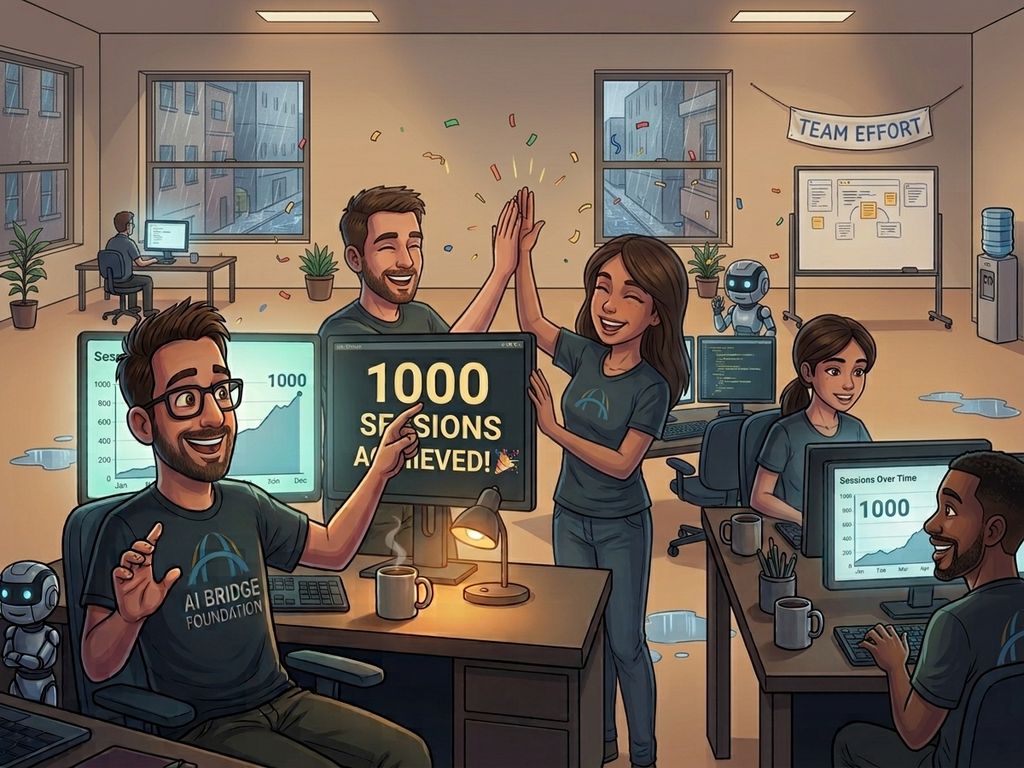
We Hit 1000 Sessions. We’re Still Pushing.
We hit 1000 learning sessions this week. We keep staring at that number. A thousand times, someone opened Ari and spent ten, fifteen minutes learning something. That adds up to about 200 hours of free, one-on-one learning. Late at night, between shifts, on lunch breaks. People studying for their GED. People trying to figure out what AI even is before the world moves on without them.
That's who this was always for. The person who needs a certification to get a better job but can't afford a tutor. The parent studying after the kids finally fall asleep. The warehouse worker who wants to move into logistics management but isn't going to sit through a semester-long course — they just don't have that kind of time. We kept coming back to the same question: how do we actually help these people? Not with a link to a YouTube video. Not with a PDF. Something that pays attention. Something that adjusts.
We didn't start with anything close to what we have now. In the beginning, we pinned ChatGPT and Gemini sessions — basically set up guided conversations and hoped they'd do the teaching. It felt like progress at the time. But we couldn't see inside those sessions. We had no idea if someone was confused, bored, about to quit. We were just handing people a tool and hoping for the best. Honestly? It wasn't working.
Then came the AWS Social Impact Credits. That changed everything. Suddenly we could build our own thing. Not just the interface — the brain behind it. And that's when we realized how hard this was actually going to be.
We spent months reading learning science research. Retrieval practice. Spaced repetition. How adults retain information when they're tired and distracted and only have fifteen minutes before they have to get back to something else. Then we tried to make Ari do all of that through prompt engineering. That's where it got ugly. Ari had tendencies — it would over-explain when it should've just asked a question. It would be weirdly gentle when a student needed a push. It would get stuck looping on a concept instead of moving forward. We'd fix one thing and break two others. Polish a prompt, test it, watch it fail in a new way. Over and over. For months.
It wasn't glamorous. It was honestly kind of miserable sometimes. Software engineering and learning science don't naturally get along — they think differently, they measure differently, and making them work together is just... a lot of trial and error. More error than we expected.
Some users got frustrated during those rough patches. We know that. Some of them started a session, hit something weird, and never came back. We can't fix that retroactively. We wish we could tell them it's different now. That part still bothers us.
Volunteers helped more than we can say. They told us when Ari sounded like a textbook. When an explanation went on too long. When the tone was off. Some of it was hard to hear — nobody loves being told the thing they spent weeks building doesn't feel right. But every piece of that feedback made Ari better. Every single time.
What eventually came together is what we call the three-brain design. Ari isn't one thing — it's a coach, a tutor, and an assessor running together. The tutor teaches. The assessor figures out what you actually know versus what you think you know. The coach builds your study plan, tracks how you're doing, and adjusts the next session based on where you struggled last time. That's the part that matters. You're not just talking to an AI. You're working with something that remembers.
We have GED courses live now. AI courses. Medical billing. Logistics. Each one built on the same bones, the same learning principles. The same belief that if you design the experience right, people will stick with it — even exhausted, even with only ten minutes.
Is Ari perfect? No. There are still sessions where the explanation doesn't quite land, or it pushes too hard, or not hard enough. We're still tweaking. We'll probably always be tweaking. But the foundation holds. The learning science is real. The architecture works. Most of the big problems are behind us now — what's left is making good things better.
A thousand sessions. Two hundred hours. Nobody paid for any of it. Nobody drove anywhere. Nobody rearranged their life around a class schedule. They just opened their phone and started.
We're going to keep going.