Here's a Slack Channel, Good Luck
We've been thinking a lot lately about what it actually means to manage volunteers when you're a small nonprofit building AI-powered learning tools. Not manage in the corporate sense — manage in the "how do we make this worth someone's time?" sense.
Before we started ABF, one of us volunteered at other organizations. It was always the same: find something on Idealist, send an email, get a reply a week later, and show up to be handed a task list and a schedule. It wasn't bad — it was just empty. Nobody asked what you were curious about or what you wanted to learn. You were a pair of hands, not a person.
We didn't want to repeat that, but we also didn't know what the alternative looked like.
Most nonprofits either over-manage with rigid check-ins or under-manage with a "here's a Slack channel, good luck." We wanted something in between: structured enough to be useful, flexible enough to respect the person.
The first surprise was who showed up. We expected a handful of college students looking for resume lines. Instead, we got high schoolers, career changers, retired professionals, and parents from halfway across the world. A 16-year-old and a 55-year-old corporate consultant were suddenly asking the same question: How can I help?
Automating the paperwork was the easy part — consent forms and agreements became a digital flow. But that removed friction without solving the real problem: What do you actually give these people to do?
A static task list fails when your volunteers are this diverse. A teenager interested in social media has nothing in common with a software engineer who wants to test a mobile app.
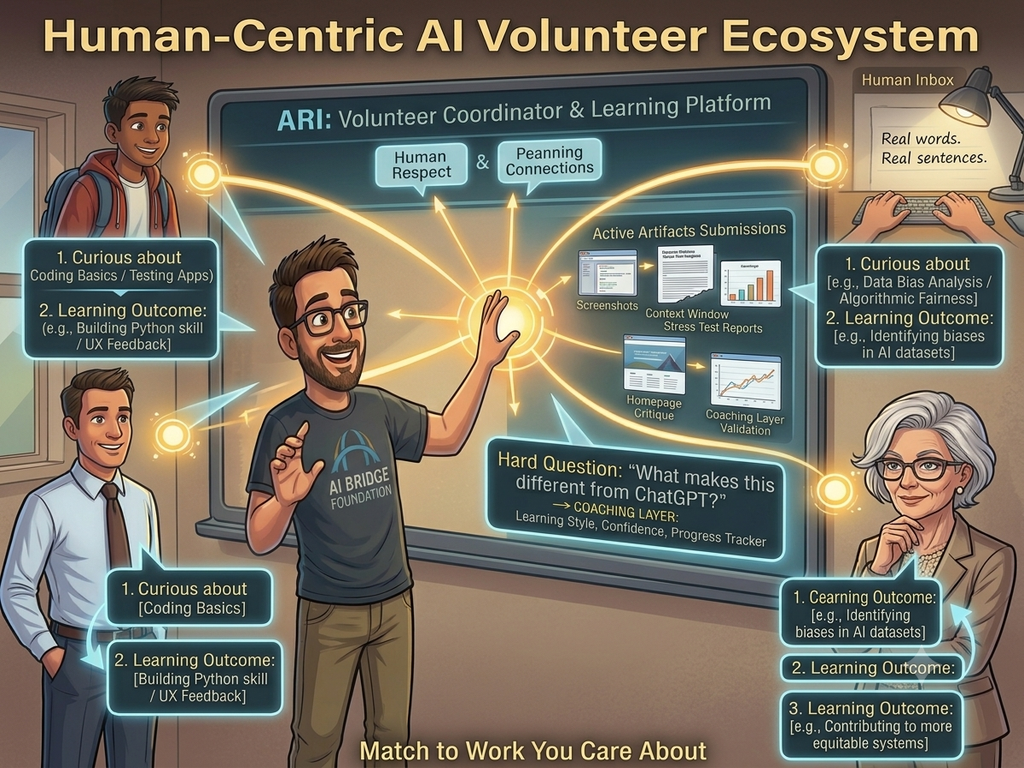
So we built Ari into the process — not Ari the tutor, but Ari the volunteer coordinator.
When a volunteer opens their dashboard, Ari asks what they're curious about, what skills they bring, and what they want to learn. Then it connects their answer to real work on our platform. Not "here's a task," but "here's why this task will teach you something you care about." Leading with what you'll learn instead of what we need changed everything.
Once they start, volunteers submit artifacts — screenshots, evaluation reports, and critiques. And we learn from them constantly.
One volunteer stress-tested Ari's context window until it broke — a bug we never would have caught ourselves. Another group pointed out that we were missing a proper homepage. Volunteers flagged slowness, pushed us to think about how waiting feels, and confirmed that our conversation format actually helped them learn.
Overnight, they became three things at once: testers who find bugs, critics who point out what's missing, and validators who prove the approach works.
They also keep asking the hardest question: "What makes this different from just using ChatGPT?"
That question won't leave us alone, and it forces us to build better. It pushed us to create a coaching layer where Ari tracks learning styles, confidence, and progress across topics. ChatGPT can't do that — it doesn't remember that you bombed fractions last week but crushed geometry today. Our volunteers keep us honest.
Even my own daughter volunteers. She bluntly told me our teen courses were too long. We listened and cut them down significantly. That's the system working exactly as designed: a real person using the product honestly and telling us what needs to change.
We still write our own emails. Real relationships need real words, and when someone gives you their time for free, the least you owe them is a human sentence written by a human hand.
We didn't set out to build a feedback engine; we set out to give people a decent volunteer experience. But it turns out that when you respect volunteers enough to match them to work they care about, they give you back something no analytics dashboard ever could: the truth about what you're building.